Axewelledge, a leading exporter from India, specializes in high-quality Bentonite. With a commitment to excellence, we supply premium Bentonite to the Middle East and Southeast Asia markets.


North Angle Complex, 304,
150 Feet Ring Rd, Opposite Ambedkar Nagar BRTS Stop,
Madhav Park, Punit Nagar,
Mavdi, Rajkot, Gujarat 360004
© Axewelledge 2026, All Rights Reserved.
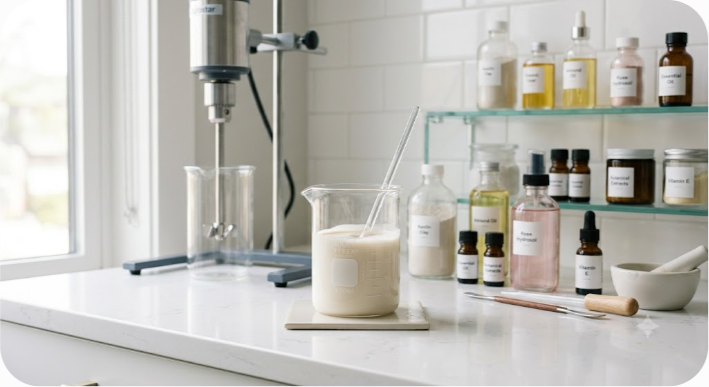
Adding untreated bentonite clay directly to an aqueous cosmetic base without prior pre-hydration guarantees lump formation, gritty texture, and phase separation within days. When properly purified, hydrated, and stabilized, cosmetic-grade bentonite creates luxurious, silky textures, stabilizes oil-in-water emulsions, and delivers unmatched oil-absorbing power for facial masks, cleansers, and body treatments.
Bentonite is one of the most versatile natural minerals in cosmetic chemistry. Working with smectite clays requires a solid grasp of colloidal physics, mineralogy, charge interactions, and microbial preservation. This technical guide breaks down everything cosmetic chemists and skincare formulators need to know to successfully integrate cosmetic-grade bentonite into stable, high-performance skincare products.
Not all bentonite clay is suitable for personal care products. Industrial bentonite—used in foundry molds, oil well drilling, and civil engineering—contains crystalline silica, heavy metals, grit, and high microbial counts that make it completely unsafe for human skin.
Cosmetic-grade bentonite undergoes intensive refining, thermal treatment, washing, and microbial decontamination to meet strict international pharmacopeia standards (such as USP, Ph. Eur., or JP).
At the molecular level, bentonite is primarily composed of montmorillonite, a 2:1 layer-type aluminosilicate clay mineral. Each individual sheet consists of an octahedral layer of aluminum hydroxide sandwiched between two tetrahedral layers of silicon dioxide.
Choosing between sodium and calcium bentonite changes the rheology, texture, and stability of your final formulation:
| Property | Cosmetic Sodium Bentonite | Cosmetic Calcium Bentonite |
|---|---|---|
| Swelling Capacity | High (12x – 20x dry volume) | Moderate (2x – 5x dry volume) |
| Rheology Profile | Strong thixotropic gel builder | Low viscosity builder, higher solids loading |
| Primary Function | Viscosity modifier, emulsion stabilizer | Detoxifying absorbent, body wraps, scrub base |
| Feel on Skin | Smooth, silky, gel-like structure | Slightly earthier, higher powder feel |
| Electrolyte Sensitivity | High | Moderate |
For active viscosity building, suspension of heavy actives, and emulsion stabilization, sodium bentonite (or sodium-activated bentonite) is the industry standard. Calcium bentonite is preferred when formulating high-solids paste masks or dry powder cleansers where rapid swelling would consume too much free water.
Because bentonite is a mined earth mineral, raw ores naturally contain trace elements from the earth's crust. Formulating compliant, consumer-safe skincare requires verifying that your raw material supplier adheres strictly to global cosmetics regulations.
The single biggest cause of batch failure when formulating with bentonite is improper hydration. Bentonite platelets must fully separate (exfoliate) in pure water before any other ingredients, salts, or surfactants are added.
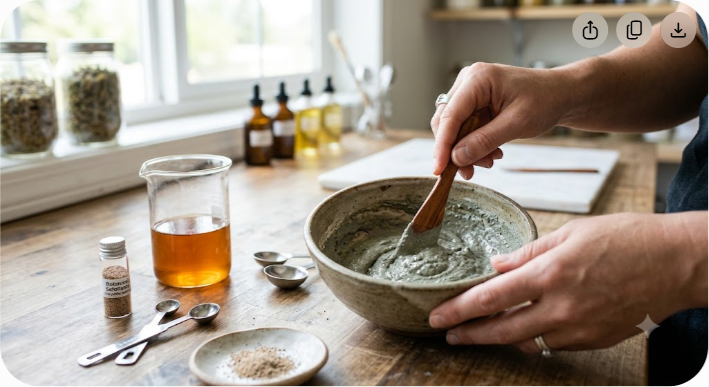
Use deionized or reverse osmosis (RO) water heated to $65^\circ\text{C} - 75^\circ\text{C}$ ($149^\circ\text{F} - 167^\circ\text{F}$). Warm water accelerates the hydration rate of smectite clays without altering their chemical integrity. Make sure no chelating agents, preservatives, or salts have been added to the water yet.
Sift the dry cosmetic bentonite slowly into the vortex of the water phase. Do not dump the powder all at once, or the outer layer will hydrate instantly, forming waterproof dry agglomerates ("fish eyes"). Use a high-shear mixer (such as a Silverson or rotor-stator homogenizer) operating between 3,000 to 5,000 RPM.
Continue high-shear mixing for 20 to 30 minutes. As water enters the interlayer spaces, the negatively charged faces repel each other, causing the structure to expand. The solution will transform from a cloudy liquid into an opaque, viscous, translucent-to-grayish gel.
Allow the pre-hydrated clay gel (typically prepared as a $3\%\text{ to }5\%$ solid pre-dispersion) to rest for 12 to 24 hours at room temperature. This rest period allows full house-of-cards colloidal network formation, yielding maximum viscosity and yield value.
Once properly hydrated in water, bentonite forms a unique 3D gel structure known in colloid chemistry as a house-of-cards structure.
Because the flat faces of the clay platelets are negatively charged and the edges are slightly positive under neutral pH, the positive edges attract the negative faces of adjacent platelets. This electrostatic attraction locks the fluid into a rigid structural matrix when at rest.
Cosmetic-grade bentonite performs diverse technical roles depending on the formula type and inclusion rate.
In traditional paste masks, bentonite acts as the main functional absorbent, drawing away sebum, dead skin cells, and environmental pollutants.
Formulation Tip: Combining $10\%$ sodium bentonite with $10\%$ kaolin clay prevents extreme shrinkage, cracking, and tight skin pulling as the mask dries on the face. Adding $3\% - 5\%$ glycerin or propanediol keeps the mask pliable and comfortable.
In lotions and creams, bentonite reinforces oil-in-water (O/W) emulsions. It sits in the aqueous phase, physically blocking oil droplets from coalescing.
Formulation Tip: Bentonite works synergistically with organic thickeners. Combining $1\%$ bentonite with $0.2\%$ xanthan gum yields a dramatically higher yield stress and smoother skin feel than using either ingredient alone at double the dose.
In gel and cream cleansers, bentonite introduces a cushiony, rich slip while absorbing surface excess oil. It also suspends exfoliant beads or scrub particles indefinitely.
For oil-control primers and mattifying moisturizers, micronized cosmetic bentonite absorbs excess facial sebum throughout the day without imparting a heavy or cakey feel.
This sample formulation demonstrates how to build a light, oil-absorbing face gel-cream with excellent stability and a silky matte finish.
| Phase | Trade / INCI Name | Function | Weight % |
|---|---|---|---|
| Phase A | Deionized Water | Solvent | 72.30 |
| Phase A | Cosmetic-Grade Sodium Bentonite | Rheology Modifier / Absorbent | 2.50 |
| Phase A | Glycerin | Humectant | 4.00 |
| Phase A | Xanthan Gum | Secondary Stabilizer | 0.20 |
| Phase B | Caprylic/Capric Triglyceride | Emollient | 8.00 |
| Phase B | Cetearyl Alcohol (and) Cetearyl Glucoside | Non-Ionic Emulsifier | 3.50 |
| Phase B | Jojoba Seed Oil | Light Emollient | 2.00 |
| Phase C | Niacinamide | Skin-Soothing Active | 2.00 |
| Phase C | Deionized Water (for active dissolv.) | Solvent | 4.00 |
| Phase D | Phenoxyethanol (and) Ethylhexylglycerin | Broad-Spectrum Preservative | 1.00 |
| Phase D | Citric Acid ($10\%$ Sol.) | pH Adjuster | q.s. |
| Total | 100.00 |
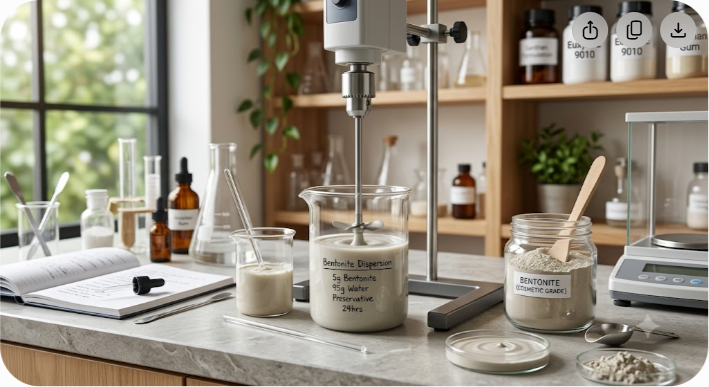
Formulating with natural minerals presents chemical challenges that differ from synthetic polymers like carbomer or acrylates copolymer. Here is how to navigate the most common formulation traps.
Bentonite's negative surface charges rely on low ionic strength to maintain its swelled colloidal matrix. Adding high concentrations of salts or divalent ions—such as calcium chloride, magnesium sulfate, zinc PCA, or sodium-rich preservatives—collapses the hydration sphere.
Clay minerals are porous, high-surface-area materials that act as physical sponges. They can absorb organic preservative molecules—particularly cationic preservatives like benzalkonium chloride or cetrimonium bromide—rendering the preservative completely inactive.
Smectite clays naturally buffer aqueous dispersions to an alkaline pH ($8.5 - 10.5$). If you force the pH below 4.5 using strong acids, you protonate the edge charges and destroy the montmorillonite structure.
Mixing bentonite (anionic surface) with cationic conditioning agents (such as polyquaternium-7, polyquaternium-10, or behentrimonium methosulfate) results in immediate charge neutralization and thick, stringy coacervate precipitates.
When scaling up from lab-bench formulation to commercial production, raw material consistency is essential. Batch-to-batch variations in mineral purity, swell capacity, color, or heavy metal profiles will cause viscosity drift and regulatory headaches.
Formulators should demand full documentation from their mineral suppliers, including:
Leading global suppliers like Axewelledge supply ultra-pure, cosmetic-grade bentonite processed specifically to eliminate impurities, ensure high swelling capacity, and comply with international personal care quality benchmarks.
Cosmetic-grade bentonite is a highly purified montmorillonite clay processed specifically for personal care applications. It undergoes thermal and mechanical refining to remove grit, crystalline silica, heavy metals, and micro-organisms, making it safe for direct skin application.
The standard INCI name for cosmetic-grade bentonite is Bentonite. In specialized formulations featuring modified or purified smectite fractions, it may be listed as Montmorillonite or Magnesium Aluminum Silicate.
To disperse bentonite without lumps, sift the dry clay powder slowly into warm ($65^\circ\text{C} - 75^\circ\text{C}$) water under high-shear mixing (3,000–5,000 RPM). Allow the pre-dispersion to rest for 12 to 24 hours to achieve full exfoliation.
Bentonite clay is stable within a pH range of 5.5 to 9.0. In strongly acidic environments (below pH 4.0), the clay structure breaks down, causing gel collapse and loss of viscosity. Use non-ionic thickeners for low-pH formulations.
Bentonite's high surface area and negative net charge adsorb cationic preservative molecules, deactivating them. To maintain antimicrobial protection, always use non-ionic broad-spectrum preservative systems and perform USP $<51>$ challenge testing.
Sodium bentonite swells significantly in water (12x–20x) and acts as an efficient thixotropic thickener and emulsion stabilizer. Calcium bentonite swells moderately (2x–5x) and is preferred for dry powders, body wraps, and high-solids facial paste masks.
Integrating cosmetic-grade bentonite into your skincare formulations unlocks superior oil control, unique thixotropic textures, and natural emulsion stability. By following proper hydration protocols, maintaining appropriate pH limits, and selecting compatible preservatives, you can engineer luxurious personal care products that remain stable throughout their shelf life.
To source high-purity, cosmetic-grade bentonite that meets international pharmacopeia standards, explore Axewelledge's premium mineral solutions or contact their technical sourcing team today.













Have questions about our products? We're here to help!