Axewelledge, a leading exporter from India, specializes in high-quality Bentonite. With a commitment to excellence, we supply premium Bentonite to the Middle East and Southeast Asia markets.


North Angle Complex, 304,
150 Feet Ring Rd, Opposite Ambedkar Nagar BRTS Stop,
Madhav Park, Punit Nagar,
Mavdi, Rajkot, Gujarat 360004
© Axewelledge 2026, All Rights Reserved.
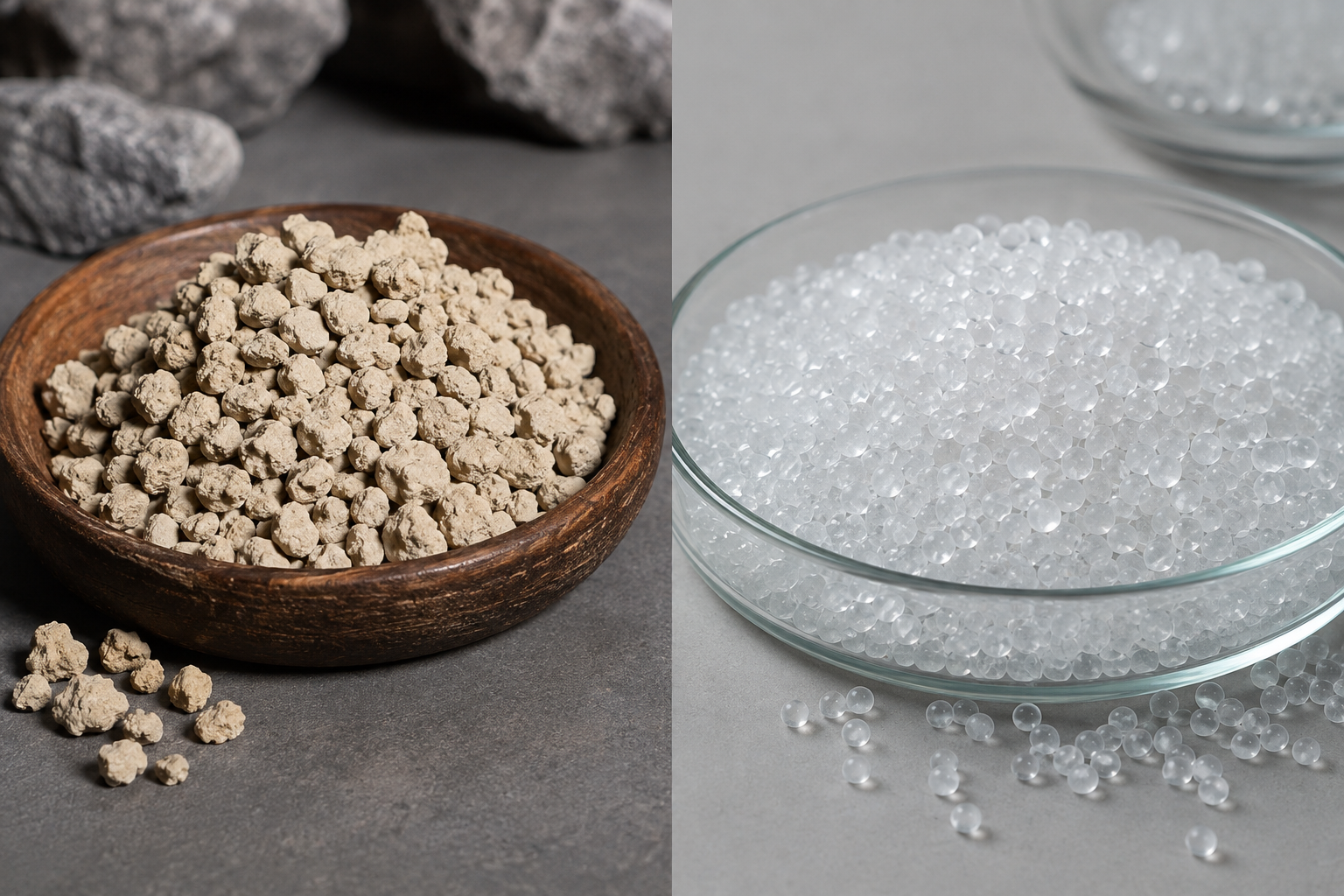
Desiccant grade clay absorbs up to 28% of its dry weight in moisture at standard ambient conditions (25°C and 50% Relative Humidity) while costing roughly half as much as synthetic silica gel. While silica gel reaches higher peak absorption capacity (35% to 40%) under near-saturating humidity, natural bentonite clay outperforms synthetic gel in total cost efficiency, carbon footprint, and thermal moisture retention during standard shipping transit.
For packaging engineers, supply chain managers, and quality assurance specialists, choosing between desiccant grade clay and silica gel isn't just about grabbing the nearest white packet out of a bin. It directly influences container logistics, product shelf life, corporate sustainability compliance, and total packaging overhead. Selecting the wrong desiccant formulation can lead to container rain, corroded circuit boards, degraded pharmaceuticals, or moldy leather goods.
This guide breaks down the physical mechanisms, chemical traits, performance metrics, financial trade-offs, and environmental footprints of activated bentonite clay versus synthetic silica gel.
Before analyzing specific performance metrics, it helps to clarify how desiccants capture water vapor. Neither bentonite clay nor standard silica gel absorbs moisture through a chemical reaction that changes its molecular identity. Instead, both rely on physical adsorption.
Adsorption occurs when water molecules bind to the internal surface area of a porous solid through weak intermolecular forces (primarily van der Waals forces and hydrogen bonding). Because no covalent chemical bond forms, the process is fully reversible through thermal reactivation—baking out the bound water.
Desiccant grade clay—frequently designated in technical specifications as activated clay or montmorillonite clay—is a naturally occurring mineral composed primarily of calcium or sodium bentonite. Raw clay undergoes washing, controlled drying, thermal activation, and precise sizing to produce dense, highly porous granules.
Its mineral architecture consists of microscopic, layered phyllosilicate sheets. These sub-nanometer layers create a network of capillary spaces. A single gram of high-purity processed bentonite clay provides an internal surface area of 200 to 300 square meters. Moisture is drawn into these microscopic channels, trapping water molecules tightly within the crystal lattice without expanding the granule or creating liquid slurry.
Silica gel is a synthetic, amorphous form of silicon dioxide ($SiO_2$), manufactured through acid treatment and controlled gelation of sodium silicate. The resulting hydrogel is washed to remove residual salts and dried into hard, glassy beads or irregular granules.
Silica gel features an ultra-porous internal structure with interconnected pores measuring 2 to 3 nanometers in diameter. This architectural consistency gives synthesized silica gel an enormous surface area—roughly 700 to 800 square meters per gram. This massive internal surface acts like a micro-sponge, condensing ambient water vapor inside its pores through capillary action.
Evaluating desiccant materials requires reviewing performance across varying environmental conditions. Moisture control varies significantly based on relative humidity (RH), ambient temperature, airflow exposure, and enclosure volume.
| Performance Metric | Desiccant Grade Clay (Activated Bentonite) | Silica Gel (Synthetic Amorphous $SiO_2$) |
|---|---|---|
| Primary Source | Natural mineral (mined & refined bentonite) | Synthetic chemical synthesis (sodium silicate + acid) |
| Internal Surface Area | 200 – 300 m²/g | 700 – 800 m²/g |
| Capacity @ 20% RH (25°C) | ~13% – 15% by weight | ~10% – 12% by weight |
| Capacity @ 50% RH (25°C) | ~20% – 28% by weight | ~25% – 30% by weight |
| Capacity @ 90% RH (25°C) | ~28% – 32% by weight | ~36% – 40% by weight |
| Thermal Limit (Desorption) | Retains moisture up to 50°C–60°C (122°F–140°F) | Begins releasing moisture above 30°C–40°C (86°F–104°F) |
| Dusting Tendency | Low to moderate (requires non-woven substrates) | Low (hard spherical beads resist friability) |
| Relative Raw Material Cost | Low (Baseline 1.0x) | Moderate to High (1.8x – 2.5x base cost) |
| Environmental Impact | Eco-friendly natural mineral; straightforward disposal | Energy-intensive manufacturing; synthetic material |
A common pitfall in packaging design is evaluating desiccant capacity strictly by maximum saturation figures measured at 90% RH. In sealed packaging, your real goal is keeping the internal environment below critical threshold limits—often under 40% RH for electronics and under 30% RH for sensitive active pharmaceutical ingredients.
However, total capacity tells only part of the story. You must also account for thermal stability—how reliably the material retains captured moisture when ambient temperatures climb.
Consider what happens when a freight container sits on a sunny port tarmac where interior temperatures exceed 50°C (122°F).
This condition highlights a primary limitation of standard silica gel. Because silica gel binds water through light physical surface tension inside macro-pores, it begins desorbing (releasing captured water back into the air) at lower temperatures. Once internal package temperatures cross 30°C to 40°C (86°F to 104°F), silica gel starts venting bound moisture back into the sealed cavity, driving up internal relative humidity.
Desiccant grade clay holds onto bound water much more effectively at elevated transit temperatures. It maintains structural moisture retention up to 50°C–60°C (122°F–140°F). For sea freight crossing tropical ocean corridors, clay provides a stable thermal buffer against internal condensation cycles.
To standardize desiccant specifications across global procurement networks, international standards organizations—including the US Military (MIL-D-3464E), the Society of Automotive Engineers (SAE AS8839), and the German Institute for Standardization (DIN 55473)—use the concept of the Desiccant Unit.
A single "Unit" (abbreviated as U) is not defined by raw weight or physical volume. Instead, one Unit represents the quantity of desiccant that absorbs a specific mass of water vapor under standard test conditions:
Because silica gel features higher internal surface area per gram, it requires less physical mass to achieve one standard Unit than clay:
When specifying protection levels, frame your requirements in Units (U) rather than total gram weight. A package requiring 5 Units of moisture protection requires 5 Units of clay or 5 Units of silica gel. The clay packet weighs roughly 15% to 18% more, but it provides identical adsorption performance under standard rating conditions at lower cost.
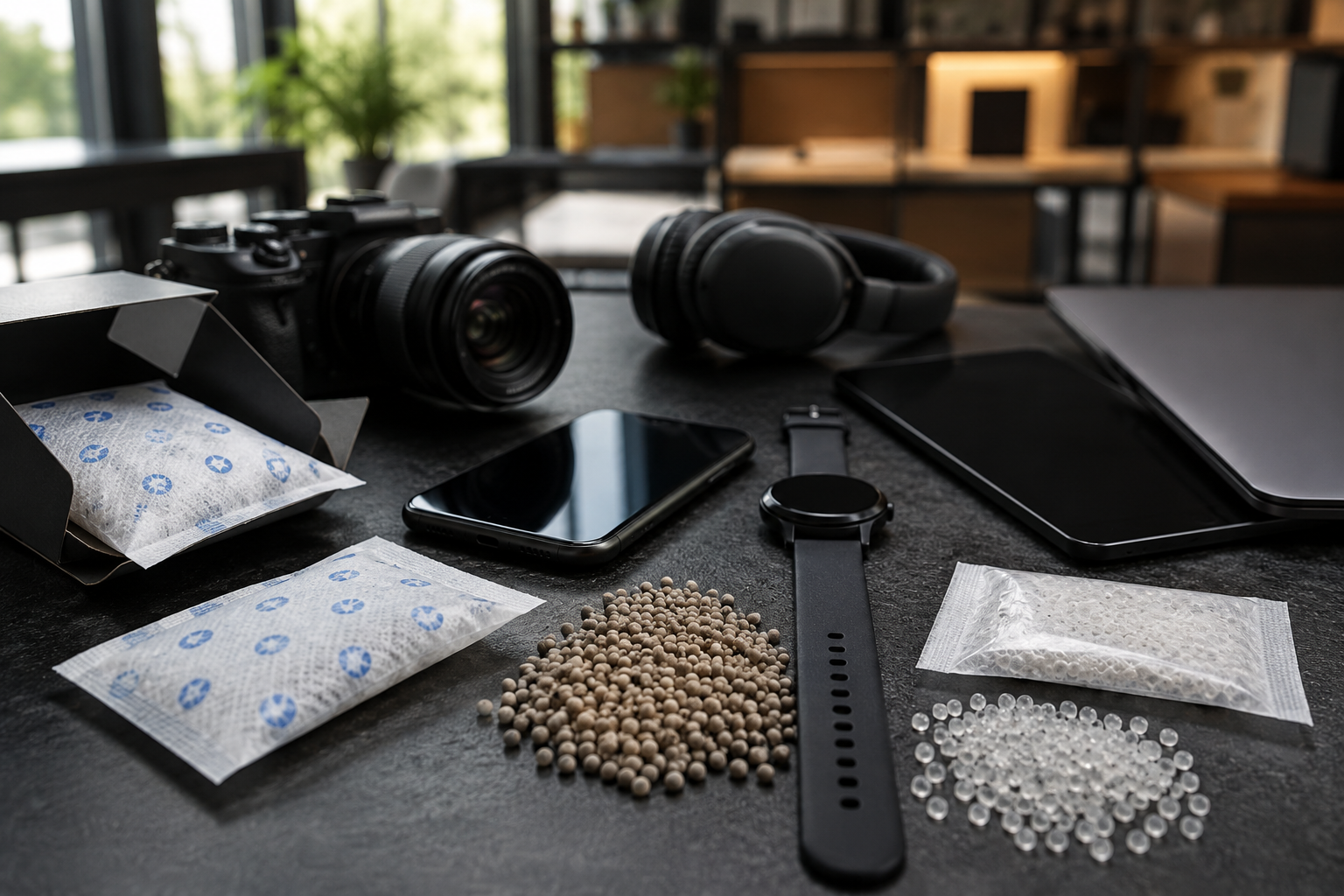
For high-volume manufacturing lines packaging tens of thousands of pallets annually, small differences in desiccant unit pricing directly affect gross margins.
On a raw material cost-per-kilogram basis, processed desiccant grade clay runs 40% to 60% lower than standard silica gel.
Even after factoring in the minor weight adjustment needed to match unit capacity (33 grams of clay versus 28 grams of silica gel per Unit), bentonite clay delivers 30% to 40% net cost savings per Unit of absorbed moisture.
When shipping high-volume export goods, automotive components, or industrial equipment, switching from synthetic silica gel packets to activated clay desiccant bags reduces overall packaging spend without compromising moisture protection.
Environmental compliance has transitioned from an optional marketing claim to a firm procurement standard. Regulatory frameworks, including the EU Packaging and Packaging Waste Regulation, place increasing scrutiny on single-use synthetic materials.
Because bentonite extraction and mechanical screening require far less heat and chemical processing than synthesizing silica gel from sodium silicate, desiccant grade clay features a 50% to 70% lower cradle-to-gate carbon footprint per unit of moisture absorbency.
No single desiccant fits every packaging scenario. Below is a practical breakdown of where desiccant grade clay and silica gel align best across major industrial verticals.
Determining the right desiccant volume for a sealed enclosure requires calculating your target internal volume, barrier film moisture vapor transmission rate (MVTR), transit duration, and expected climate exposure.
To calculate required desiccant units under standard MIL-P-116 and DIN 55474 methodology, follow these steps:
$$U = (A \times M) + (D \times W)$$
Even high-grade desiccants underperform when applied incorrectly. Avoid these four operational errors:
Not all raw clay minerals meet industrial desiccant requirements. Dependable moisture control demands high-purity montmorillonite clay with strong ion-exchange capacity, high surface area, and uniform pore distribution.
As a global producer of premium bentonite, Axewelledge draws from over 60 million tons of high-purity mineral reserves and uses precise thermal processing to manufacture desiccant-grade bentonite clay. Meeting recognized international quality benchmarks, Axewelledge supplies refined bentonite solutions engineered to safeguard freight, machinery, and commercial goods across global distribution channels.
By combining controlled mineral extraction with dedicated processing, industrial packagers obtain a thermally stable, eco-friendly desiccant that controls packaging costs while protecting valuable cargo.
By transitioning bulk packaging operations from synthetic silica gel to natural activated clay, industrial shippers maintain effective moisture control while lowering total packaging expenses and environmental impact.













Have questions about our products? We're here to help!