Axewelledge, a leading exporter from India, specializes in high-quality Bentonite. With a commitment to excellence, we supply premium Bentonite to the Middle East and Southeast Asia markets.


North Angle Complex, 304,
150 Feet Ring Rd, Opposite Ambedkar Nagar BRTS Stop,
Madhav Park, Punit Nagar,
Mavdi, Rajkot, Gujarat 360004
© Axewelledge 2026, All Rights Reserved.
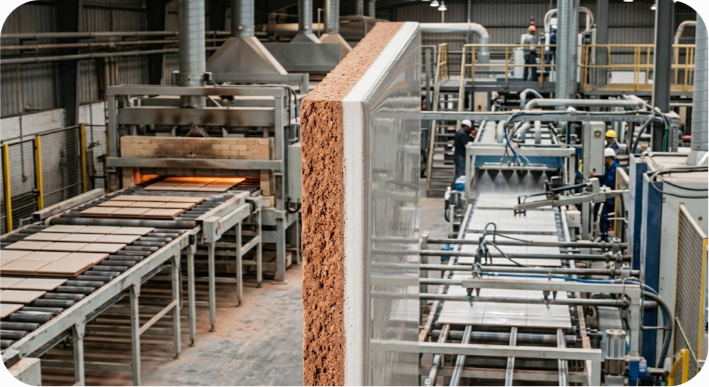
Plant diagnostics indicate that over 60 percent of surface defects in fast-fired ceramic tiles originate in the engobe layer or at the interface where the body, engobe, and glaze meet. When cold greenware enters a roller kiln running at 1,180 to 1,220 degrees Celsius on a 30 to 60 minute firing cycle, chemical reactions, organic burnouts, and phase transformations happen almost simultaneously.
If your engobe and glaze layers are not engineered to handle this rapid thermal profile, defects like pinholes, crawling, dunting, and severe warping can ruin entire production runs. Resolving these issues requires treating engobe and glaze as distinct functional layers rather than simple surface coatings.
An engobe is an intermediate ceramic slurry composed of refractory minerals, clays, and fluxes applied directly onto unfired or partially dried biscuit greenware. It functions as a structural, chemical, and optical buffer. Glaze is a vitreous coating formulated primarily with frits, silica, and fluxes designed to melt completely into a non-porous, highly decorative, and chemically resistant top surface.
When fast firing fails, technicians frequently alter glaze chemistry or kiln temperature curves. However, true stability requires balancing thermal expansion, gas permeability, and melting behavior across all three phases: body, engobe, and glaze.
To prevent defect formation, evaluate engobe and glaze as an integrated multi-layer system. Each material responds differently to heat absorption, gas release, and volumetric contraction.
Think of the engobe as a structural bridge. Raw clay bodies, especially red-firing clays or low-grade porcelain bodies, contain iron oxides, organic carbon, and sulfur compounds. As the tile heats up, these materials gas off aggressively.
The primary jobs of the engobe are:
Glaze melts into a liquid state at peak firing temperatures (typically 1,150 to 1,230 degrees Celsius depending on whether you produce wall tile, floor tile, or technical porcelain). As it melts, surface tension causes it to smooth out across the tile surface.
The core jobs of the glaze are:
Because the glaze melts into an airtight glass sheet, any gas attempting to bubble up from the underlying body after the glaze seals becomes trapped. This trapped gas is a primary cause of surface defects in high-speed kilns.
| Property | Engobe Layer | Glaze Layer |
|---|---|---|
| Primary Composition | Kaolin, ball clay, feldspar, quartz, alumina, specialized bentonite | Frits, quartz, feldspar, nepheline syenite, pigments, opacifiers |
| Melting Behavior | Sintered/semi-vitrified (does not fully melt) | Fully melted vitreous liquid phase |
| Gas Permeability | High open porosity up to 950-1,050 degrees Celsius | Non-permeable liquid seal above 1,000-1,080 degrees Celsius |
| Thermal Expansion (CTE) | Engineered strictly between body CTE and glaze CTE | Formulated slightly lower than engobe CTE for compression |
| Layer Thickness | Thick application (0.3 mm to 0.8 mm) | Thin application (0.1 mm to 0.4 mm) |
| Primary Function | Masking, strain mitigation, degassing buffer | Impermeability, scratch resistance, aesthetics |
In traditional tunnel kilns running 12 to 24 hour firing schedules, heat transfer occurs gradually. Organic compounds in the clay body have time to oxidize fully between 400 and 750 degrees Celsius. Carbonate minerals like calcite and dolomite decompose slowly, venting carbon dioxide cleanly through open pores long before sintering begins.
Fast firing in modern roller hearth kilns condenses this timeline into 30 to 40 minutes. This accelerated ramp-up creates three major technical challenges:
In a 35-minute cycle, the oxidation of carbon and sulfur in the core of the tile overlaps directly with the melting point of the glaze frits. If your glaze begins to form a sealed liquid film at 1,020 degrees Celsius while the clay body is still venting carbon dioxide gas, that gas forces its way through the liquid glaze, creating permanent pinholes or craters.
Roller kilns heat tiles rapidly from top and bottom. The top surface covered in engobe and glaze absorbs radiant heat faster than the inner core of the tile. This dynamic creates steep temperature differentials across the tile thickness, generating severe physical shear stress at the interface between the body, engobe, and glaze.
Traditional kilns hold peak temperatures for hours, allowing air bubbles trapped in molten glaze to rise to the surface, pop, and heal smoothly. In fast firing, the soak time at peak temperature is often less than 5 minutes. The liquid glaze lacks the time to heal over gas disruptions, meaning every bubble that pops near peak temperature leaves an unhealed crater.
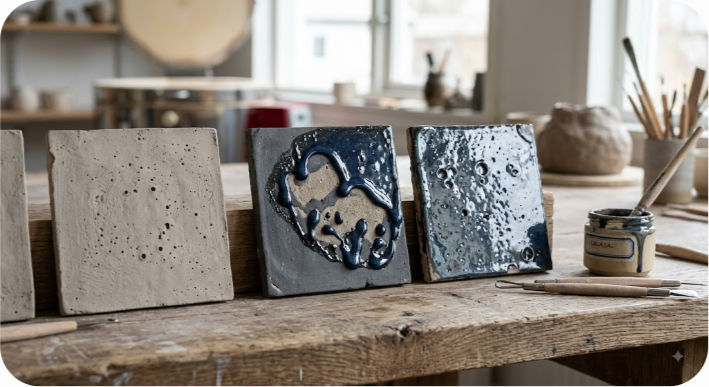
Pinholes are fine, needle-like punctures on the fired glaze surface, while craters are larger, rounded depressions with raised edges. Both defects stem from gas bubbles bursting through the glaze layer when the glaze is too viscous to flow back together or when gas generation occurs too late in the firing curve.
Raw clays and feldspars often contain trace amounts of calcium carbonates, barium carbonates, or iron sulfates. Carbonates decompose between 700 and 900 degrees Celsius, releasing carbon dioxide. Sulfates decompose much later, often between 1,050 and 1,150 degrees Celsius—right during peak firing.
If the engobe slurry contains high-volatility organic binders or excessive moisture, these compounds burn off rapidly. If the engobe densifies too quickly, it traps moisture inside the body core.
If the glaze melt is too viscous at peak temperature, gas bubbles cannot escape easily, or the liquid cannot level out after a bubble bursts.
Crawling occurs when liquid glaze or engobe pulls away from the tile body during firing, rolling up into beads or islands and exposing bare patches of substrate. Peeling (or flaking) happens when the fired coating snaps off the body in solid flakes, either during cooling or after exiting the kiln.
Both defects indicate a failure of adhesion or a severe mismatch in physical shrinkage prior to melting.
Crawling is almost always caused by poor mechanical bonding between green layers or excessive drying shrinkage in the applied engobe/glaze film. When wet slurry is sprayed onto a dry ceramic body, it must dry smoothly without shrinking so much that it cracks.
If the engobe contains excessive amounts of high-shrinkage, highly plastic raw clays, the wet layer develops micro-cracks as it dries on the glaze line. When heat is applied in the kiln, surface tension pulls the glaze back along those pre-existing micro-cracks, forming separated islands.
Every ceramic material expands when heated and contracts when cooled. The Coefficient of Thermal Expansion (CTE) measures this dimensional change per degree of temperature shift.
In a triple-layer system (body, engobe, glaze), managing the CTE gradient across all three layers is critical to keeping tiles flat and preventing mechanical failure.
To ensure structural integrity, the layers must exist in a controlled compressive state upon cooling:
Why must the body have a higher thermal expansion rate than the glaze? As the tile cools down from 1,200 degrees Celsius inside the cooling zone of the roller kiln, all layers contract. Because the body contracts slightly more than the glaze layer, it pulls the glaze inward, placing the glaze under continuous compressive stress.
Ceramic glazes are strong under compression, but weak under tension.
To alter thermal expansion coefficients safely without compromising firing temperature ranges:
Black core appears as a dark grey or black central layer inside the fired tile body, visible when the tile is broken. It is often accompanied by swelling, bloating, or surface pinholing directly over the dark region.
An improperly formulated engobe makes black core worse. If the engobe contains excessive fluxes (such as low-melting frits or high sodium feldspar), it seals the surface of the green tile at 900 degrees Celsius.
This premature sealing blocks oxygen from entering the body and prevents carbon monoxide from exiting, trapping the black core inside.
In modern porcelain and technical tile production, preventing water absorption through the back or face of the tile is a critical quality standard (ISO 10545-3 requires water absorption below 0.5 percent for porcelain).
While glazes are non-porous, micro-fissures or unglazed tile edges can allow moisture to penetrate. Once moisture enters the tile, sub-zero outdoor temperatures cause freezing water to expand, leading to frost spalling and tile failure.
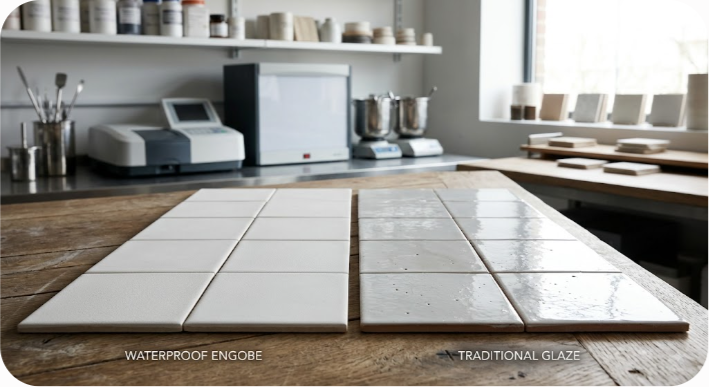
A specialized class of technical coatings known as waterproof engobes or impermeable bottom engobes is applied to the underside or directly below the decorative glaze layer.
Waterproof engobes differ from standard engobes in two key ways:
Thermal shock resistance (ISO 10545-9) measures a tile's ability to withstand rapid temperature swings—such as placing hot cookware on a porcelain countertop or installing outdoor paving in freezing climates.
Thermal shock failure occurs when micro-cracks form at the interface between glaze and body due to localized stress spikes. Dense engobe layers act as a stress-damping matrix. By absorbing localized expansion differentials, a well-formulated engobe prevents thermal stress from propagating into micro-fractures.
Developing high-performance engobe and glaze formulations for high-speed roller kilns requires precise raw material selection. The goal is balancing thermal expansion, green suspension stability, particle packing, and melting profiles.
| Material Component | Standard Engobe Range (wt %) | Waterproof Engobe Range (wt %) | Fast-Fire Matt Glaze (wt %) |
|---|---|---|---|
| Kaolin / Refractory Clay | 25% - 40% | 15% - 25% | 5% - 15% |
| Potash / Soda Feldspar | 20% - 35% | 30% - 45% | 15% - 30% |
| Quartz / Silica Powder | 15% - 25% | 10% - 20% | 15% - 25% |
| Zirconium Silicate | 5% - 12% | 5% - 10% | 5% - 12% |
| Low-Melting Ceramic Frit | 0% - 10% | 10% - 20% | 35% - 60% |
| Alumina Oxide | 5% - 15% | 2% - 8% | 2% - 8% |
| Refined Bentonite Binder | 0.5% - 1.5% | 0.5% - 1.0% | 0.2% - 0.8% |
To ensure consistent application on high-speed glazing lines:
When defects occur on an active line, use this systematic guide to diagnose and resolve issues efficiently.
Break the defective tile and examine the cross-section under magnification:
| Visual Symptom | Primary Cause | Immediate Line Adjustment |
|---|---|---|
| Fine Pinholes Across Surface | Gas escaping while glaze is melting | Reduce glaze application density; increase oxidation zone air extraction; replace raw carbonates with wollastonite. |
| Glaze Crawling (Bare Spots) | Micro-cracking during slurry drying | Lower engobe drying shrinkage; replace raw clay with calcined kaolin; clean dust off greenware before spraying. |
| Tile Warping Upward (Concave) | Glaze in excessive compression | Decrease quartz in glaze; increase quartz in body; lower glaze CTE slightly. |
| Tile Warping Downward (Convex) | Glaze in tension | Increase quartz in glaze; replace low-expansion fluxes with soda/potash feldspar; raise glaze CTE. |
| Peeling Flakes at Edges | Engobe CTE severely mismatched | Adjust engobe formula so its CTE sits halfway between body CTE and glaze CTE. |
| Black Core and Bloating | Premature engobe sealing | Reduce flux content in engobe; slow down kiln heating speed between 600°C and 850°C. |
Ensure raw material consistency across incoming shipments. Fluctuations in raw clay moisture, plastic index, or mineral impurities can disrupt an optimized system.
Utilizing consistent raw materials—such as high-purity, processed bentonites and standardized kaolins—eliminates rheological swings in your slurry tanks. Mineral suppliers like Axewelledge provide specialized sodium bentonites and raw mineral formulations engineered to maintain precise green binding, suspension stability, and slurry viscosity across high-volume production runs.
Eliminating defects in fast-fired ceramic tiles requires moving past the idea that glaze performance exists in isolation. Surface quality, dimensional flatness, and mechanical durability are achieved when the ceramic body, engobe layer, and glaze topcoat operate in harmony.
By managing gas permeability during oxidation, engineering a step-down thermal expansion gradient (CTE Body > CTE Engobe > CTE Glaze), and controlling drying shrinkage on the glaze line, plant managers can eliminate pinholes, crawling, warping, and black core.
For tile manufacturers seeking to boost production throughput while maintaining high yields, upgrading raw material specifications is a practical first step. Working with mineral specialists like Axewelledge ensures access to refined bentonite and mineral binders designed to stabilize slurry rheology, maximize green strength, and deliver consistent fast-firing performance.













Have questions about our products? We're here to help!