Axewelledge, a leading exporter from India, specializes in high-quality Bentonite. With a commitment to excellence, we supply premium Bentonite to the Middle East and Southeast Asia markets.


North Angle Complex, 304,
150 Feet Ring Rd, Opposite Ambedkar Nagar BRTS Stop,
Madhav Park, Punit Nagar,
Mavdi, Rajkot, Gujarat 360004
© Axewelledge 2026, All Rights Reserved.
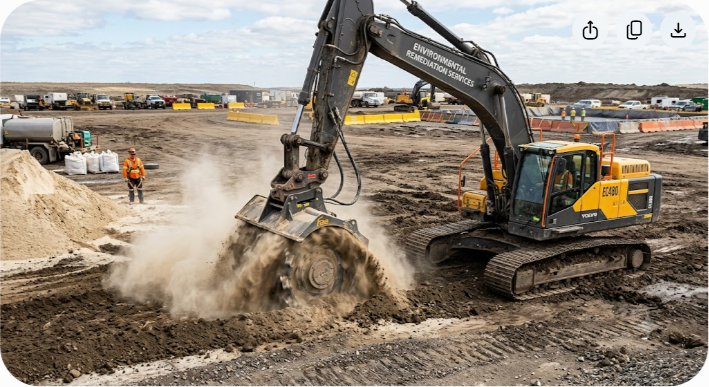
Heavy metals do not degrade over time. Unlike organic pollutants that break down under sunlight, microbial activity, or chemical oxidation, toxic elements like lead, cadmium, chromium, and arsenic remain in topsoil indefinitely unless they are physically removed or chemically stabilized.
For land developers, agricultural managers, environmental engineers, and industrial site operators, traditional excavation and landfill disposal (often called 'dig-and-dump') is rarely cost-effective. Off-site hauling and disposal fees for hazardous soil can range from $100 to over $300 per ton.
This is why in situ immobilization using bentonite clay has become a go-to method for managing heavy metal contamination on site.
By leveraging the high cation exchange capacity (CEC), expansive surface area, and hydration behavior of smectite clay minerals, bentonite locks heavy metal cations into its mineral framework or binds them tightly to charged outer surfaces. This process renders contaminants insoluble and bio-unavailable, halting leaching into local groundwater networks and stopping entry into crop systems.
Here is a complete breakdown of the mineralogy, field application methods, dosage math, and practical trade-offs involved in using bentonite clay for heavy metal soil stabilization.
To see why bentonite clay works so reliably, we first need to look at how metals travel through open soil matrixes.
Heavy metals accumulate through industrial emissions, mining operations, legacy leaded paints, agricultural chemicals, and unlined waste pits. The primary elements managed in environmental site assessments include:
When heavy metals exist as free ions in soil pore water, they threaten surrounding ecosystems through plant uptake, vertical leaching into water tables, and airborne dust transport.
Soil stabilization does not destroy the element itself—which is impossible—but shifts it into a permanent chemical state that will not dissolve in groundwater or interact with biological systems.
Bentonite is an absorbent phyllosilicate clay composed primarily of montmorillonite. Formed from volcanic ash deposits, montmorillonite possesses specific structural traits that make it uniquely effective at binding inorganic contaminants.
Montmorillonite features a 2:1 sheet structure where a single octahedral sheet containing aluminum or magnesium sits sandwiched between two tetrahedral silica sheets. Natural substitution inside these layers creates a net negative structural charge across the clay surfaces.
To neutralize its internal charge deficit, montmorillonite holds exchangeable cations like Na?, Ca²?, and Mg²? within its expandable interlayers. When dissolved metal ions like Pb²? or Cd²? pass through the clay, they swap places with these lighter ions and become fixed inside the structure.
Natural bentonite clays offer a CEC between 70 and 110 meq/100g, compared to standard agricultural soils that typically measure between 5 and 25 meq/100g.
Hydrated montmorillonite separates into extremely thin platelets, exposing its internal structure. A single gram of processed sodium bentonite features a total surface area of 700 to 800 square meters, providing an enormous volume of binding sites per kilogram of applied material.
When sodium bentonite absorbs water, it swells dramatically to form a tight, low-permeability matrix. Mixed into coarse or loose soil, bentonite lowers hydraulic conductivity down to 10?? or 10?? cm/sec. This sealing effect blocks rainfall percolation, removing the liquid carrier that drives subsurface leaching.
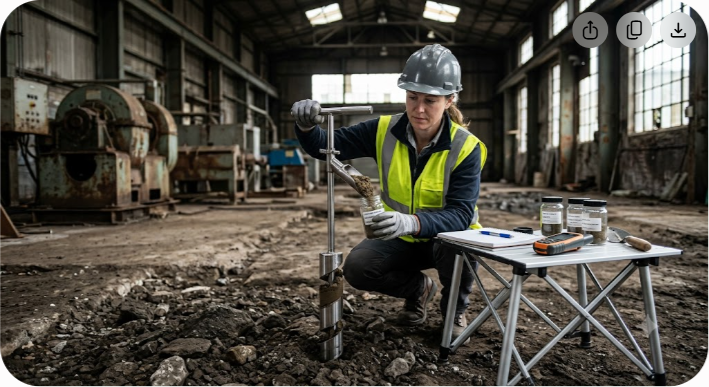
The predominant exchangeable cation in bentonite determines how the raw mineral behaves when tilled into moist soil.
| Feature / Property | Sodium Bentonite (Na-Bentonite) | Calcium Bentonite (Ca-Bentonite) |
|---|---|---|
| Primary Interlayer Cation | Sodium (Na?) | Calcium (Ca²?) |
| Swelling Volume | High (12x to 18x dry volume) | Moderate (1.5x to 3x dry volume) |
| Hydraulic Conductivity | Extremely low (ideal for hydraulic seals) | Moderate |
| Exchange Kinetics | Fast; sodium ions displace easily | Slower; calcium holds tighter to layers |
| Best Project Fit | Leaching barriers, subsoil sealing, deep stabilization | Surface topsoil conditioning, agricultural tilling |
| Alkalinity Impact | Mildly alkaline (pH 8.5–10.5) | Near-neutral to mild alkaline (pH 7.0–8.5) |
For environmental projects focused on preventing groundwater leaching, natural high-swelling sodium bentonite offers the best performance. Its expansion fills soil pore space while its loosely bound sodium ions readily exchange for heavier metal cations.
Calcium bentonite can be amended with sodium carbonate (soda ash) to increase swell capacity, but high-purity natural sodium bentonite provides consistent long-term stability without processing additives.
Blending bentonite clay into contaminated soil activates four primary trapping pathways:
Target metal ions floating in pore liquid replace sodium or calcium ions on the clay's structural surfaces:
Because heavy metal cations hold higher ionic valency and charge density than sodium, the clay holds them tightly, preventing re-release under normal field conditions.
Beyond electrostatic exchange, metal ions form direct chemical bonds with hydroxyl groups (-SiOH and -AlOH) located along the broken edges of clay crystals. These inner-sphere complexes resist changes in soil water content.
Bentonite carries a slightly alkaline pH. Introducing it into acidic or neutral soil raises the local pH around clay particles, converting dissolved metals into solid hydroxides or carbonates:
These mineral solids form directly on the surface of the clay particles, locking the metals out of solution.
As bentonite expands, it fills voids between surrounding sand and silt grains. This physical barrier stops water movement through the soil matrix, cutting off the transport mechanism that carries dissolved elements downward.
Field remediation requires clear soil testing, accurate dosage design, and thorough mixing. Here is the standard workflow used by environmental contractors.
Gather detailed baseline data before specifying material volumes:
Design application rates around target cleanup criteria, soil density, and mixing depth.
Sample Field Calculation: To treat a 1,000 m² plot to a depth of 30 cm (0.3 m) at a 5% application rate:
Clear surface debris, rocks, and plant roots. Check that soil moisture levels sit near optimal working range (12% to 18%). Soil that is too dry generates excessive dust during spreading, while oversaturated soil prevents uniform mechanical blending.
Collect core samples at 7, 28, and 90 days. Run Toxicity Characteristic Leaching Procedure (TCLP) or Synthetic Precipitation Leaching Procedure (SPLP) tests to confirm that leachable metal concentrations meet regulatory goals.
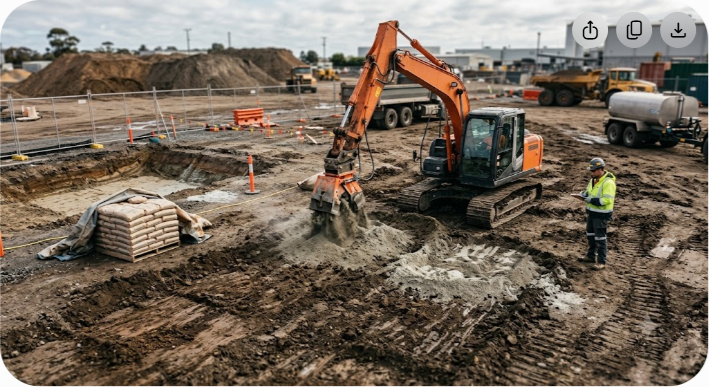
While unmodified sodium bentonite excels at binding positively charged metal ions (Pb²?, Cd²?, Cu²?, Zn²?), complex sites require altered material chemistry.
Arsenic exists in soil as negatively charged oxyanions like arsenate (AsO?³?) or arsenite (AsO?³?), while chromium VI forms chromate (CrO?²?). Because standard clay surfaces carry a negative net charge, untreated bentonite repels these species.
Site engineers balance material costs, operational turnaround, and structural goals when picking a stabilization plan.
| Remediation Method | Relative Cost per Ton | Environmental Footprint | Long-Term Stability | Operational Complexity |
|---|---|---|---|---|
| Excavation & Landfilling | High ($100–$300+) | High (Off-site transport, landfill use) | Complete removal from site | Moderate |
| Bentonite Immobilization | Low to Moderate ($25–$60) | Low (Uses natural earth mineral) | High (Permanent mineral trapping) | Low to Moderate |
| Phytoremediation | Low ($10–$25) | Low (Vegetated cover) | Variable (Slow; requires biomass management) | High maintenance |
| Soil Washing | High ($80–$150) | High (Requires wash water treatment) | High | High |
| Lime / Cement Stabilization | Moderate ($40–$80) | Moderate (Dramatically alters soil pH) | Good, but sensitive to long-term weathering | Moderate |
Bentonite clay offers a practical middle path: it delivers structural stability comparable to cement additives while preserving natural soil texture at a lower overall material cost.
Avoiding common operational mistakes ensures the clay performs as expected over time:
While bentonite buffers surrounding soil toward a neutral-alkaline range, severe acidity (pH < 4.0) fills exchange sites with hydrogen ions (H?), reducing the space available for metal binding. On acid-mine sites, blend agricultural lime into the soil alongside bentonite to keep pore pH stable.
If soil pore water holds high concentrations of dissolved salts (such as coastal soils or de-icing runoff areas), background sodium and calcium ions compete with heavy metals for binding sites. In high-salinity zones, increase bentonite dosage rates by 20% to 40% to compensate.
Always specify pulverized, powder-grade bentonite (200 mesh or finer) for soil blending projects. Granular bentonite or coarse pellets work well for well seals and slurry trenches, but they cannot achieve the intimate particle contact required for uniform topsoil stabilization.
A former industrial property slated for urban redevelopment showed lead concentrations averaging 1,450 mg/kg. Contractors blended 6% high-purity sodium bentonite into the upper 40 cm of soil.
Follow-up testing showed a 92% drop in TCLP-leachable lead, bringing soil runoff well within local environmental compliance standards without removing topsoil from the site.
Agricultural land affected by historical runoff showed elevated bioavailable cadmium levels (12 mg/kg), which threatened crop safety.
Tilling 3% sodium bentonite into the working soil layer reduced plant-available cadmium by 78% over a single growing season, restoring soil safety while maintaining soil moisture retention.
Predictable soil remediation relies on consistent mineral purity. Low-grade clays with poor montmorillonite content fail to deliver the expected cation exchange capacity or hydraulic performance.
As India's largest mine owner and exporter of high-grade bentonite—ranking among the top five producers globally—Axewelledge supplies industrial-grade bentonite engineered for civil and environmental applications.
Whether you are constructing a containment barrier, treating contaminated agricultural acreage, or stabilizing an industrial site, Axewelledge provides the high-purity clay minerals your project demands.
Contact our technical team to discuss bulk sourcing, custom sizing, and site delivery options.
Review these core field steps before launching an on-site clay stabilization project:













Have questions about our products? We're here to help!