Axewelledge, a leading exporter from India, specializes in high-quality Bentonite. With a commitment to excellence, we supply premium Bentonite to the Middle East and Southeast Asia markets.


North Angle Complex, 304,
150 Feet Ring Rd, Opposite Ambedkar Nagar BRTS Stop,
Madhav Park, Punit Nagar,
Mavdi, Rajkot, Gujarat 360004
© Axewelledge 2026, All Rights Reserved.
You have poured millions into a new infrastructure project. The concrete is set, the steel is reinforced, and the blueprints look flawless on paper. But then, water does what water does best: it finds a way. Whether you are designing a municipal landfill in Ohio, reinforcing an earthen dam in California, or managing groundwater around a deep excavation in Manhattan, controlling moisture is not just a part of the job. It is the job.
Water migration causes soil erosion, structural instability, and severe environmental contamination. If you do not stop it early, you will pay for it later in massive remediation costs. This is exactly where high-swelling sodium bentonite steps in. It is a naturally occurring, highly absorbent clay that acts as an impermeable barrier when hydrated. Not all bentonite is created equal, and knowing how to leverage high-quality sodium bentonite can make or break the sealing efficiency of your US civil engineering projects.
Let us break down the mechanics, the applications, and the science behind why high-swelling sodium bentonite remains the ultimate defense against water intrusion.
Before looking at the solution, you need to understand the scale of the problem. In civil engineering, permeability is a measure of how easily fluids move through a porous medium like soil or rock. High permeability means water flows freely, while low permeability means water is trapped or heavily restricted.
In the United States, infrastructure is aging rapidly. The American Society of Civil Engineers regularly points out the glaring vulnerabilities in our dams, levees, and wastewater systems. When earthen structures lack a proper seal, hydrostatic pressure builds up. Seepage starts small—a damp patch on a retaining wall, a slight pooling at the base of a landfill. Over time, that minor seepage turns into piping, a phenomenon where water carves out underground channels, eventually leading to catastrophic structural failure.
Environmental protection is another massive factor. The Environmental Protection Agency (EPA) enforces strict guidelines on municipal solid waste landfills. If hazardous leachate escapes the landfill boundary and hits the local groundwater, you are looking at federal fines, public health crises, and project shutdowns. You need a material that achieves a hydraulic conductivity of less than 1 x 10^-7 centimeters per second. That is a highly specific engineering requirement, and achieving it consistently requires a sealant that adapts, swells, and holds the line.
Bentonite is an absorbent aluminum phyllosilicate clay consisting mostly of montmorillonite. It was named after Fort Benton, Wyoming, where it was first discovered in large quantities. However, the global demand for this mineral has spurred production worldwide, with industry leaders like Axewelledge mining and processing vast reserves to meet international needs.
The secret to bentonite's sealing capability lies in its crystalline structure. Montmorillonite consists of tiny, microscopic platelets. When water meets these platelets, they absorb the liquid and push apart. This is the 'swelling' effect.
There is a critical distinction you need to make: there are two main types of bentonite used in commercial applications—calcium bentonite and sodium bentonite.
Calcium bentonite is highly absorbent. It is fantastic for soaking up oil spills or acting as a binding agent in animal feed. However, it does not swell significantly. It might expand a little, but it will not form the tight, gelatinous, impermeable seal required for heavy-duty civil engineering.
Sodium bentonite, on the other hand, is the star of the show for waterproofing. Because of the specific sodium ions situated between its clay platelets, water molecules are drawn in exponentially. Premium sodium bentonite can swell up to 15 to 20 times its original dry volume. When you confine this swelling action—say, by sandwiching the clay between two layers of geotextile fabric or mixing it deep into a soil trench—the expanding clay has nowhere to go. It completely fills the microscopic voids in the surrounding soil. The result is a dense, highly viscous barrier that virtually stops water dead in its tracks.
How exactly does this swelling translate to sealing efficiency on a messy, unpredictable job site? It comes down to three physical actions: hydration, expansion, and void filling.
When you mix high-swelling sodium bentonite into native soil or deploy it in a slurry, it starts in a dry, granular, or powdered state. It is easy to transport and handle. Once exposed to water—either groundwater or water deliberately added by your crew—the hydration process begins immediately. The sodium ions in the clay lattice aggressively attract water molecules.
As the clay hydrates, it expands. If you leave a pile of sodium bentonite in a bucket of water, it will form a soft, slippery gel. But civil engineers do not leave it in buckets. They compact it under tons of soil or concrete. Because the bentonite is confined, the expansion pressure forces the hydrating clay into every available pore, crack, and crevice in the surrounding substrate. It acts like thousands of microscopic corks plugging the gaps in the soil matrix.
This is why high-swelling capacity is a non-negotiable metric. A low-grade clay will not generate enough expansion pressure to plug larger soil voids. You will end up with weak spots in your barrier, leading to seepage. By sourcing premium sodium bentonite from a top-tier producer like Axewelledge, you guarantee that the swelling capacity meets the rigorous demands of your specific engineering application.
Now that we have covered the physics, let us look at how American engineers actually deploy this material in the field. The United States presents a unique blend of regulatory strictness and geographical diversity, making sodium bentonite a vital tool across multiple sectors.
Designing a landfill in the US means dealing with EPA Subtitle D regulations. You are legally required to prevent garbage liquids (leachate) from reaching the groundwater. Historically, engineers used thick layers of compacted native clay. But finding a massive source of the right kind of clay near your job site is rare and transporting it is cost-prohibitive.
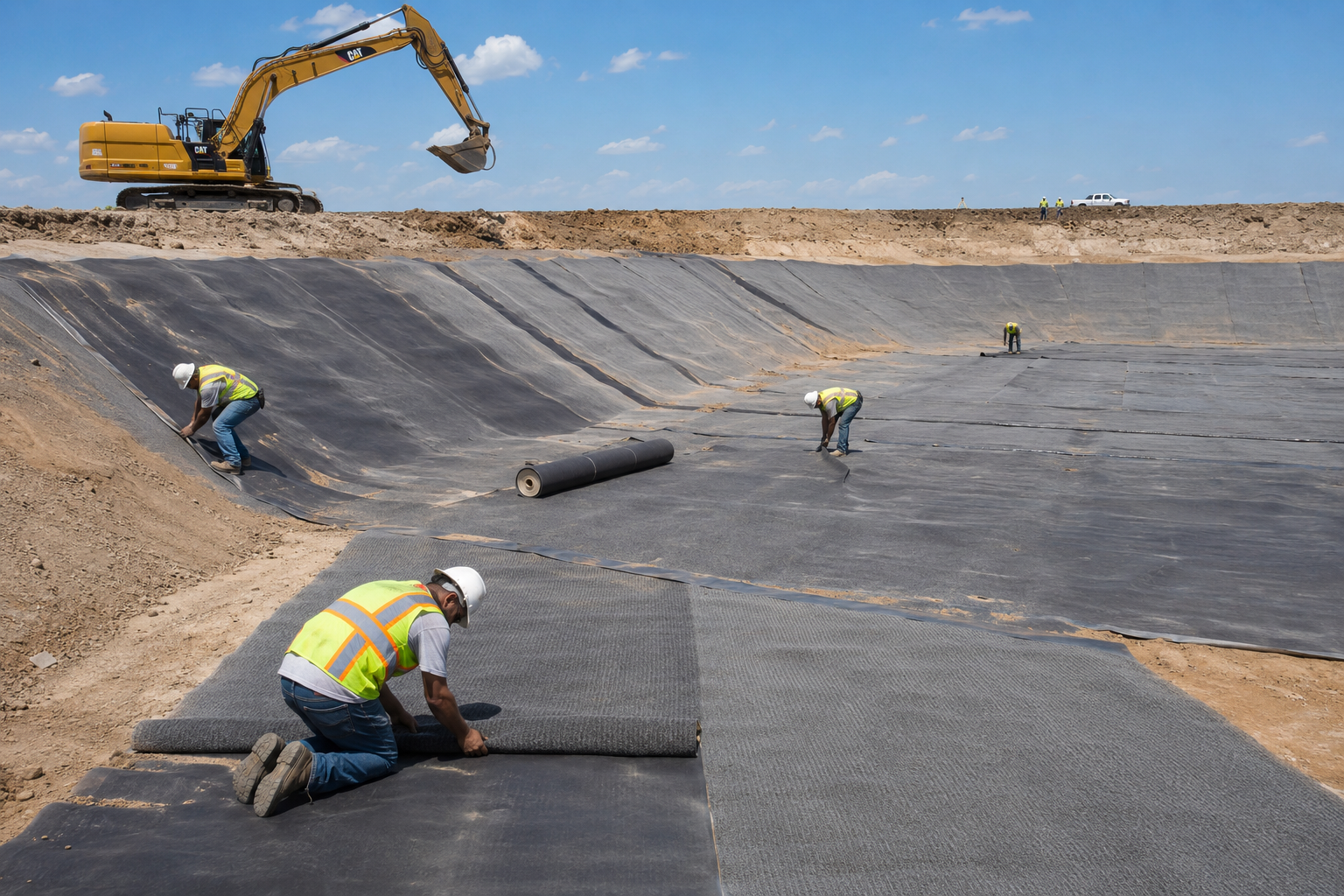
Today, the industry standard involves Geosynthetic Clay Liners (GCLs). A GCL is essentially a factory-manufactured blanket. It consists of a thin layer of high-swelling sodium bentonite sandwiched between two layers of synthetic fabric (geotextiles).
When placed at the bottom of a landfill and covered with waste, the bentonite inside the GCL hydrates from the moisture in the soil and the leachate. It swells, the fabric holds it in place, and you have an impermeable barrier that performs better than several feet of compacted natural soil. Because GCLs are relatively thin, they also save valuable airspace in the landfill, allowing municipal operators to store more waste and increase profitability. The quality of the GCL depends entirely on the quality of the bentonite inside it. With over 60 million tons of high-quality reserves, Axewelledge supplies the raw material that makes these critical liners perform flawlessly.
Imagine you need to excavate a deep foundation for a skyscraper in a coastal city like Boston or Miami. The moment you dig down, the hole fills with groundwater. Pumping the water out continuously is expensive and can destabilize surrounding buildings.
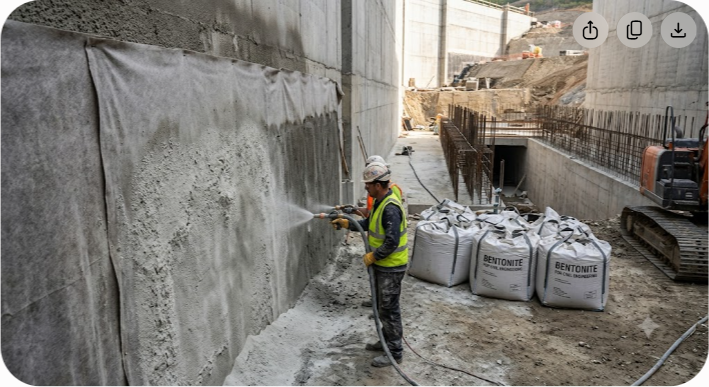
The solution is a slurry wall. A trench is excavated around the perimeter of the site. As the dirt is pulled out, the trench is simultaneously filled with a bentonite slurry—a thick mixture of high-swelling sodium bentonite and water. The slurry does two things. First, its high density exerts hydrostatic pressure against the trench walls, preventing them from collapsing during excavation. Second, the bentonite particles penetrate the porous soil walls, creating a 'filter cake.'
Once the trench is fully excavated to the required depth, the slurry is displaced by concrete or mixed with soil to form a permanent soil-bentonite cutoff wall. This creates a watertight box in the ground. You can now excavate the interior safely and dryly. The effectiveness of the slurry wall relies heavily on the viscosity and fluid-loss properties of the bentonite used. Superior swelling properties ensure a tough, durable filter cake that will not degrade under pressure.
Earthen dams and irrigation canals form the backbone of agricultural water management, particularly in the Western US. States like California, Nevada, and Arizona rely heavily on complex canal networks to move water across vast, arid landscapes.
Seepage in canals is a massive issue. You can lose up to 30% of your water to the surrounding soil before it even reaches the crops. Pouring concrete liners is wildly expensive and prone to cracking in regions with high seismic activity or temperature fluctuations.
Instead, engineers use the 'blanket' or 'mixed-in-place' method using dry sodium bentonite. The canal is drained, and native soil is mixed with a specific ratio of granular bentonite. The mixture is wetted and heavily compacted. When water is reintroduced to the canal, the bentonite swells and locks the soil particles together, stopping the seepage.
What makes bentonite perfect for this is its self-healing property. If a minor earthquake or ground shift causes a crack in the canal bed, a rigid concrete liner would stay broken, requiring costly repairs. But a bentonite-soil mixture is pliable. When water enters the new crack, the bentonite simply swells again and fills the gap. It physically repairs itself. This self-healing nature is a massive asset for long-term infrastructure stability.
Urban expansion in cities like Seattle and New York requires extensive tunneling for subways, water mains, and utility lines. Tunnel Boring Machines (TBMs) grind through solid rock and loose soil beneath the city streets.
To lubricate the cutting face of the TBM and stabilize the tunnel walls before the concrete segments are placed, engineers pump a bentonite slurry to the front of the machine. The high-swelling bentonite conditions the soil, reducing friction and preventing the earth from collapsing onto the expensive machinery. It also seals the tunnel walls against groundwater intrusion during the digging process. High-yield sodium bentonite is preferred here because you can achieve the required fluid viscosity using less material, saving on transport and mixing costs.
The US climate is incredibly varied, and civil engineering materials must be adaptable. A waterproofing solution that works in the swampy conditions of Louisiana might fail miserably in the freezing winters of Minnesota.
In regions that experience harsh winters, the ground routinely freezes and thaws. This cycle wreaks havoc on rigid waterproofing structures. Concrete cracks, and synthetic membranes can become brittle and tear.
High-swelling sodium bentonite handles freeze-thaw cycles exceptionally well. Because it remains in a semi-plastic, gelatinous state when hydrated, it simply flexes with the shifting earth. If the water inside the clay freezes, the barrier might temporarily change physical properties, but once it thaws, the bentonite re-hydrates and regains its full sealing capacity without permanent damage.
In dry regions like Arizona or New Mexico, the challenge is desiccation—the drying out of the soil. If a bentonite seal is exposed to extreme heat and loses its moisture, it will shrink and crack.
Engineers counter this by ensuring the bentonite layer is buried under an adequate layer of cover soil to retain moisture. However, even if desiccation occurs during a prolonged drought, premium sodium bentonite retains its 'memory.' The moment seasonal rains return or the water level rises, the clay will immediately absorb the moisture and swell back to its protective state. Lower-quality clays often lose their swelling capacity after repeated wet-dry cycles, but a high-purity product ensures reliable, repeatable performance.
Having the right material is only half the battle. Executing the installation correctly is what guarantees sealing efficiency. While your specific project engineers will outline exact protocols, there are general best practices for handling high-swelling sodium bentonite.
When mixing bentonite directly into native soil for a pond liner or landfill cap, uniformity is everything. If you have clumps of bentonite in one area and none in another, you will have severe seepage. Contractors typically use heavy machinery like rotary tillers or specialized soil stabilizers to blend the dry bentonite powder or granules deeply and evenly into the top few inches of the soil base.
Once mixed, the soil must be compacted to the correct density using padfoot rollers. Proper compaction ensures that when the bentonite eventually hydrates and swells, it pushes against the soil matrix rather than just expanding loosely upward.
For slurry walls or tunneling, the bentonite is mixed with water before application. You cannot simply dump dry bentonite into a vat of water; it will instantly clump into unmanageable, dry-centered balls called 'fish eyes.'
Instead, crews use high-shear colloidal mixers. The dry clay is injected rapidly into a spinning vortex of water, ensuring every single platelet is fully wetted and dispersed. The slurry is then allowed to 'yield' or rest in a holding tank for several hours, giving the clay time to fully hydrate and reach its maximum viscosity before it is pumped into the trench.
Installing Geosynthetic Clay Liners requires careful logistical planning. The rolls are extremely heavy, often requiring specialized spreader bars attached to excavators. The most critical rule when installing GCLs is keeping them dry until they are buried. If a sudden rainstorm hits an exposed GCL, the bentonite will prematurely swell without the necessary confining pressure of the cover soil. This ruins the barrier. Crews must work systematically, unrolling the GCL, overlapping the seams (often sprinkling loose dry bentonite between the overlaps to seal the joint), and immediately covering it with protective soil.
You might wonder why US civil engineering firms look to international producers like Axewelledge for their bentonite needs. It comes down to scale, quality control, and consistency.
As India's largest mine owner and exporter of Bentonite, Axewelledge ranks among the top five global producers. We own the reserves. With over 60 million tons of high-quality mineral reserves, we have complete control over the entire supply chain, from extraction to final milling.
Civil engineering projects run on tight schedules. You cannot afford delays due to raw material shortages, nor can you risk using a batch of clay that fails independent lab testing. We process our bentonite with advanced refinement techniques at strategically located plants. This means we can consistently produce specific grades of sodium bentonite tailored to exact industry standards, whether you need a high-yield powder for a deep trench slurry or a specific granular size for a custom GCL manufacturing run.
Furthermore, our robust logistics network ensures that we can land bulk shipments at major US ports reliably and cost-effectively. You get the quality of a top-tier global mineral processed specifically for the rigorous demands of American infrastructure.
Beyond pure engineering performance, high-swelling sodium bentonite aligns perfectly with modern sustainability goals. It is a 100% natural, eco-friendly mineral. Unlike synthetic polymer resins or petroleum-based sealants, bentonite does not degrade into toxic microplastics or leach harmful chemicals into the soil. It is literally earth sealing earth.
From an economic standpoint, the cost-to-benefit ratio is unmatched. While premium sodium bentonite represents an upfront material cost, it drastically reduces long-term maintenance expenses. Consider a municipal wastewater lagoon. If you line it with a cheap, synthetic membrane that tears after five years, the facility has to drain the lagoon, excavate the waste, and install a new liner—a multi-million dollar disaster. A properly installed bentonite-enhanced soil liner can last indefinitely, surviving ground shifts, heavy equipment traffic, and extreme weather. It is a permanent solution.
To be an expert in your field, you also have to understand the limitations of your materials. High-swelling sodium bentonite is incredibly powerful, but it is not immune to chemical interference.
The biggest challenge engineers face is ion exchange. Remember that the swelling magic comes from the sodium ions in the clay. If the bentonite barrier is exposed to groundwater or industrial leachate that is extremely high in calcium, magnesium, or heavy metals, a chemical reaction can occur. The calcium ions in the water can physically swap places with the sodium ions in the clay. Over time, your highly expansive sodium bentonite converts into non-swelling calcium bentonite, and the barrier loses its seal.
Similarly, environments with very high salinity (like seawater) or extreme pH levels can inhibit the initial hydration and swelling of the clay.
How do you overcome this? Through rigorous pre-construction testing. Geotechnical engineers always take samples of the site's groundwater and the expected chemical runoff. They run compatibility tests in the lab. If chemical interference is a risk, there are solutions. You can use 'contaminant-resistant' bentonite, which is treated with specific polymers that protect the clay platelets from ion exchange. Alternatively, you can pre-hydrate the bentonite with clean, fresh water before exposing it to the contaminated environment. Once fully hydrated and expanded, bentonite is far more resistant to chemical attack than in its dry state.
The demand for reliable, high-performance sealing materials is only going to increase. The US government's recent legislative pushes to rebuild roads, bridges, ports, and water systems represent a multi-generational investment in infrastructure.
We are seeing an increased focus on climate resilience. Coastal cities are building massive seawalls and subterranean storm surge barriers to combat rising sea levels and extreme weather events. These massive concrete structures require deeply embedded, waterproof foundations—the exact environment where bentonite slurry walls excel.
Furthermore, the shift toward green energy requires new mining operations for lithium and copper, materials essential for electric vehicles and battery storage. These mining operations generate vast amounts of tailings (waste rock and water) that must be safely contained in enormous lined ponds to prevent heavy metal contamination of local ecosystems. Premium sodium bentonite is the material of choice for these massive environmental containment efforts.
Achieving true sealing efficiency is not about throwing dirt in a hole and hoping for the best. It is an exact science that relies heavily on the physical and chemical properties of your raw materials. High-swelling sodium bentonite offers a unique combination of extreme impermeability, physical flexibility, self-healing mechanics, and environmental safety.
When you are planning your next major civil engineering project in the US—whether it is managing groundwater in a dense urban excavation, securing a municipal landfill, or rehabilitating an aging agricultural dam—you need to know exactly what is going into your soil.
Axewelledge stands ready to provide the superior products necessary for these demanding applications. With decades of expertise, an unshakeable commitment to international quality standards, and the sheer volume to support massive infrastructure rollouts, we deliver the reliability that engineers demand.
Don't let water dictate the lifespan of your projects. Take control of your site's permeability, invest in the highest quality materials, and build structures designed to outlast the challenges of tomorrow.













Have questions about our products? We're here to help!