Axewelledge, a leading exporter from India, specializes in high-quality Bentonite. With a commitment to excellence, we supply premium Bentonite to the Middle East and Southeast Asia markets.


North Angle Complex, 304,
150 Feet Ring Rd, Opposite Ambedkar Nagar BRTS Stop,
Madhav Park, Punit Nagar,
Mavdi, Rajkot, Gujarat 360004
© Axewelledge 2026, All Rights Reserved.
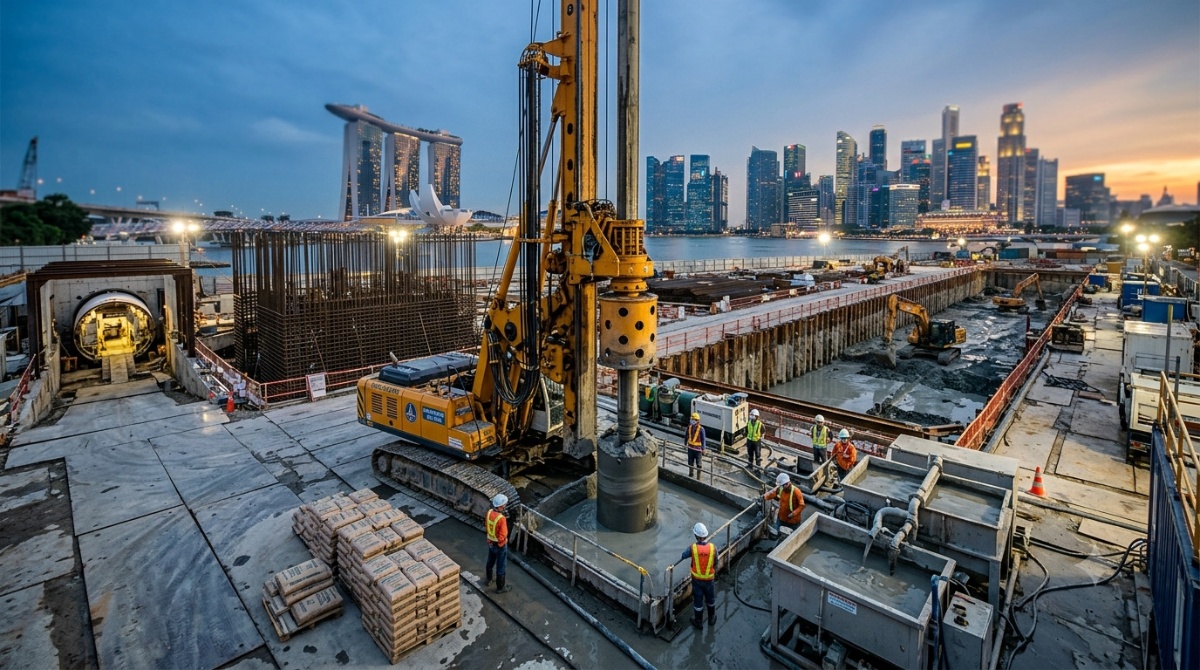
Singapore is a global marvel of modern engineering. With its iconic skyline, deep underground MRT lines, expansive subsea tunnels, and ongoing land reclamation projects like the Tuas Mega Port, the city-state is constantly pushing the boundaries of civil engineering. However, building upward and tunneling downward in Singapore presents a massive geological challenge. The island’s subsurface is a complex, unpredictable mix of soft marine clay, loose sand, and hard granitic rock formations.
To prevent catastrophic collapses during deep excavations, horizontal directional drilling (HDD), and micro-tunneling, Singaporean engineering and drilling firms rely heavily on a critical hidden partner: premium Sodium Bentonite clay.
Among global sources, Indian Sodium Bentonite, particularly mined from the mineral-rich regions of Bhuj and Kutch in Gujarat, has become the gold standard for Singapore's drilling industry. This article explores why Singaporean drilling operations are highly dependent on Indian Bentonite, how it is applied across various infrastructure sectors, and how pioneering exporters like Axewelledge provide the precise technical grades that meet Singapore’s strict regulatory and environmental standards.
Before understanding how drilling mud functions, one must look at what lies beneath Singapore’s surface. Geotechnical engineers on the island primarily contend with three tricky geological formations:
The Kallang Formation: A highly variable layer consisting of incredibly soft, compressible marine clay, peaty soils, and loose sand. It has very low shear strength, making boreholes prone to immediate cave-ins.
The Old Alluvium: A dense, sandy, and clayey silt deposit that can behave unpredictably when interacting with groundwater.
The Bukit Timah Granite: Extremely hard rock that requires massive mechanical force to drill through, generating immense frictional heat and rapid tool wear.
When drilling a deep foundation pile (bored pile) or cutting a tunnel through soft marine clay, the earth exerts immense lateral pressure. Without an engineered counter-force, the walls of the borehole will swell, slough, or completely collapse inward. Furthermore, Singapore’s high water table means that groundwater constantly threatens to flood the excavation zone, washing away soil stability.
To combat these challenges, drilling companies use a specialized fluid known as drilling slurry, and the primary active ingredient that gives this slurry its magical properties is high-yield Sodium Bentonite clay.
While bentonite is mined in several parts of the world, Singaporean buyers systematically prefer importing from India. The reasons stem from a combination of geological superiority, processing excellence, and logistical convenience.
Indian Sodium Bentonite, especially from the Kutch region, is rich in Montmorillonite, the mineral responsible for the clay's unique properties. When mixed with water, Indian sodium bentonite exhibits an extraordinary swelling index. It can expand up to 15 to 20 times its dry volume. This high hydration capacity creates a highly viscous, thixotropic fluid that is ideal for stabilizing loose formations.
Thixotropy is the property of a fluid that allows it to liquefy when agitated (stirred or pumped) and turn into a stiff gel when left static. Indian bentonite provides excellent thixotropic gel strength. When drilling pauses—such as when changing drill pipes—the slurry gels instantly to keep heavy soil and rock cuttings suspended in place, preventing them from falling to the bottom of the hole and jamming the equipment.
Singapore’s Building and Construction Authority (BCA) enforces stringent quality controls. Materials used in mega-projects must strictly comply with international standards such as API (American Petroleum Institute) Specification 13A or OCMA (Oil Companies Materials Association) standards. Indian mineral processors utilize advanced refining techniques to ensure their export shipments hit these exact parameters consistently.
Singapore is geographically positioned along major maritime trade lanes originating from India. Shipping routes from Indian ports like Mundra or Kandla (located right next to the Gujarat mines) directly to the Port of Singapore are incredibly efficient. This proximity ensures shorter lead times, lower freight costs, and a highly stable supply chain for large-scale projects that cannot afford single-day operational delays.
Drilling companies in Singapore deploy Indian Bentonite across a broad array of specialized civil engineering and geotechnical applications.
Because Singapore lacks space, buildings must grow upward. Constructing skyscrapers requires drilling deep bored piles into the earth, which are later filled with concrete and reinforced steel.
During the drilling process, Indian Sodium Bentonite powder is mixed with water to form a dense piling slurry. As the drilling bucket cuts into the ground, the slurry is continuously pumped into the borehole. The hydrostatic pressure of the heavy slurry column pushes outward against the borehole walls, counteracting the active earth pressure and groundwater influx.
Before constructing deep underground basements or subway stations, engineers build concrete perimeter walls called diaphragm walls. This involves excavating deep, narrow trenches.
Without stabilization, these long trenches would collapse instantly. High-purity Indian bentonite slurry fills the trench during excavation. The clay platelets deposit themselves onto the porous sand and clay walls of the trench, forming an impermeable layer known as a filter cake. This cake stops the fluid from escaping into the surrounding ground while providing a smooth, stable wall that holds back the earth until concrete is tremie-poured into place.
Singapore’s dense urban layout means tearing up roads to lay pipes, fiber-optic cables, or power lines is highly disruptive. Instead, utility companies utilize trenchless technology via Horizontal Directional Drilling (HDD).
In HDD, a steerable drill bit cuts a horizontal path underground. Indian bentonite drilling mud serves multiple roles here:
Lubrication: It significantly reduces rotational friction between the drill string and the soil, saving energy and machinery wear.
Cooling: It absorbs the intense heat generated by the drill bit and carries it away.
Cuttings Transport: It encapsulates loose sand and gravel, sweeping them out of the horizontal hole back to the surface recycling system.
For larger underground pipelines, such as deep tunnel sewerage systems (DTSS), micro-tunneling boring machines (MTBMs) are used. In these operations, heavy concrete or steel pipes are jacked hydraulically behind the tunnel shield. Indian bentonite is injected around the outer perimeter of the pipe string to act as an ongoing annular lubricant, radically lowering the required jacking forces and preventing the pipe string from getting stuck in sticky marine clays.
To maximize efficiency, Singaporean engineers meticulously monitor the rheological properties of their bentonite slurries. The performance of Indian bentonite relies on specific chemical and physical mechanics:
| Slurry Property | Technical Target | Why Indian Bentonite Excels |
| Marsh Funnel Viscosity | 32 to 50 seconds | High montmorillonite content allows rapid viscosity buildup with minimal powder consumption. |
| Filtrate Loss (Fluid Loss) | < 15 ml (under standard pressure) | Forms an ultra-thin, low-permeability filter cake that seals the borehole wall and prevents water from migrating into surrounding formations. |
| pH Level | 8.5 to 10.0 | Naturally alkaline profile ensures optimum dispersion of clay particles and prevents premature flocculation. |
| Sand Content | < 1% upon entry | Advanced refinement in Indian processing units guarantees low grit content, preserving drilling pumps from abrasive wear. |
When the slurry has low fluid loss, it ensures that water does not seep out into Singapore's sensitive marine clays. If water escapes into marine clay, the clay can swell, lose its structure, and cause sudden ground settlement—a nightmare scenario when drilling next to existing buildings or active MRT tracks.
For a drilling contractor in Singapore, a failure in material quality can result in millions of dollars in structural damages, ruined equipment, or project penalties. That is why sourcing from a reliable, asset-backed supplier is paramount.
As detailed in our overview of how Axewelledge Leads the Market, our company operates as India's premier mine-owner, manufacturer, and exporter of industrial-grade bentonite solutions. With vast high-quality reserves located across Gujarat and Rajasthan, we maintain complete end-to-end control over the mineral's purity, milling consistency, and chemical optimization.
We recognize that no two drilling sites in Singapore are identical. Sinking piles near Marina Bay requires a different slurry formulation than tunneling through the rocky formations of Bukit Timah. To address this, Axewelledge supplies specialized, high-yield drilling muds formulated to endure variable groundwater salinities and demanding soil conditions. Our products undergo stringent in-house laboratory testing, ensuring every batch delivered to the Port of Singapore strictly adheres to API 13A specifications.
Furthermore, our large-scale processing facilities enable us to handle high-volume demands effortlessly, delivering securely packed bulk jumbo bags that are ready for immediate site deployment. For contractors navigating global procurement, our comprehensive guide on How to Import Bentonite from India breaks down the essential testing, documentation, and quality verification steps needed to guarantee a seamless import cycle.
Singapore is widely recognized for its uncompromising stance on environmental safety. Under regulations managed by the National Environment Agency (NEA), any chemical or mineral compound used in civil construction must be non-toxic and eco-friendly.
Indian Bentonite is a 100% natural, volcanic-origin clay mineral. It introduces no hazardous toxins, heavy metals, or synthetic polymers into the subterranean ecosystem or regional aquifers.
Furthermore, modern drilling setups in Singapore utilize sophisticated slurry recycling systems. After the bentonite mud brings soil cuttings to the surface, it passes through desanders, desilters, and centrifuges. High-grade Indian bentonite stands up beautifully to mechanical shear, allowing the slurry to be recycled and pumped back down into the borehole multiple times. This drastically minimizes material waste, lowers overall procurement costs, and fits perfectly within Singapore’s green building frameworks.
As Singapore continues its ambitious journey toward urban expansion—expanding its underground footprint, building deeper foundations for denser communities, and connecting the island via sprawling rail networks—the demand for reliable ground stabilization will only rise.
The strategic synergy between Singapore's world-class engineering execution and India's elite mineral wealth is irreplaceable. By utilizing the incredible swelling, sealing, and lubricating characteristics of Indian Sodium Bentonite, Singaporean drilling companies can safely navigate treacherous geological strata with absolute confidence.
For international construction firms and procurement managers seeking consistent, high-yield bentonite products engineered for maximum subterranean stability, exploring the diverse industrial solutions at Axewelledge ensures your critical projects are built on a rock-solid, expert-backed foundation.













Have questions about our products? We're here to help!