Axewelledge, a leading exporter from India, specializes in high-quality Bentonite. With a commitment to excellence, we supply premium Bentonite to the Middle East and Southeast Asia markets.


North Angle Complex, 304,
150 Feet Ring Rd, Opposite Ambedkar Nagar BRTS Stop,
Madhav Park, Punit Nagar,
Mavdi, Rajkot, Gujarat 360004
© Axewelledge 2026, All Rights Reserved.
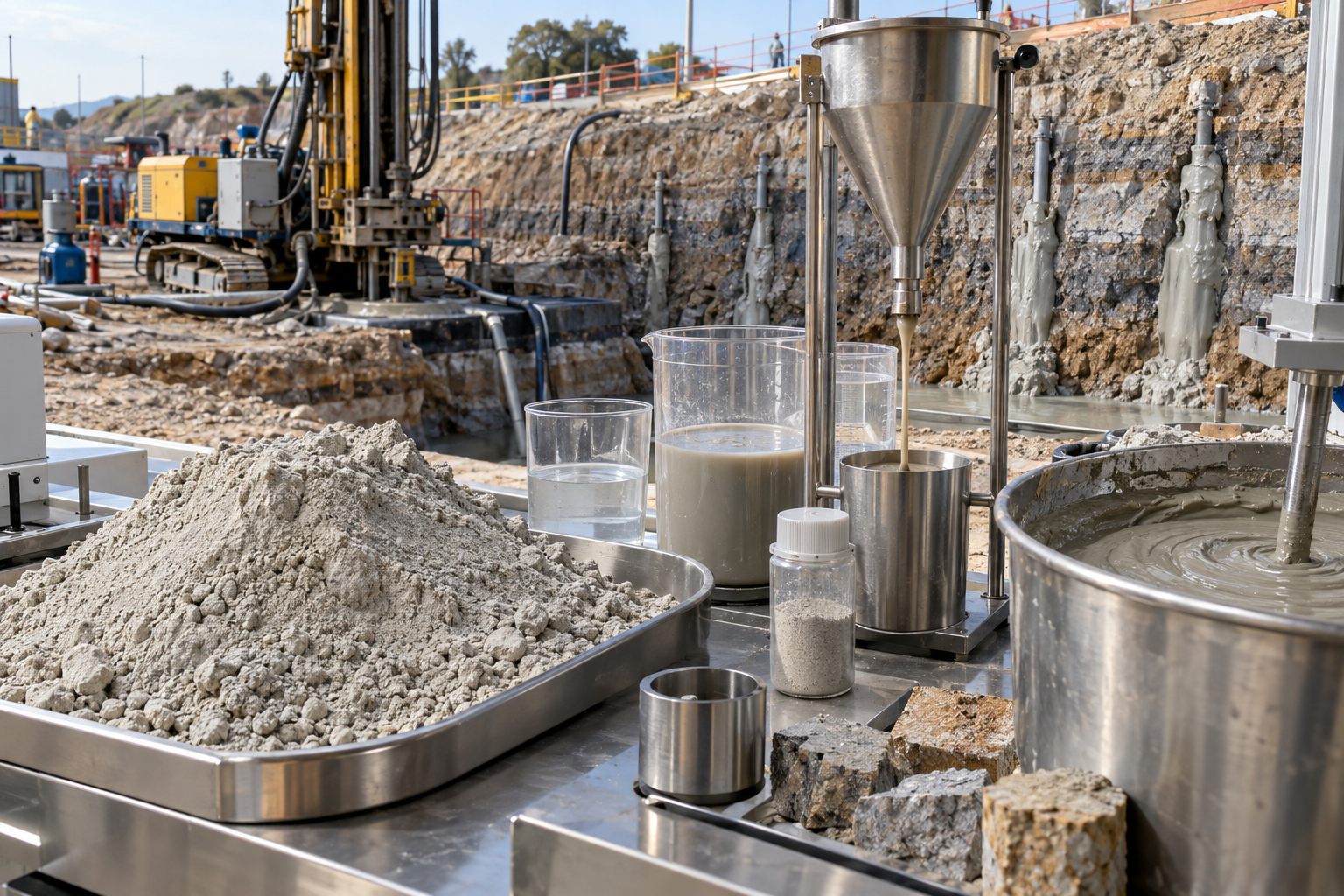
Choosing bentonite for geotechnical grouting starts with the grout's job, not the product's headline swelling value or price per ton.
For many water-based geotechnical applications, sodium bentonite is the first material engineers consider because sodium-rich montmorillonite can hydrate, swell, and form a low-permeability clay structure. But mineral type alone doesn't tell you whether a particular product will work on your project.
The right selection depends on the behavior of the complete grout system. Swelling, viscosity, filtration, hydration rate, particle size, water chemistry, solids concentration, cement compatibility, additives, pumpability, and field conditions all matter. A bentonite that performs well in clean laboratory water may behave very differently when mixed with saline groundwater, cement, or chemical admixtures.
This guide explains how to evaluate bentonite for geotechnical grouting, what to test before purchase, which properties deserve attention, and how to avoid common selection mistakes.
Bentonite is a natural clay containing a significant proportion of montmorillonite. When mixed with water, suitable bentonite can hydrate and form a suspension with useful viscosity, filtration, sealing, and particle-suspension characteristics.
Sodium bentonite is widely considered for construction slurry applications because sodium-rich montmorillonite generally hydrates and swells more strongly than calcium bentonite. That behavior can help produce a stable slurry and a low-permeability filter cake under suitable conditions.
Depending on the project, bentonite may be used in:
These applications don't all require the same material or mix design. A bentonite slurry used to support an excavation has different requirements from a cement-bentonite grout intended to seal fractures in rock.
So instead of asking, "Which bentonite is best?", start with a more useful question: Which bentonite can give this particular grout system the required performance?
Choose the bentonite by defining the required field performance first, then work backward to the material specification.
A practical selection process is:
This process avoids a common procurement mistake: choosing a material because one number on its technical data sheet looks impressive, without checking how the finished grout behaves.
Before comparing suppliers or prices, define what the bentonite needs to accomplish.
A deep excavation may require a stable slurry that supports the surrounding ground during construction. A rock-grouting operation may require controlled rheology and filtration so the grout can enter the intended fractures without excessive loss. A cement-bentonite system may need good suspension and low bleeding while remaining practical to mix and pump.
Those are different engineering requirements.
In slurry construction, hydrated bentonite can provide viscosity and help form a filter cake against a permeable soil surface. The filter cake can reduce fluid loss and help maintain the pressure and stability needed during excavation.
The useful properties aren't limited to swelling. Slurry density, viscosity, sand content, filtration behavior, hydration, and stability can all affect field performance.
In cement-bentonite systems, bentonite modifies the fresh grout's rheology, suspension, bleeding, and permeability-related characteristics. Cement provides the principal cementitious structure after setting, while bentonite influences how the mixture behaves before and during placement.
The dosage has to be controlled carefully. Too little bentonite may provide inadequate suspension or sealing characteristics. Too much can increase viscosity and make mixing, pumping, or placement unnecessarily difficult.
Soil-bentonite cutoff walls are a separate application with their own mix-design requirements. Hydraulic conductivity, workability, stability, soil characteristics, bentonite content, and compatibility with the liquid contacting the cutoff material all need to be considered.
The key point is simple: application comes before product selection.
For many water-based geotechnical slurry applications, sodium bentonite is the first material engineers evaluate because of its hydration and swelling characteristics.
| Property | Sodium bentonite | Calcium bentonite |
|---|---|---|
| Hydration in water | Generally higher | Generally lower |
| Swelling tendency | Generally higher | Generally lower |
| Common slurry use | Widely used | More limited depending on application |
| Sealing potential | Often advantageous | Depends on formulation and conditions |
| Response to dissolved salts | Can be sensitive | Behaves differently depending on chemistry |
| Selection method | Verify through testing | Verify through testing |
This doesn't mean sodium bentonite is automatically correct for every project. Groundwater chemistry, additives, target viscosity, filtration requirements, and the final grout design can change the material requirements.
A purchase specification that says only "bentonite" is not detailed enough for a technical application. Identify the clay type, grade, relevant test data, intended use, and applicable test methods.
Swelling is one of the most familiar properties of sodium bentonite. When hydrated, montmorillonite absorbs water and expands, creating a dispersed clay structure.
That behavior can be valuable when the grout or slurry needs strong hydration and sealing characteristics. However, a higher swelling figure doesn't automatically mean better grouting performance.
The material still has to be mixed, pumped, placed, and controlled. A highly swelling product may produce a slurry that becomes difficult to handle at the concentration required for the project.
Evaluate swelling alongside:
A useful supplier should be able to explain what its swelling data means for the proposed application rather than simply quoting the largest number on a product sheet.
Viscosity influences how a bentonite slurry moves, suspends particles, and behaves during pumping and placement.
One important distinction is often missed: Marsh Funnel Viscosity is an index measurement, not a complete measurement of true rheological behavior. It is useful for construction-slurry quality control and routine comparisons, but it doesn't describe every aspect of how a grout flows.
For a geotechnical grout, ask practical questions instead of simply looking for the highest viscosity:
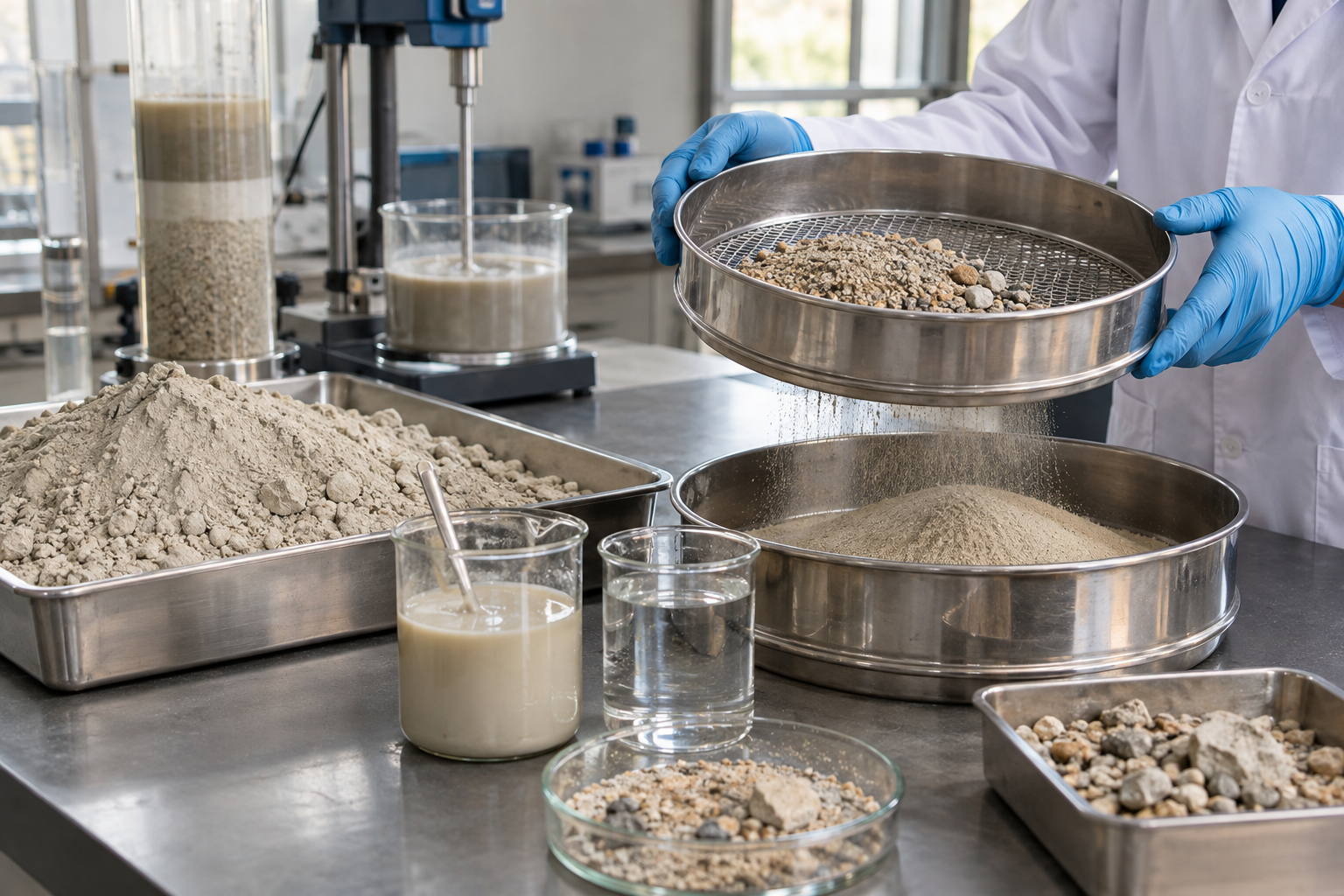
A slurry that is too thin may not provide sufficient suspension or containment. A slurry that is excessively viscous can create mixing and pumping problems and may have difficulty entering the intended pores or fractures.
The target should come from the application and grouting method, not from a generic idea that higher viscosity is always better.
Fluid loss becomes particularly important when the bentonite system is expected to limit water movement or create a low-permeability seal.
When hydrated bentonite particles move toward a permeable surface, they can form a filter cake. The cake's structure and permeability affect how readily liquid passes through it.
For this reason, filtration behavior can be an important part of qualifying a bentonite for sealing and slurry applications.
But low fluid loss shouldn't be treated as a universal measure of grout quality. The grout must still reach the intended zone, remain pumpable, maintain the required stability, and develop the required final properties.
For example, a formulation intended for very fine rock fractures may need enough fluidity to enter those fractures. A cutoff application may place greater emphasis on containment and low permeability. The test limits should reflect the engineering objective.
Site water is one of the easiest variables to overlook during bentonite selection.
Bentonite hydrates in water, so the chemistry of that water can directly affect slurry behavior. Clean laboratory water may produce a very different result from groundwater containing substantial dissolved salts, hardness, or other minerals.
The same issue can arise after cement and chemical admixtures are introduced into the formulation.
If groundwater is saline, brackish, highly mineralized, or otherwise unusual, use representative site water in trial mixes. That gives the project team a much better indication of how the bentonite will behave during construction.
Depending on the project, useful parameters can include:
Not every project needs an extensive water analysis. The level of testing should reflect the risk and the chemistry of the site.
What matters is avoiding a qualification process that bears little resemblance to actual field conditions.
Bentonite performance depends on more than mineral composition. Processing and particle-size distribution can influence how quickly and uniformly the powder disperses and hydrates.
Excessively coarse material may take longer to hydrate or leave undispersed particles, depending on the product and mixing process. A suitable particle-size distribution can make the batching process more predictable.
Batch consistency is equally important.
Imagine qualifying one shipment and finding that the next shipment produces noticeably different slurry properties at the same dosage. The construction team may then have to adjust water, mixing time, bentonite concentration, or additives. That creates unnecessary uncertainty.
When evaluating a supplier, ask for quality-control information rather than relying only on a general product description.
Useful technical information may include:
The required tests and acceptance limits should match the project specification.
Density is a simple measurement, but it can be useful for checking whether slurry batches are being produced consistently.
For freshly prepared bentonitic slurry, density can help indicate changes in mix proportions or solids concentration. This makes it useful during both laboratory trials and field quality control.
Density alone doesn't describe grout performance. Two slurries can have similar densities while differing in viscosity, filtration, or stability. That's why density should be considered alongside the other required tests.
On a large project, regular density checks can help identify changes in batching before those changes become more serious production problems.
Excess sand or coarse solids can affect the behavior of a bentonitic slurry, particularly where the slurry needs tightly controlled viscosity, suspension, pumping, or filtration characteristics.
Sand content testing can therefore be useful in construction-slurry quality control.
When evaluating a supplier, don't ask only whether the bentonite is "pure." Ask how the delivered material is processed, tested, and controlled from batch to batch.
The relevant question is whether the product consistently meets the requirements of your mix design.
This is the most important principle in bentonite selection.
The dry clay is only one component of the final grout.
If the formulation contains cement, water reducers, dispersants, retarders, accelerators, polymers, or other additives, the final behavior can differ substantially from hydrated bentonite on its own.
For that reason, laboratory qualification should reproduce the proposed field formulation as closely as practical.
The goal isn't to produce one impressive laboratory result. It is to establish a mix that can be produced consistently and that behaves predictably under realistic construction conditions.
Two bentonite products can eventually produce similar slurry properties but behave differently during the first stages of mixing.
That difference can matter on a construction site where batching and placement need to follow a tight production cycle.
If a product requires extended hydration, the operation may need additional tank capacity, longer residence time, or a dedicated hydration stage. A product that hydrates efficiently under the planned mixing conditions may simplify production.
However, fast hydration isn't automatically the most important characteristic. The appropriate hydration procedure depends on the product, water chemistry, concentration, mixing energy, temperature, and application.
Ask the supplier for a recommended procedure, then validate it using the equipment and water that will actually be used.
The purchase price is only one part of the cost.
A cheaper product may require a higher dosage, longer hydration time, more intensive mixing, or additional process adjustments. If it produces inconsistent slurry properties, the apparent saving can disappear during construction.
Compare the cost of achieving the required performance, not simply the cost per metric ton.
Swelling is useful, but it doesn't describe pumpability, filtration, rheology, compatibility, or final grout behavior.
Use a group of relevant performance criteria rather than making one property the deciding factor.
If the project uses groundwater containing significant dissolved minerals, a trial conducted only with clean freshwater may not represent field behavior.
Use representative site water during qualification when water chemistry could affect the result.
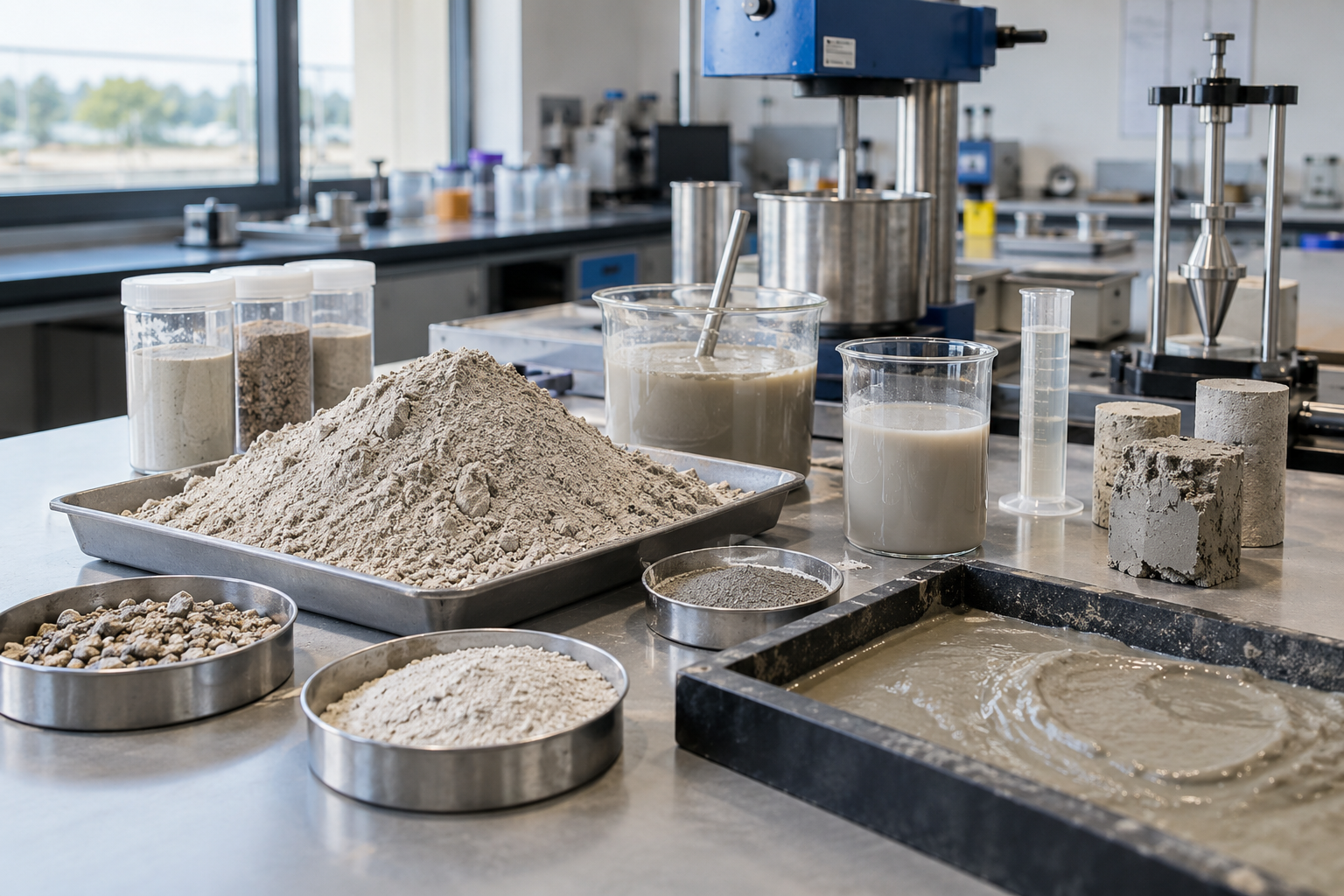
The Marsh Funnel test is useful for routine construction-slurry control, but it is an index measurement rather than a complete description of rheological behavior.
Use it for its intended purpose and add more detailed rheological testing when the engineering requirements call for it.
Cement and admixtures can change the behavior of the system significantly.
Always qualify the formulation that will actually be mixed and pumped.
A specification has limited value if delivered material varies substantially from one batch to another.
Request quality documentation, establish acceptance criteria, and retain samples where the project is sensitive to material variation.
A dosage that worked in one soil, groundwater, or grout system may not work elsewhere.
Bentonite grade, water chemistry, cement content, additives, equipment, target rheology, and ground conditions can all change the required dosage.
Use previous project data as a reference, not as a substitute for qualification testing.
A good procurement specification gives the supplier enough information to provide an appropriate material and gives the project team measurable criteria for acceptance.
Depending on the application, consider specifying:
Avoid specifications that say only "high-quality bentonite." That phrase doesn't give the supplier or contractor a measurable target.
Define the properties that actually matter to the project.
Before approving a product, work through the following questions:
| Question | Why it matters |
|---|---|
| Is it sodium bentonite or another clay type? | Mineral type influences hydration and swelling behavior. |
| What is the swelling performance? | Helps assess hydration and sealing potential. |
| What viscosity does it produce at the target dosage? | Indicates handling and suspension characteristics. |
| How quickly does it hydrate under the proposed mixing conditions? | Affects batching and production time. |
| How does it behave with site water? | Dissolved salts and minerals can change slurry performance. |
| What is the fluid-loss performance? | Important when filtration and sealing are part of the design. |
| What happens after cement is added? | The final grout, not the clay slurry alone, controls field behavior. |
| Is batch consistency documented? | Helps reduce variation during long construction operations. |
| Can the supplier provide technical support? | Useful when formulation or site conditions change. |
| Has the final mix been tested before full-scale use? | Reduces the risk of costly field adjustments. |
If multiple suppliers can meet the basic specification, compare their technical data and trial results before using price as the deciding factor.
There is no universal bentonite dosage for geotechnical grout.
The required amount depends on the bentonite grade, water quality, target solids content, cement content, additives, required viscosity, permeability requirements, pumping equipment, and ground conditions.
A recommendation such as "use X kilograms per cubic metre" without the rest of the formulation can therefore be misleading.
A better approach is to establish a target performance range and test several concentrations around the proposed mix. The project team can then compare density, viscosity, bleeding, filtration, stability, workability, and pumpability before selecting the working formulation.
The final dosage should be based on the project's engineering requirements and validated laboratory and field results.
Ground conditions can change what the grout needs to accomplish. The same bentonite concentration may behave differently in a coarse granular formation, fine soil, fractured rock, or mineralized groundwater.
Coarse soils can contain relatively large voids and pathways for grout movement. The formulation may need enough viscosity and suspension stability to limit uncontrolled loss while still entering the intended treatment zone.
The appropriate balance depends on the grouting method, pore size, pressure, and required penetration.
Fine soils present a different problem. Penetration can be limited by small pore spaces, so an unnecessarily viscous formulation may work against the treatment objective.
The grout should be designed around the actual pore structure and the selected grouting technique rather than simply increasing bentonite concentration.
Fracture width, connectivity, groundwater pressure, and grout loss all become important. A formulation that works well in relatively open fractures may not penetrate narrow fractures effectively.
Where fracture sealing is the objective, filtration and rheology need to be considered together with the required penetration behavior.
Water chemistry deserves particular attention in these conditions. Representative groundwater should be included in trial mixes so that changes in hydration, swelling, viscosity, or filtration can be identified before field placement.
Temperature can influence hydration, viscosity, setting, and admixture performance. Projects operating outside normal ambient conditions should evaluate the complete grout system at representative temperatures when those effects could affect performance.
Selecting the right bentonite is only part of the job. The material also has to be stored and handled correctly.
Keep powdered bentonite dry and protect it from moisture before use. Damaged packaging or prolonged exposure to humid conditions can cause lumps and make consistent dispersion more difficult.
Accurate weighing is equally important. Small proportioning errors can become significant when a large volume of grout is produced.
Mixing energy matters as well. A laboratory mixer doesn't necessarily disperse bentonite in the same way as the colloidal or high-shear equipment used on site.
That difference is another reason to validate the formulation with representative equipment and field procedures whenever practical.
A short technical discussion with the supplier can prevent avoidable problems later in the project.
Ask:
A technically useful supplier conversation should focus on measurable properties and the actual application rather than vague descriptions such as "premium quality."
Large geotechnical projects rarely consume bentonite from a single batch. Material may be delivered over weeks or months, and even small changes can affect a tightly controlled grout process.
If one shipment behaves differently from another, the construction team may need to adjust water content, bentonite dosage, mixing time, or admixtures to recover the required slurry properties.
That creates unnecessary operational uncertainty.
A reliable supply program should include clear product identification, consistent processing, appropriate quality control, suitable packaging, and batch documentation.
International projects add logistical considerations. Delivery schedules, port handling, moisture protection, packaging format, and customs documentation can all affect whether the required material reaches the site when it is needed.
Technical suitability and supply reliability should therefore be considered together.
Axewelledge supplies bentonite for industrial applications and supports international mineral supply from India. Its bentonite products are intended for applications where properties such as swelling, absorption, sealing, and slurry performance are relevant.
For a geotechnical project, the useful starting point isn't simply a request for a price. Share the application, target slurry properties, water conditions, expected dosage, mixing process, and relevant project specification. That information gives the supplier a basis for recommending and qualifying the material against the actual requirement.
For technically demanding projects, product samples and trial-mix data can be more useful than a generic product description. The final decision should be based on the performance requirements of the grout system.
The right bentonite for geotechnical grouting isn't necessarily the product with the highest swelling value, highest viscosity, or lowest purchase price.
It is the material that helps the complete grout system meet its engineering requirements consistently.
Start with the grouting objective and ground conditions. Then evaluate bentonite type, hydration, swelling, viscosity, filtration, density, particle characteristics, water compatibility, additives, and final grout behavior. Use representative water and realistic trial mixes whenever site conditions could change performance.
For large or technically sensitive projects, ask suppliers for samples, technical data, recommended mixing procedures, and batch documentation. A properly qualified product gives the construction team a much stronger basis for consistent field production.
A few hours spent testing the proposed bentonite and grout formulation can be far less costly than discovering during construction that the slurry doesn't behave as the design requires.













Have questions about our products? We're here to help!