Axewelledge, a leading exporter from India, specializes in high-quality Bentonite. With a commitment to excellence, we supply premium Bentonite to the Middle East and Southeast Asia markets.


North Angle Complex, 304,
150 Feet Ring Rd, Opposite Ambedkar Nagar BRTS Stop,
Madhav Park, Punit Nagar,
Mavdi, Rajkot, Gujarat 360004
© Axewelledge 2026, All Rights Reserved.
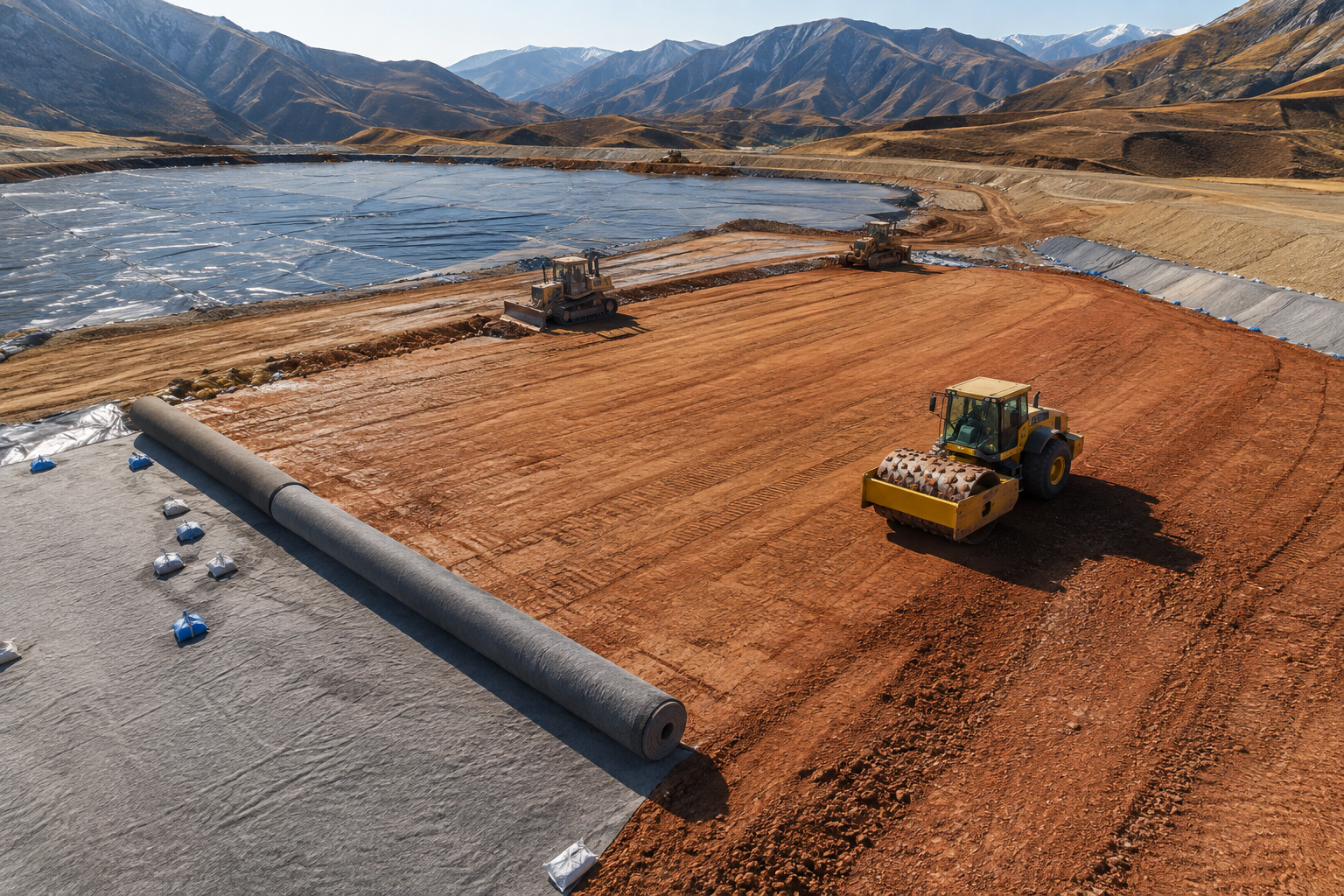
Uncontained tailings seepage can ruin groundwater, trigger regulatory fines, and compromise the structural stability of containment dams. Achieving zero-leakage performance requires a hydraulic barrier with a hydraulic conductivity rating of $1 \times 10^{-7}\text{ cm/s}$ or lower. High-swell sodium bentonite achieves this performance level by swelling 12 to 18 times its dry volume upon hydration. This expansion fills micro-voids, forms an impermeable gel matrix, and self-heals around minor structural shifts.
Properly sealing a mining tailings pond requires selecting the right grade of sodium bentonite, determining exact application rates, and executing precise soil amendment or Geosynthetic Clay Liner (GCL) installation procedures.
Tailings ponds store the liquid and fine mineral slurry left over after metal and mineral processing. These slurries contain processed water, leftover reagents like cyanide, xanthates, or sulfuric acid, and heavy metals including arsenic, cadmium, lead, and mercury.
When an impoundment lacks a low-permeability liner, fluids migrate downward into local aquifers or outward into nearby streams. This migration creates two major risks:
To prevent these issues, regulatory authorities like the U.S. Environmental Protection Agency (EPA) and environmental agencies globally mandate strict permeability limits. Standard regulations typically require a hydraulic barrier with a hydraulic conductivity ($k$) of $1 \times 10^{-7}\text{ cm/s}$ or lower.
Bentonite is an aluminum silicate clay derived from weathered volcanic ash. Its primary active mineral is montmorillonite, a crystalline structure built from three-layer sheets consisting of one alumina octahedral sheet sandwiched between two silica tetrahedral sheets.
At the microscopic level, each bentonite platelet carries a negative surface charge balanced by exchangeable sodium ions ($Na^+$) in the interlayer zone. As moisture enters the system, these sodium ions draw water molecules directly into the molecular structure via osmosis, pushing the microscopic clay plates apart and expanding the bulk mineral volume.
Not all bentonite clay performs the same. Choosing the correct mineral form is critical for mining containment applications:
High-swell sodium bentonite features natural self-healing properties. Tailings ponds experience settlement, ground shifting, and localized punctures during operation. Synthetic membranes like High-Density Polyethylene (HDPE) can tear or crack under strain, creating immediate leak pathways. When a tear occurs over a bentonite-backed layer, incoming water hydrates the nearby clay, causing it to swell and seal the gap.
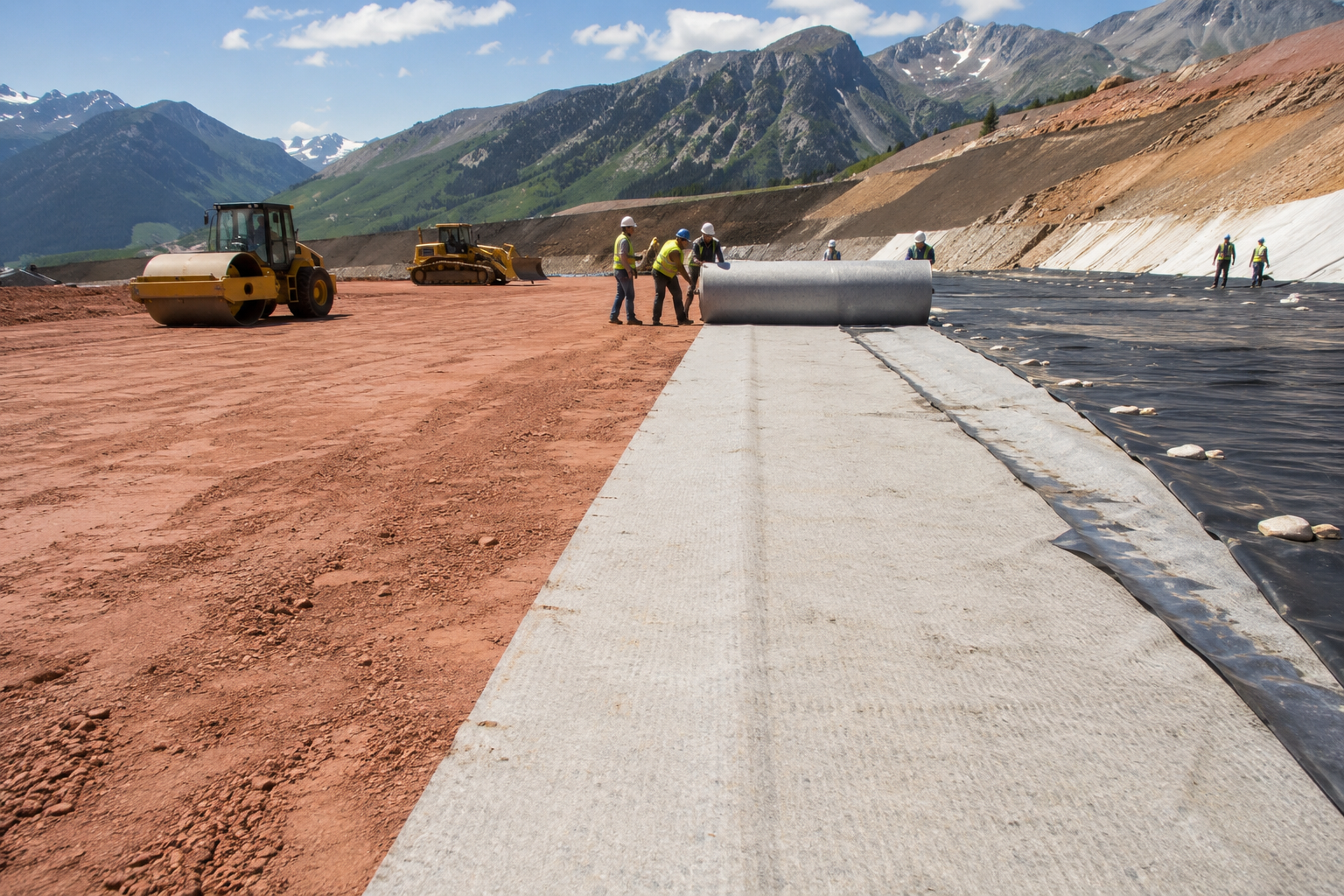
Engineers often choose between raw soil amendment, synthetic membranes, or composite systems. The table below compares these common tailings lining options:
| Liner Characteristic | High-Swell Sodium Bentonite (Amended Soil) | High-Density Polyethylene (HDPE) Membrane | Geosynthetic Clay Liner (GCL) | Composite System (HDPE + GCL) |
|---|---|---|---|---|
| Hydraulic Conductivity ($k$) | $1 \times 10^{-7}$ to $1 \times 10^{-9}\text{ cm/s}$ | Practically $0$ (until punctured) | $1 \times 10^{-9}\text{ cm/s}$ | $1 \times 10^{-11}\text{ cm/s}$ |
| Puncture Resistance | Extremely High (Self-healing natural soil matrix) | Moderate (Requires protective geotextile cushions) | High (Bentonite swells to seal punctures) | Maximum (Dual-layer protection) |
| Installation Complexity | Moderate (Requires standard earthmoving equipment) | High (Requires specialized field welding and QA/QC testing) | Moderate to Low (Unrolled in panels with overlapped seams) | High (Requires both geotextile unrolling and field welding) |
| Chemical Compatibility | High (Can be polymer-modified for aggressive waters) | High resistance to acids and bases | Moderate to High (Requires compatibility testing) | Exceptional overall resistance |
| Lifespan | Indefinite (Natural mineral; does not degrade over time) | 30 to 100+ years (Susceptible to UV damage before burial) | Indefinite (Bentonite component never ages) | Exceptional long-term durability |
| Relative Installed Cost | Low to Moderate | Moderate to High | Moderate | High |
Depending on slope geometry, available local soils, project budget, and chemical composition of the tailings, three primary application methods are used:
This method blends dry, granular high-swell sodium bentonite directly into the native subgrade soil using a soil stabilizer or rotary tiller, followed by moisture conditioning and compaction.
A continuous, uniform layer of pure granular or powdered sodium bentonite is applied directly across the subgrade and capped with a protective cover of native soil or crushed rock.
GCLs are factory-manufactured hydraulic barriers composed of a thin layer of high-swell sodium bentonite (typically 1 pound per square foot or $5\text{ kg/m}^2$) encased between two layers of woven and non-woven geotextile fabric, bonded together via needle-punching or stitch-bonding.
Executing a soil-amended bentonite liner installation requires careful site prep, uniform blending, correct moisture control, and precise compaction.
Clear the impoundment area of all vegetation, organic topsoil, large rocks (greater than 1 inch or 25 mm in diameter), and debris. Compact the raw subgrade to at least 90% Standard Proctor Density ($ASTM\ D698$). Smooth out sharp drop-offs and backfill soft spots with suitable structural fill.
Before applying bentonite, collect representative native soil samples across the site. Run baseline index tests including Grain Size Analysis ($ASTM\ D422$) and Atterberg Limits ($ASTM\ D4318$).
Perform a series of flexible-wall permeability tests ($ASTM\ D5084$) using varying bentonite dosages (e.g., 3%, 5%, 7%, and 9% by dry weight of soil) to establish a dosage curve that reliably yields $k \le 1 \times 10^{-7}\text{ cm/s}$.
Spread the dry, granular sodium bentonite uniformly across the prepared subgrade using a calibrated mechanical spreader, drop spreader, or bulk bag dispenser attached to a tractor or excavator. Avoid spreading bentonite during high winds (greater than 15 mph or 25 km/h) or heavy rainfall.
Incorporate the distributed bentonite into the top 6 to 8 inches ($15\text{ to }20\text{ cm}$) of soil using a dedicated rotary tiller, reclaimer, or disk harrow. Make multiple perpendicular passes to ensure the bentonite is evenly mixed into the soil matrix without leaving streaks or unmixed pockets.
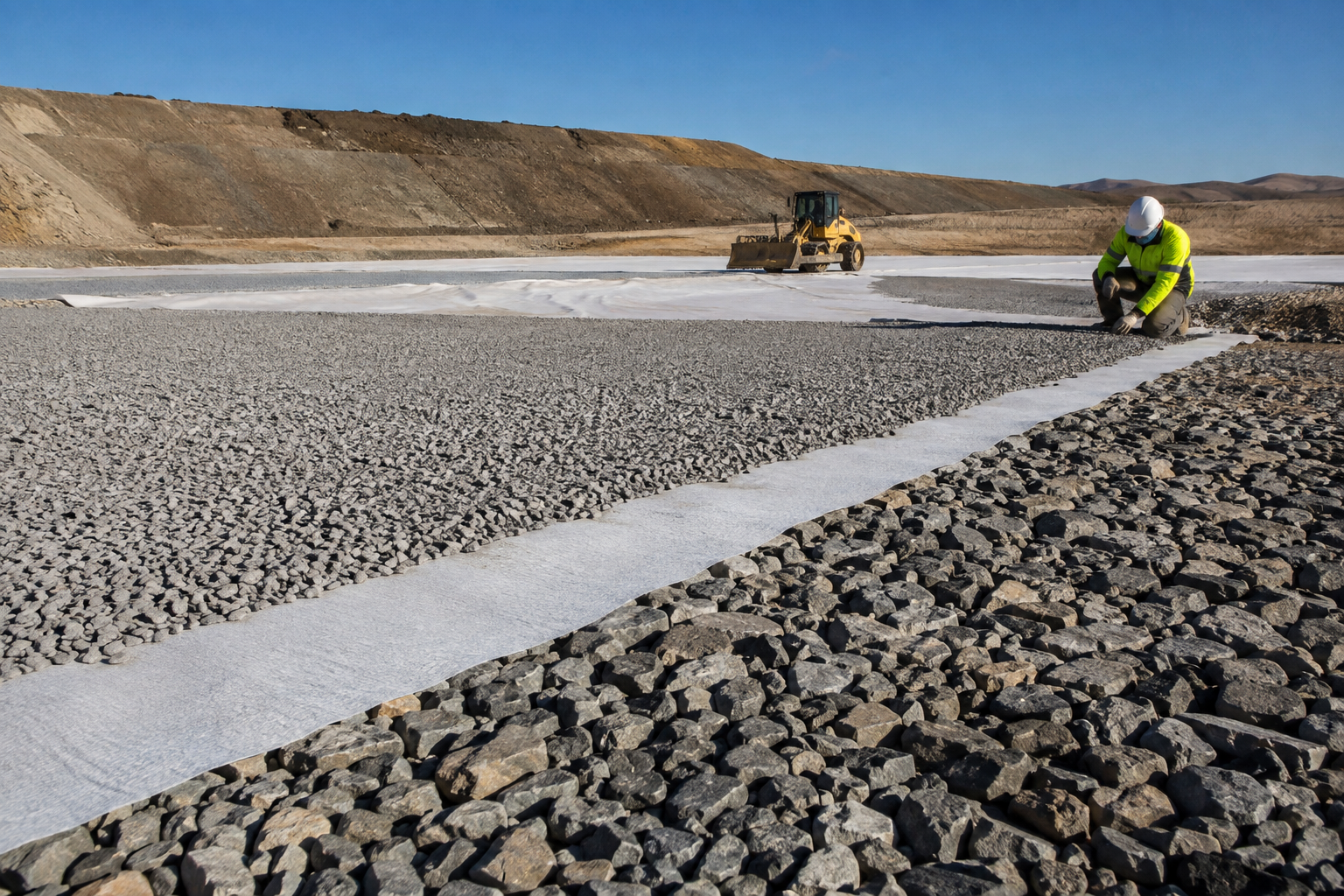
Add clean water using a distributor truck equipped with a spray bar until the soil-bentonite mixture reaches its Optimum Moisture Content (OMC) or slightly wetter ($+1\%\text{ to }+3\%$ above OMC), as determined by a Standard Proctor test. Water acts as a lubricant during compaction and initiates early hydration of the clay particles.
Compact the moist soil-bentonite mixture using a padfoot (sheepsfoot) roller for initial deep compaction, followed by a smooth-drum roller to seal the top surface. Achieve a minimum compaction density of 95% Standard Proctor Density ($ASTM\ D698$) or 90% Modified Proctor Density ($ASTM\ D1557$).
Immediately place a 12-inch ($30\text{ cm}$) protective cover layer of clean native soil, gravel, or waste rock over the compacted liner. This cover layer provides confining pressure (essential for bentonite gel structure) and prevents the liner from drying out, cracking, or taking erosion damage from wave action.
Rigorous Quality Assurance and Quality Control (QA/QC) programs prevent costly containment failures:
Field conditions rarely match laboratory conditions. Here is how to handle the three most frequent challenges in tailings sealing:
Standard sodium bentonite relies on low-ionic-strength fresh water to hydrate fully. If exposed to high concentrations of calcium ($Ca^{2+}$), magnesium ($Mg^{2+}$), or heavy metals before swelling, cation exchange occurs. Calcium replaces sodium in the clay lattice, collapsing the swelling capacity and raising hydraulic conductivity.
Exposed bentonite liners can lose moisture during hot periods, causing desiccation cracks, or undergo heave during winter freezing cycles.
Dry bentonite gets slick when hydrated. Installing raw soil-bentonite mixtures or un-reinforced GCLs on steep embankments (steeper than $3H:1V$) risks slope sliding during compaction or after filling.
While initial materials cost is a major decision factor, total cost of ownership should guide liner selection:
Sealing a mining tailings pond requires balancing mineral chemistry, site preparation, and field compaction. Using premium high-swell sodium bentonite with a verified swell index ($>24\text{ mL}/2\text{g}$) provides an impermeable, self-healing hydraulic barrier that protects regional ecosystems and maintains dam embankment stability for decades.
For major mining projects, securing a consistent supply of certified high-swell bentonite is essential. Axewelledge supports mining and environmental engineering teams globally with high-purity, laboratory-tested sodium bentonite tailored for demanding containment, wastewater, and drilling applications.













Have questions about our products? We're here to help!