Axewelledge, a leading exporter from India, specializes in high-quality Bentonite. With a commitment to excellence, we supply premium Bentonite to the Middle East and Southeast Asia markets.


North Angle Complex, 304,
150 Feet Ring Rd, Opposite Ambedkar Nagar BRTS Stop,
Madhav Park, Punit Nagar,
Mavdi, Rajkot, Gujarat 360004
© Axewelledge 2026, All Rights Reserved.
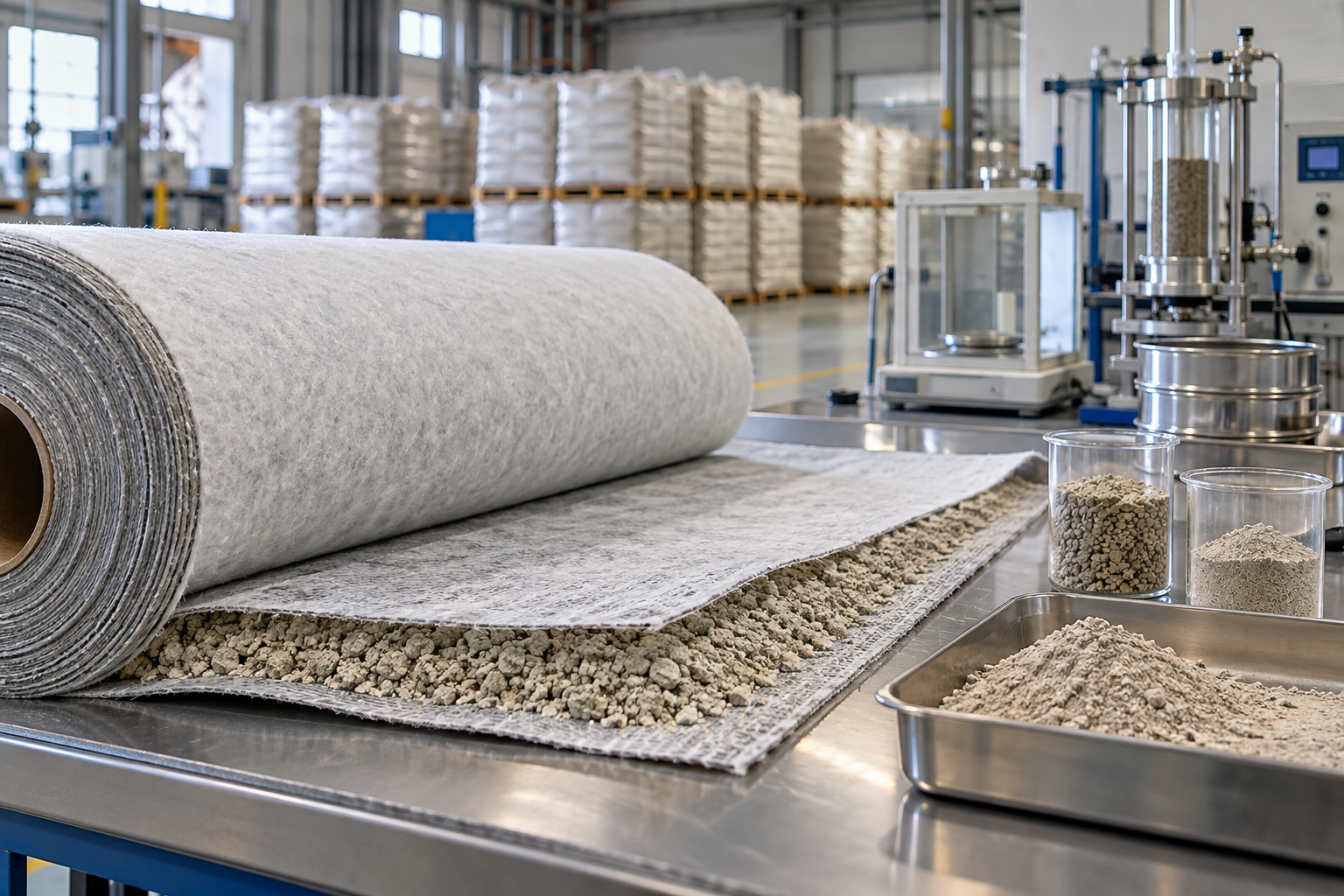
Choosing bentonite for a geosynthetic clay liner is not simply a matter of finding the material with the highest swelling value. The more useful question is whether the bentonite can help the finished GCL maintain the required hydraulic performance under the conditions it will actually encounter.
That distinction is important because a GCL is a composite barrier, not a layer of loose clay. Bentonite provides the low-permeability mineral component, while the geotextiles, manufacturing process, hydration conditions, confinement, loading and liquid chemistry all affect the behavior of the finished liner.
For many conventional GCL applications, sodium-dominant bentonite is the starting point because it can develop substantial swelling when properly hydrated. But the product name alone isn't enough to qualify a material. Swell index, fluid loss, particle size, moisture, mineralogy, chemical compatibility and finished-GCL performance all deserve attention.
If the GCL will contact landfill leachate, saline water, industrial wastewater or another chemically concentrated liquid, the selection process needs to go further. Site chemistry can change bentonite hydration and swelling behavior, so project-specific compatibility and hydraulic testing may be appropriate.
A geosynthetic clay liner, commonly called a GCL, is a factory-manufactured hydraulic barrier that contains a layer of low-permeability clay supported or enclosed by geosynthetic materials. The bentonite is the primary mineral component responsible for restricting liquid movement through the clay layer.
When suitable bentonite hydrates, water enters the clay structure and the smectite minerals expand. Under appropriate confinement, the hydrated clay can form a dense layer with very low permeability. That is the basic sealing mechanism behind many GCL designs.
The field result, however, depends on more than the clay's ability to swell in a laboratory test. The bentonite needs to hydrate under the conditions provided, remain sufficiently confined, tolerate the expected chemical environment and work properly within the manufactured GCL.
This is why a specification that simply says "high-swelling bentonite" is incomplete. A technically useful specification connects the clay properties to the performance required from the finished liner.
Sodium-dominant bentonite is widely used in GCLs because it generally develops stronger hydration and swelling behavior than calcium-dominant bentonite in suitable water. These characteristics are associated largely with the smectite content of the clay, particularly montmorillonite, and the type of exchangeable cations associated with the clay.
Natural bentonite deposits aren't identical. Some are naturally rich in sodium, while others contain more calcium or a mixture of exchangeable cations. Processing and beneficiation can also affect the consistency and performance of the commercial product.
Calcium-dominant bentonite generally has lower swelling in water than sodium-dominant bentonite. That doesn't mean a calcium-containing material can never be used in an engineered barrier. It means the material needs to be evaluated against the actual product design and performance requirements rather than selected from the mineral name alone.
For a conventional GCL where strong hydration, swelling and low hydraulic conductivity are important, sodium-dominant bentonite is commonly considered first. Even then, two products marketed as sodium bentonite can behave differently.
Differences in smectite content, mineralogy, exchangeable cations, processing, moisture and particle-size distribution can affect laboratory results and manufacturing consistency. Qualification should therefore be based on test data rather than the label on the bag.
A practical selection process should examine several properties rather than relying on one headline number:
ASTM D5890 covers the swell index of clay mineral components used in GCLs, ASTM D5891 addresses fluid loss, and ASTM D5887 addresses index flux through saturated GCL specimens. These methods provide useful standardized measurements, but they should be interpreted within the context of the project specification.
Let's look at the main selection factors in more detail.
Swell index is one of the most familiar bentonite specifications in GCL procurement. It provides a standardized way to assess how much a clay sample expands when exposed to water under defined laboratory conditions.
ASTM D5890 is specifically intended to measure the swelling properties of clay mineral components for their potential use in reducing permeability or hydraulic conductivity in GCLs.
A stronger swell result can indicate useful hydration and expansion characteristics. But it does not automatically mean that the material with the highest swell value will produce the best GCL under every field condition.
The reason is simple: the finished liner will not operate in the same conditions as a standardized laboratory test. In service, the GCL may encounter a particular liquid chemistry, normal stress, temperature, hydration history and installation environment.
Swell index should therefore be treated as an important screening and quality-control property, not as the entire purchasing decision.
When comparing bentonite suppliers, ask for:
Always compare results generated using the same test method. A number without its test method has limited value because apparently similar measurements may have been produced under different conditions.
Fluid loss is another important property when evaluating bentonite for GCL production.
ASTM D5891 evaluates the fluid-loss behavior of the clay mineral component under specified laboratory conditions. The measurement provides information related to the clay's ability to form a low-permeability filter cake.
Swell and fluid loss are related, but they don't measure the same thing. Swell index focuses on expansion under the specified test conditions, while fluid loss provides another indication of the sealing behavior of the hydrated clay system.
That difference matters during procurement. A supplier who provides only a strong swell result has not given you a complete picture of the bentonite's performance profile.
A better question is: what are the swell and fluid-loss results, how were they measured, and do they support the requirements for the finished GCL?
This approach also makes supplier comparisons more useful. Instead of choosing a material because one number looks impressive, you can examine several properties together and identify whether the product is consistent with the intended GCL design.
Site chemistry is one of the most important reasons not to select GCL bentonite from a generic product sheet alone.
Bentonite that performs well with relatively clean water can behave differently when exposed to liquids containing high concentrations of dissolved salts or multivalent cations. Calcium and magnesium, for example, can participate in ion exchange with sodium in bentonite and may alter the clay's swelling behavior.
For this reason, sodium bentonite should not be described as automatically suitable for every liquid. Its performance still depends on the chemical environment and the way the GCL hydrates and remains confined.
ASTM D6141 provides a screening approach for evaluating the chemical compatibility of the clay component of a GCL with liquids. Where compatibility is uncertain or the consequences of leakage are significant, additional hydraulic testing under representative conditions may be warranted.
Chemical compatibility deserves particular attention in applications such as:
If the GCL will contact an aggressive liquid, don't stop at the question, "Is this bentonite chemical resistant?" Identify the actual liquid and determine whether the clay and finished GCL retain the required performance under representative exposure conditions.
Start by characterizing the liquid that the GCL will encounter. Depending on the project, useful information can include pH, electrical conductivity, dissolved solids, major cations and anions, and other constituents that could influence clay hydration or ion exchange.
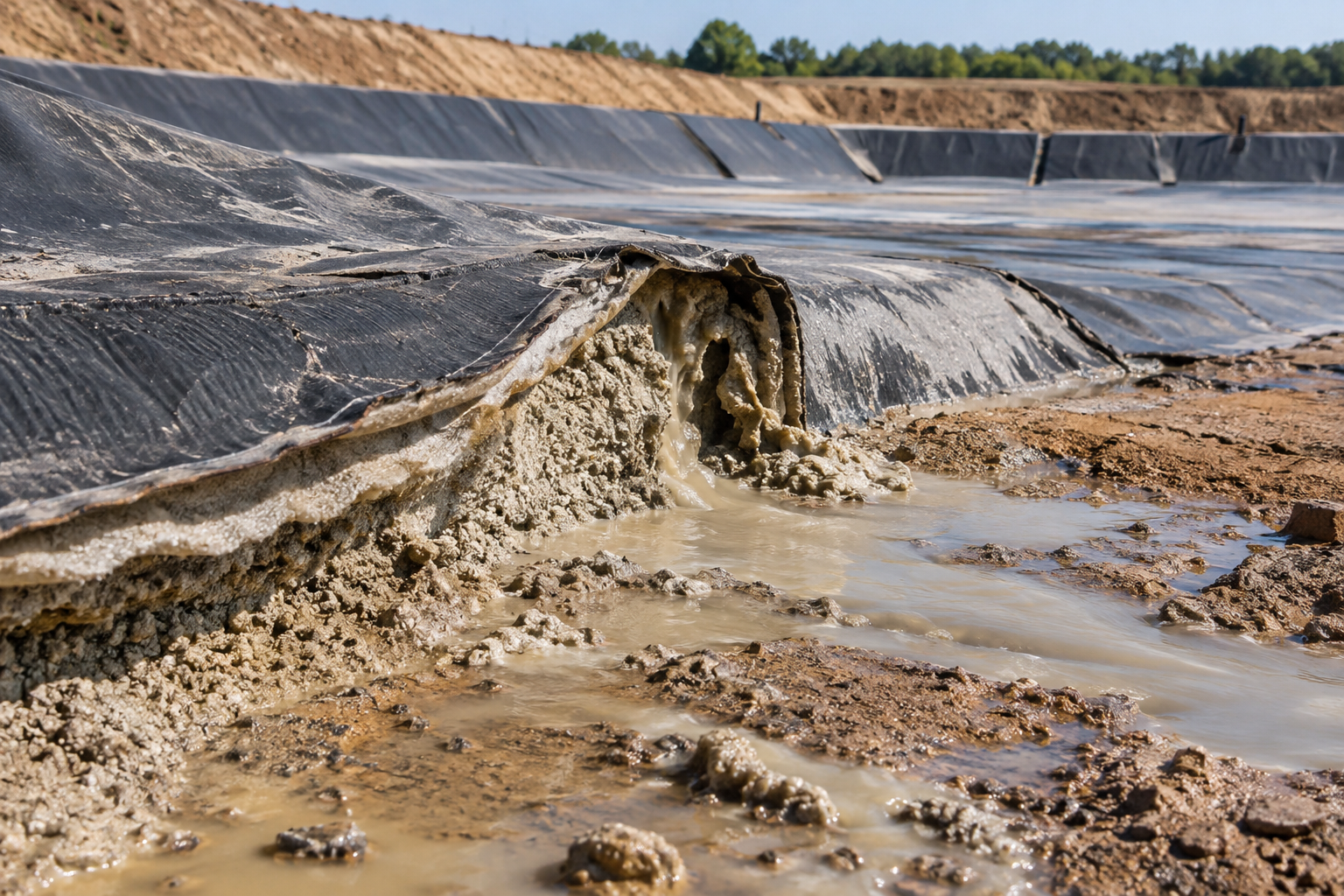
The exposure sequence also matters. Ask whether the GCL is expected to hydrate with relatively clean water before encountering the process liquid, or whether the dry GCL could initially contact the chemical liquid.
Those two situations can produce different hydraulic responses.
ASTM D6766 provides a method for evaluating hydraulic properties of GCL specimens exposed to potentially incompatible aqueous solutions. The testing approach can account for different hydration and exposure scenarios, which is useful when trying to reproduce conditions that are relevant to a particular containment system.
For a high-consequence project, this type of evaluation provides much stronger evidence than a general statement that a product is suitable for chemical service.
Bentonite supplied for GCL production needs a controlled physical form that fits the manufacturer's production process.
Commercial bentonite may be supplied as powder or granular material. Particle-size distribution affects handling, feeding, distribution and incorporation into the GCL. It can also influence how the material behaves during hydration.
The goal isn't necessarily to buy the finest possible powder. A GCL manufacturer needs a physical specification that works reliably with its equipment and process.
When qualifying a supplier, ask about:
ASTM D5890 and ASTM D5891 contain preparation requirements for testing granular bentonite, including preparation steps before the clay is evaluated by those procedures. This is another reason to record the test method when comparing supplier data.
Bentonite is moisture-sensitive, so storage and packaging can affect its condition before it reaches GCL production.
A material that has absorbed unwanted moisture during storage may handle differently from material supplied under controlled conditions. Moisture can also affect weighing, feeding and processing consistency.
For bulk procurement, check how the supplier protects the material during storage and transport. Ask whether bags are sealed, how pallets are protected from rain and ground moisture, and whether production lots are identified.
The finished GCL has its own storage requirements as well. Keeping rolls protected from weather and handling damage is important before installation. ASTM D5888 provides guidance related to the storage and handling of GCLs.
Good material selection can be undermined by poor storage, so the supply chain needs to be treated as part of quality control.
This is one of the most important principles in GCL qualification.
Raw bentonite properties don't completely define finished-GCL performance. The final liner combines bentonite with geotextiles and other components, and it is manufactured under controlled conditions that affect the distribution and confinement of the clay.
ASTM D5887 provides a method for measuring index flux through saturated GCL specimens using a flexible-wall permeameter. The test is useful for manufacturing quality control and conformance evaluation under prescribed conditions.
An index result should still be interpreted correctly. A laboratory index test does not reproduce every field condition, and it should not be treated as a direct guarantee of in-service flux.
The useful approach is to combine raw-material testing with finished-product testing, installation controls and project-specific evaluation where necessary.
If you're buying bentonite for GCL manufacturing or evaluating a material for a containment project, use a structured qualification process. Supplier brochures are a starting point, not a qualification program.
First identify what the GCL is being used to contain or protect.
The project could involve a landfill cell, wastewater pond, mining facility, secondary containment area, canal, remediation project or another hydraulic barrier.
The application helps determine which risks deserve the most attention. A landfill GCL, for example, may require a closer look at leachate chemistry than a liner intended for relatively clean water.
Determine what liquid the liner will encounter during its service life.
Possible exposures include groundwater, stormwater, freshwater, wastewater, leachate, saline water, brine or industrial process liquids.
Avoid describing a chemically complex liquid simply as "water." If dissolved salts or other constituents could influence bentonite behavior, document them.
Define the required performance of the finished GCL before selecting the raw bentonite.
The project specification may include hydraulic requirements, clay mass per unit area, mechanical properties, interface requirements and installation criteria.
The target should be written around the finished liner. Raw bentonite properties support that target; they don't replace it.
Ask every supplier for comparable documentation. Depending on the application, this may include:
Consistent documentation makes technical comparison much easier.
A supplier reporting a swell value without identifying the test method has not provided enough information for a meaningful technical comparison.
The same principle applies to fluid loss and other measured properties. Record the standard, sample preparation, test conditions and production lot whenever those details are available.
If the application involves wastewater, leachate, saline conditions, mining fluids or industrial liquids, determine whether compatibility screening or hydraulic testing is needed.
ASTM D6141 can support chemical-compatibility screening, while ASTM D6766 provides a method for evaluating hydraulic properties of GCL specimens exposed to potentially incompatible aqueous solutions.
The appropriate level of testing depends on the liquid, containment risk, project specification and available performance data.
Work with the GCL manufacturer to confirm that the selected bentonite can consistently produce a finished product that meets the project's hydraulic and mechanical requirements.
This step closes the gap between qualifying a clay powder and qualifying an engineered liner.
Once the bentonite has been qualified, make sure the material delivered for production remains consistent with the qualified sample.
Lot traceability, packaging integrity, moisture control, storage conditions and production records all help maintain that link.
The sodium-versus-calcium question comes up frequently because the two forms can have substantially different hydration and swelling behavior.
| Property | Sodium-dominant bentonite | Calcium-dominant bentonite |
|---|---|---|
| Water swelling | Generally higher | Generally lower |
| Typical GCL consideration | Common starting material | Requires application-specific evaluation |
| Hydration response | Strong swelling in suitable conditions | Lower swelling than sodium-dominant material in water |
| Effect of dissolved ions | Requires evaluation | Requires evaluation |
| GCL use | Widely used | Depends on product design and qualification |
| Selection approach | Compare against project requirements | Do not assume suitability from mineral name alone |
This table is a practical comparison, not a substitute for laboratory qualification. Actual performance depends on mineralogy, processing, chemistry, confinement and the finished GCL design.
Imagine two suppliers submitting material for the same GCL project. Supplier A reports a very high swell index. Supplier B reports a somewhat lower value but provides consistent fluid-loss results and finished-GCL hydraulic data under conditions relevant to the project.
The swell number alone doesn't provide enough information to select between them.
That is the central point. A GCL is a system, and the bentonite needs to perform within that system. The useful question is not which raw clay has the most impressive single laboratory result. It is which qualified material supports the finished GCL's required performance with an acceptable level of consistency.
The consequences depend on the material, design and exposure conditions, but several problems can occur.
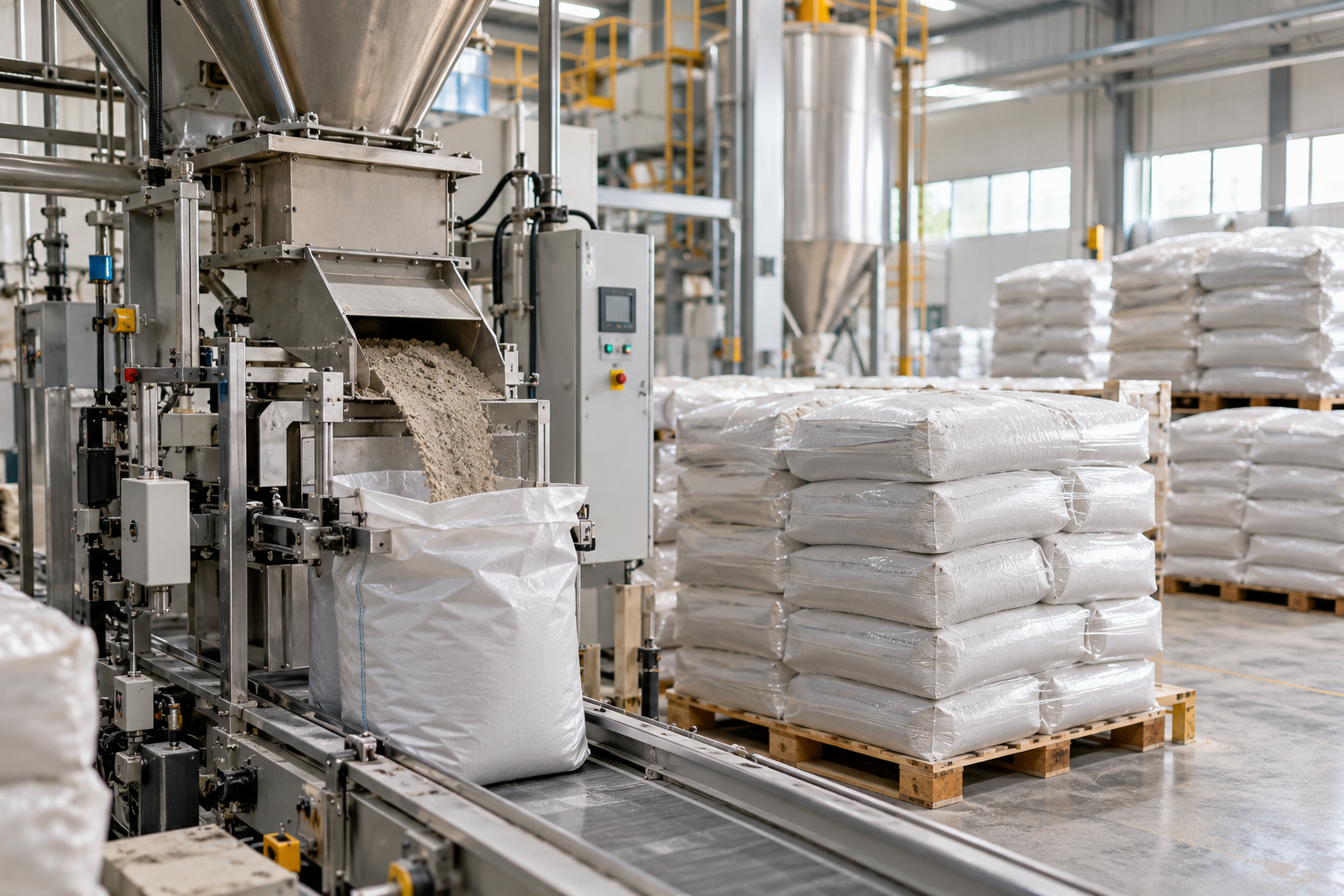
If the clay doesn't hydrate adequately under the conditions available at the site, the intended sealing structure may not develop as expected.
If chemical exposure reduces the bentonite's swelling behavior, the hydraulic performance of the GCL can change. Testing under representative chemical conditions can help identify this risk before installation.
Inconsistent particle size, moisture or mineral quality can make production less predictable. That can increase the difficulty of maintaining uniform clay distribution and finished-product properties.
Even a well-qualified bentonite can perform poorly if the GCL is damaged, hydrated incorrectly, contaminated, inadequately confined or installed outside the manufacturer's requirements.
A cheaper material isn't necessarily cheaper overall if it creates additional testing requirements, production variation, rejected batches or other quality-control problems.
Price per tonne is easy to compare, but it doesn't describe the total cost of qualification, processing and quality control.
A lower purchase price may lose its advantage if the material creates inconsistent finished-GCL properties or requires additional corrective work.
Swell is important, but it should be considered alongside fluid loss, chemistry, physical characteristics and finished-GCL performance.
Clean-water testing does not automatically represent landfill leachate, industrial wastewater, saline water or concentrated process liquids.
Sodium bentonite is a broad material category. Deposit characteristics, mineralogy and processing can produce meaningful differences between products.
The bentonite is one component of the liner. The manufactured composite needs to meet the project's performance requirements.
Ask which test method was used, when the sample was tested, which production lot it represents and how frequently the property is checked.
Bentonite can absorb moisture during storage. Poor packaging or exposure to weather can affect handling and processing characteristics. Finished GCL rolls also need appropriate storage and handling before installation.
A technically capable supplier should be able to provide practical information without relying entirely on marketing descriptions.
Ask:
A strong supplier relationship is about more than arranging shipment. You need enough information to make the material traceable, repeatable and suitable for the intended manufacturing process.
A useful specification should be clear enough that different suppliers can be evaluated using the same criteria.
At minimum, define the applicable test methods and acceptance criteria for the properties that matter to the project.
Depending on the application, the specification may include:
GCL quality-control practices can include both bentonite properties and finished-product characteristics such as clay mass per unit area, moisture content, tensile strength, peel strength and index flux. The exact acceptance criteria should come from the project specification and GCL design rather than from a generic supplier brochure.
This is the larger quality-control principle: qualify both the mineral component and the finished composite.
There is no single bentonite loading that is correct for every GCL.
The required clay mass per unit area depends on the GCL design, bentonite characteristics, manufacturing process and performance specification. Different products are engineered with different clay loadings and component configurations.
For that reason, don't select a GCL simply because it contains more bentonite per square metre. Evaluate the finished product against the required hydraulic and mechanical properties.
A higher clay loading can be appropriate for a particular design, but additional material does not automatically compensate for unsuitable bentonite chemistry, poor manufacturing consistency or inadequate compatibility with the service liquid.
Yes. In a landfill application, the GCL may encounter leachate rather than clean water, and leachate chemistry can vary with waste composition, age, moisture conditions and other site factors.
If the liquid environment changes bentonite swelling or the structure of the hydrated clay, the hydraulic performance of the GCL can also change. That is why chemical compatibility can be an important part of GCL selection for landfill containment.
ASTM D6141 provides a screening framework for chemical compatibility, while ASTM D6766 can be used to evaluate hydraulic properties under specified aqueous chemical exposure conditions.
The practical lesson is straightforward: qualify the bentonite for the liquid the liner will actually encounter, not an idealized liquid that may never reach the GCL.
Wastewater projects require the same chemistry-first approach.
The term "wastewater" covers a wide range of liquids. Municipal wastewater, food-processing effluent, textile wastewater, mining water and chemical-process wastewater can have very different compositions and ionic concentrations.
For a relatively benign application, standard GCL qualification may provide adequate information. For chemically aggressive wastewater, project-specific compatibility and hydraulic evaluation may be appropriate.
Instead of asking whether a bentonite is suitable for wastewater in general, identify the actual wastewater chemistry, expected exposure duration, hydration sequence, hydraulic loading and mechanical conditions.
Those details turn a generic material recommendation into an engineering qualification process.
Before placing a large order, create a side-by-side comparison using identical criteria for every supplier.
| Selection criterion | What to request | Why it matters |
|---|---|---|
| Bentonite type | Mineralogical and product description | Establishes basic clay characteristics |
| Swell index | Result and test method | Indicates swelling behavior under specified conditions |
| Fluid loss | Result and test method | Provides another indicator of sealing behavior |
| Particle size | Distribution and specification | Supports consistent manufacturing |
| Moisture | Lot or production result | Helps control handling and processing |
| Chemical compatibility | Screening or hydraulic data where relevant | Helps evaluate site-specific liquids |
| Finished GCL performance | Index flux and other required properties | Confirms composite performance |
| Quality control | Testing frequency and records | Indicates production consistency |
| Traceability | Lot identification | Connects supplied material with test data |
| Technical support | Samples and engineering documentation | Supports project-specific qualification |
This approach also makes procurement discussions more productive. Instead of asking a supplier to prove that its bentonite is "premium," ask for measurable evidence tied to the actual job.
For buyers sourcing bentonite internationally, consistency, documentation and traceability matter alongside the mineral itself.
Axewelledge supplies industrial bentonite for applications where swelling, absorption and sealing performance are important. For GCL projects, the useful starting point is the required specification, test method, manufacturing process and expected liquid chemistry rather than a generic product claim.
If you're evaluating bentonite for GCL manufacturing, request representative technical data and samples before committing to a larger shipment. Your laboratory or GCL manufacturing team can then assess the material against the relevant project requirements.
The qualification process should remain evidence-based. Supplier documentation can support the evaluation, but independent or project-specific testing may still be appropriate when the application presents significant chemical or hydraulic risk.
Before approving a bentonite source, make sure you can answer these questions:
If those questions have clear answers, you're evaluating bentonite as an engineered component rather than treating it as a commodity selected from a product brochure.
The right bentonite for a geosynthetic clay liner is the material that supports the required performance of the finished GCL under the conditions the liner will actually face.
For many conventional applications, high-quality sodium-dominant bentonite is the starting point. From there, selection should move beyond the product name. Compare swell index and fluid loss using consistent test methods. Check particle size, moisture and mineralogical information. Most importantly, evaluate chemical compatibility when the GCL will contact leachate, saline water, wastewater or industrial liquids.
Finished-GCL testing is equally important. Raw bentonite data can tell you a great deal about the clay, but it cannot completely reproduce the behavior of the manufactured composite. The final qualification should connect raw-material properties with finished-product hydraulic performance and the project's installation requirements.
For international buyers, supplier qualification is the final link in the process. Obtain representative samples, verify test documentation, confirm lot traceability and make sure the selected material can consistently meet the requirements of the GCL manufacturer and project specification.
If you're sourcing bentonite for GCL production or a containment project, Axewelledge can help you evaluate the material against the required application and specification rather than treating bentonite as a one-size-fits-all commodity.













Have questions about our products? We're here to help!