Axewelledge, a leading exporter from India, specializes in high-quality Bentonite. With a commitment to excellence, we supply premium Bentonite to the Middle East and Southeast Asia markets.


North Angle Complex, 304,
150 Feet Ring Rd, Opposite Ambedkar Nagar BRTS Stop,
Madhav Park, Punit Nagar,
Mavdi, Rajkot, Gujarat 360004
© Axewelledge 2026, All Rights Reserved.
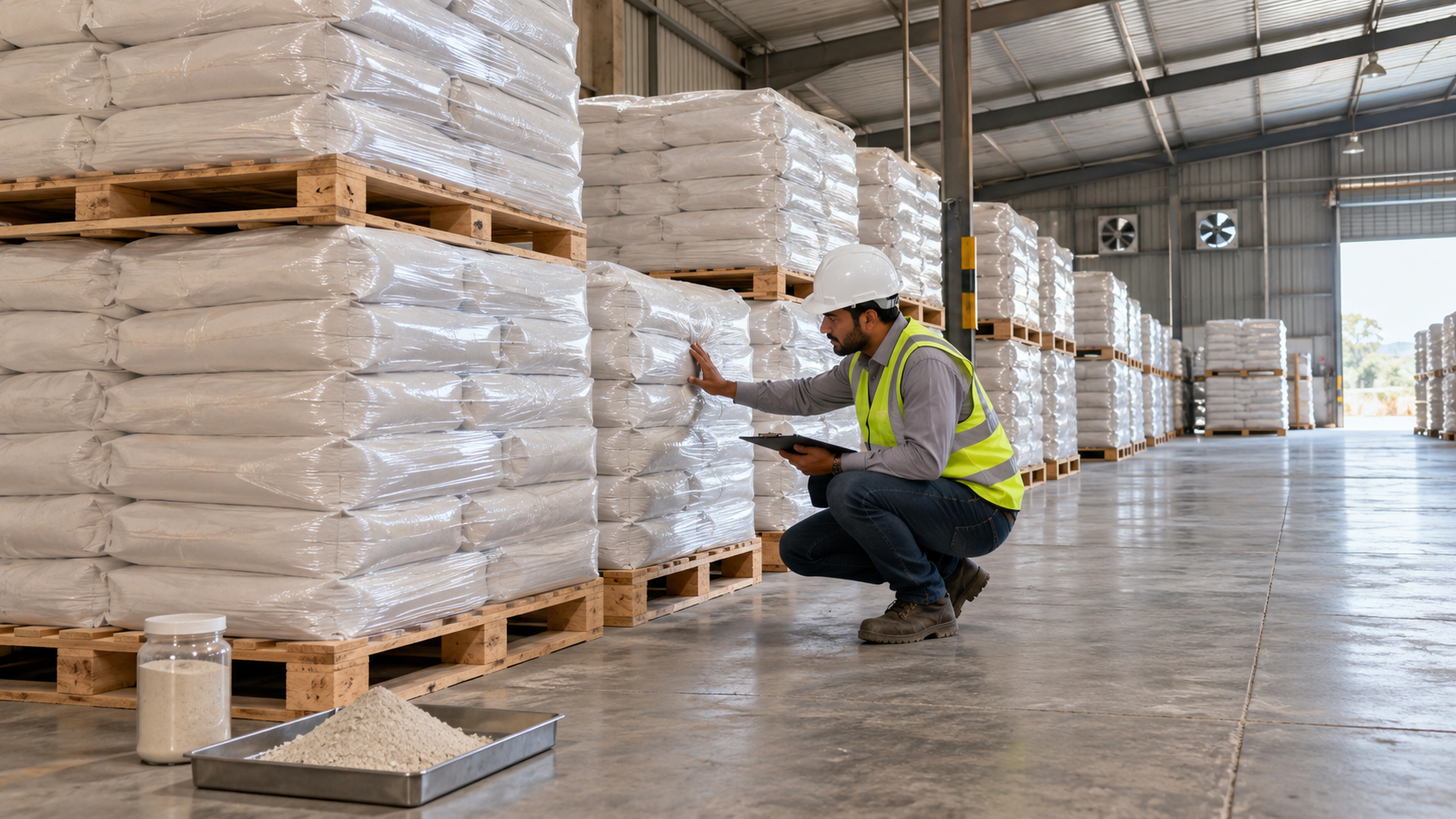
Bentonite usually doesn't become a problem simply because it has been sitting in a warehouse for a while. The bigger risk is poor storage.
For long-term industrial use, the rule is straightforward: keep bentonite dry, protect the original packaging, prevent contamination, and make sure older stock doesn't disappear behind newer deliveries. Moisture deserves particular attention because bentonite interacts strongly with water. Uncontrolled exposure can lead to caking, agglomeration, damaged bags, poor flow, and inconsistent processing behavior.
The good news is that most industrial users don't need a specialized storage facility. A sound warehouse, raised pallets, intact packaging, sensible stacking, regular inspections, and proper inventory rotation will go a long way toward protecting the material.
Bentonite is a naturally occurring clay made up largely of smectite minerals, commonly including montmorillonite. Its interaction with water is one of the properties that makes it useful across industries.
That same property needs to be managed during storage.
Dry bentonite is generally straightforward to handle. When moisture reaches the material, however, particles can hydrate and form agglomerates. Depending on the grade, packaging, humidity, duration of exposure, and intended application, the result can be harder lumps, poorer flowability, difficult feeding, or less consistent performance during processing.
Consider a drilling-fluid operation. A powdered sodium bentonite may be expected to disperse efficiently when deliberately mixed with water. If the powder has already picked up moisture in storage and formed hard agglomerates, it may not disperse as consistently as material that has remained dry and properly packaged.
Storage becomes even more important when large quantities are held for weeks or months. A warehouse that works well for short-term stock may expose long-term inventory to leaks, condensation, handling damage, or contamination that would otherwise go unnoticed.
The goal is not simply to keep bentonite inside a building. The goal is to preserve the physical condition and intended performance of the product until it reaches the process where it will be used.
The best environment for dry bentonite is clean, covered, dry, and protected from direct water exposure. Good ventilation and enough space for safe inspection and handling also matter.
In practical terms, focus on five risks:
Temperature is generally less important than moisture control for ordinary dry bentonite storage. A warehouse doesn't normally need refrigeration or unusually specialized temperature control. What matters more is keeping rain, leaks, flooding, condensation, and prolonged uncontrolled humidity away from the product.
A practical storage area should have a sound roof, a dry floor, adequate drainage, controlled loading areas, and enough room to move and inspect stock safely.
The warehouse is the first layer of protection, so inspect it before the shipment arrives.
Check for roof leaks, damaged walls, open loading bays, condensation, poor drainage, and places where water has collected in the past. A building can look perfectly dry on a sunny afternoon and still present a moisture risk during heavy rain or periods of high humidity.
This matters particularly in coastal, tropical, monsoon, and otherwise humid climates.
Before receiving a large shipment, check:
If the warehouse has flooded in the past, don't put valuable mineral inventory directly on the floor simply because the floor looks dry today. Storage decisions should account for what can happen during the entire holding period, not just the conditions at receiving.
One of the simplest improvements is to keep bentonite bags off the warehouse floor.
Use suitable pallets, racks, or another raised storage arrangement. The exact system will depend on the packaging, warehouse equipment, and operating practices, but the principle is the same: create a physical barrier between the product and possible floor moisture.
Why does this matter? A small amount of water from a leak, cleaning operation, or flood can become a serious problem when packaging remains in contact with it for hours or days. Long-term stock has more opportunity to encounter these conditions than material that is moved quickly into production.
Raised storage also makes housekeeping easier. Workers can see the floor beneath pallets, spot leaks earlier, clean around the stock, and move the material safely with appropriate handling equipment.
Don't position pallets where they can be splashed by wash water, rainwater, or routine cleaning operations.
Industrial bentonite is supplied in different forms of packaging depending on the grade, quantity, supplier, and application. Bags and bulk packaging are both common, and each system is designed to provide a certain level of protection during transport and storage.
Keep the original packaging intact until the product is needed.
There is usually no benefit to opening bags simply to inspect the powder. Inspect the outside first and look for signs that the packaging itself has been compromised.
Watch for:
If a bag is damaged, separate it from unaffected stock and assess the material before returning it to normal inventory. An outer surface that appears dry doesn't necessarily prove that the product inside has remained unaffected.
For long-term storage, packaging condition should be treated as part of product quality control, not just warehouse housekeeping.
Moisture is the storage issue that deserves the most attention from most industrial bentonite users.
Bentonite's interaction with water is fundamental to many of its applications. Sodium bentonite, for example, is valued for its swelling and water-interaction characteristics. That doesn't mean dry bentonite should be allowed to pick up uncontrolled moisture from its surroundings.
There is a clear difference between controlled hydration during an application and uncontrolled moisture exposure during storage.
In a drilling-fluid system, water is deliberately introduced under controlled conditions to achieve the required fluid properties. In a warehouse, moisture can instead cause premature agglomeration and make the material harder to handle.
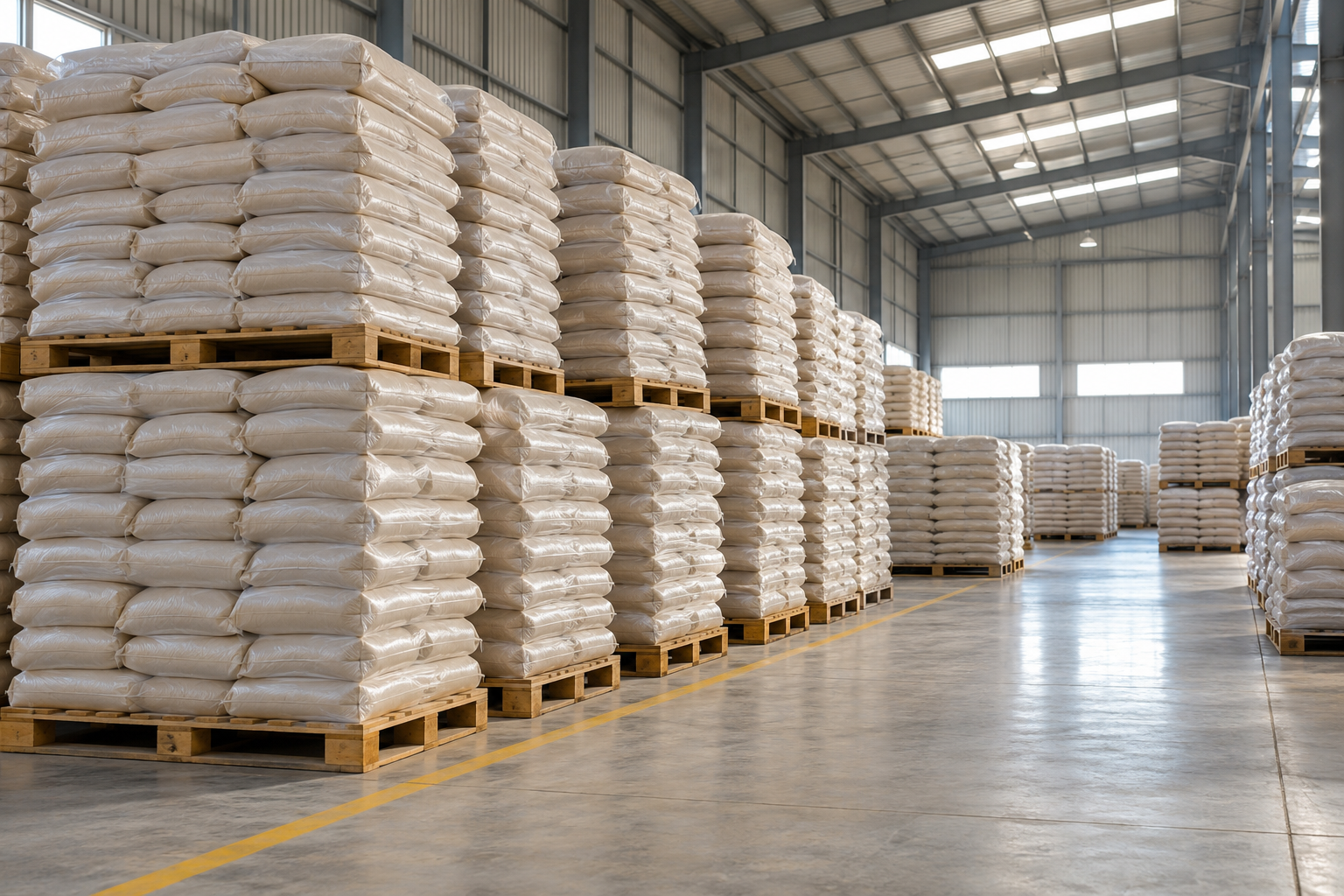
For that reason, keep bentonite away from sources of water and areas that continuously generate steam or moisture.
Avoid storage locations beside:
In a humid region, pay particular attention to condensation, packaging integrity, ventilation, and the frequency with which the warehouse is exposed to outside air.
A cool warehouse isn't automatically a dry warehouse.
Temperature affects environmental conditions and can contribute to condensation, but keeping the product protected from water remains the main objective.
Large changes between indoor and outdoor temperatures can sometimes create condensation on packaging, metal surfaces, roofs, or other nearby areas. Warehouse design and ventilation should therefore be considered together rather than focusing on one temperature figure.
For ordinary industrial storage, there is generally no reason to create an artificially cold environment simply because the product is bentonite. A dry building, intact packaging, and good moisture control are usually more useful.
Always follow the supplier's product-specific storage instructions when a particular grade has additional requirements.
Not all bentonite products are interchangeable.
Sodium bentonite, calcium bentonite, activated bentonite, and application-specific grades can have different physical and performance characteristics. Two powders may look almost identical while having different specifications and intended uses.
Mixing grades or lots creates a quality-control problem that may not be discovered until the material reaches production.
Give each product a clear identity. At minimum, your inventory records should include:
If you handle several grades, use clearly identified storage zones or strong physical and digital segregation.
This becomes especially important when one grade is intended for drilling fluids while another is intended for foundry work, construction, sealing, absorbent products, water treatment, or another application.
A short checklist can catch many problems before they become product losses.
| Storage factor | Recommended practice | Main risk if ignored |
|---|---|---|
| Moisture | Keep product dry and protected from water | Caking, hydration, handling problems |
| Flooring | Use pallets or raised storage | Water contact and packaging damage |
| Packaging | Keep bags sealed and inspect for damage | Moisture ingress and contamination |
| Warehouse | Use a covered, clean, dry building | Weather and environmental exposure |
| Stacking | Follow packaging and supplier limits | Bag deformation or pallet instability |
| Inventory | Record lot and receiving information | Traceability problems |
| Rotation | Use a sensible first-in, first-out system | Excessive storage time |
| Contamination | Separate unrelated materials | Product quality problems |
| Inspection | Check stock periodically | Late discovery of damage |
| Loading | Protect pallets during handling | Tears, punctures, and broken packaging |
There isn't one universal maximum stack height for every bentonite product. The safe arrangement depends on the bag construction, pallet design, packaging strength, warehouse equipment, and supplier recommendations.
Follow the packaging manufacturer's or supplier's recommended stacking configuration whenever one is provided.
Avoid building very tall stacks simply to increase warehouse capacity. Excessive height can increase the risk of pallet instability, crushed lower bags, damaged packaging, and unsafe manual handling.
Stable, well-supported pallet loads are preferable to improvised piles.
Keep enough aisle space for inspection and handling equipment. A warehouse that uses every available square meter but leaves no practical way to inspect the stock can create more problems than it solves.
For long-term industrial storage, indoor storage is strongly preferred.
Outdoor storage exposes packaging to rain, dew, wind-driven moisture, dust, temperature changes, direct sunlight, and accidental water contact. Covering bags with a temporary sheet can provide some protection, but it isn't equivalent to a properly designed warehouse.
If outdoor storage is unavoidable for a short period, keep the material elevated and use packaging and weather protection suitable for the product. Inspect the stock regularly for damaged bags and moisture exposure.
Don't treat a temporary cover as a substitute for proper long-term storage.
For valuable industrial inventory, a dry, enclosed warehouse gives you much more control over the conditions surrounding the material.
The result depends on how much moisture reached the product, how long it was exposed, the bentonite grade, the packaging, and the intended application.
A brief exposure doesn't automatically mean that an entire shipment is unusable. At the same time, visible wetting, hardened lumps, damaged bags, or prolonged exposure should trigger an inspection rather than an assumption that everything is fine.
Possible problems include:
For critical applications, evaluate affected material against the relevant product specification before releasing it for production.
The appropriate checks depend on the application. They may include properties such as swelling behavior, viscosity, filtration performance, particle size, moisture content, or other grade-specific requirements.
Start with the packaging and physical condition before moving to laboratory testing.
Inspect the pallet and bags for water damage, tears, unusual discoloration, hardened areas, contamination, or other signs of prolonged exposure. Check the lot identity as well so that questionable material doesn't get mixed with an unaffected batch.
If an unaffected reference lot is available, comparing the two can help identify obvious physical changes. For performance-sensitive applications, quality control may then test selected properties according to the applicable product specification and industry requirements.
The exact tests should reflect the way the bentonite will be used. A drilling-fluid grade may require a different evaluation from material intended for foundry operations, sealing, construction, or another process.
Appearance is useful for identifying obvious problems, but it shouldn't be the only quality criterion when performance depends on measurable properties.
There isn't one storage period that guarantees the same result for every bentonite grade, packaging type, and warehouse environment.
Usable storage life depends on the product, packaging, warehouse conditions, environmental exposure, contamination risk, and intended application. Properly packaged material kept in a dry, protected warehouse can remain usable for a substantial period, while poorly stored material can develop problems much sooner.
For that reason, don't rely only on a calendar date. Combine the supplier's storage guidance with receiving records, storage-condition checks, periodic inspection, and appropriate quality testing.
If older material will be used in a critical application and its condition is uncertain, evaluate it against the relevant specification before releasing it to production.
A simple rotation system prevents older stock from being forgotten behind newer deliveries.
FIFO, or first in, first out, is a practical approach when it is compatible with the product's requirements.
For example, if shipments arrive in January, March, and June, the January lot would normally be considered first, provided it meets the required specification and there isn't an application-specific reason to use another lot.
FIFO doesn't replace quality control. It simply reduces unnecessary storage time and makes inventory easier to manage.
For larger warehouses, record the lot number, receiving date, and storage location in the inventory system. A visible receiving date on each pallet can also make physical rotation easier for warehouse staff.
A floor can look completely dry while still becoming a source of moisture during leaks, cleaning, flooding, or condensation. Raised storage adds another layer of protection and makes inspection easier.
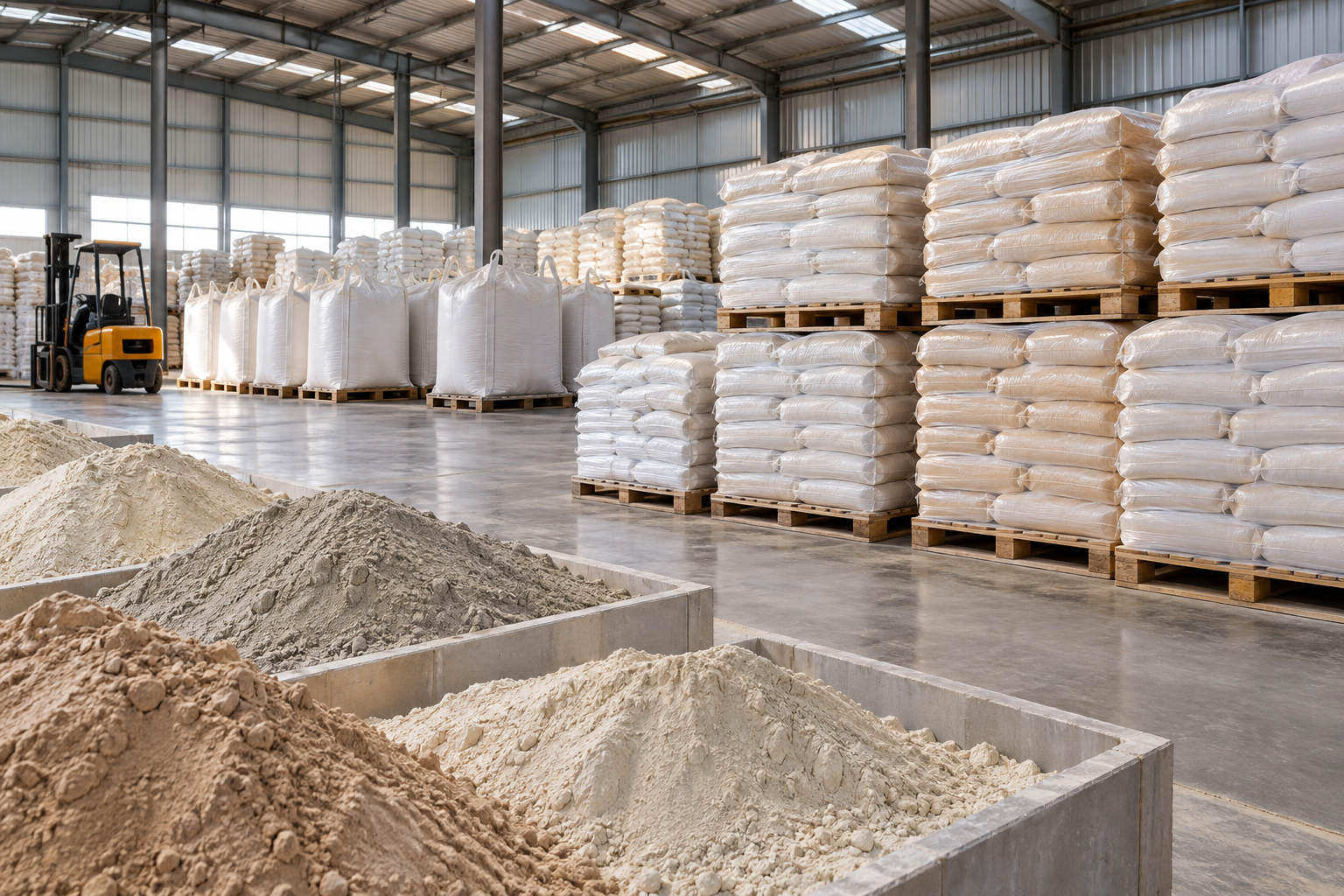
A torn bag shouldn't simply be moved to the back of the warehouse. Isolate it, inspect the product, record the issue, and decide whether the material needs testing or other corrective action.
Opening the original packaging exposes the powder to the surrounding environment unnecessarily. Keep bags sealed until the material is required for use.
Similar-looking powders aren't necessarily equivalent. Keep different grades and lots clearly identified and separated.
A location beside a tank, wash-down area, wet process, or leaking pipe may seem convenient, but repeated moisture exposure can turn that convenience into a product-quality problem.
A small roof leak above a pallet isn't just a maintenance issue. It is a direct risk to the material below it.
Warehouse capacity matters, but unstable or overloaded stacks create safety and quality risks. Follow supplier and packaging recommendations instead of choosing a height solely to save space.
Material can look acceptable and still require testing when its performance is critical to the process. Use the relevant product specification and quality-control procedure.
The basic storage principles remain similar across industries, but the reason for protecting the material can differ from one application to another.
Drilling-fluid bentonite is used for properties such as viscosity, suspension, filtration control, and other fluid-performance requirements, depending on the grade and formulation.
Storage should therefore protect the dry, free-flowing condition of the material and help preserve the properties specified for the grade.
Bentonite used for sealing applications may depend heavily on swelling and water-interaction characteristics. Keeping the product dry before installation helps prevent uncontrolled prehydration and handling problems.
Foundry operations often depend on consistent material behavior within a controlled molding process. Excess moisture, contamination, or an incorrect grade can interfere with process control.
When bentonite is used in treatment processes, predictable handling and consistent product quality can be important. Store it away from unrelated powders, chemicals, waste materials, and other potential sources of contamination.
Agricultural and specialty applications can have their own specifications and handling requirements. Store products by grade and intended application rather than assuming that all bentonite can be substituted interchangeably.
Storage requirements change when the product moves from bags into bulk handling systems.
| Factor | Bagged bentonite | Bulk bentonite |
|---|---|---|
| Moisture protection | Depends mainly on packaging and warehouse conditions | Depends heavily on silo, hopper, and bulk-system integrity |
| Inspection | Bags can be visually inspected | Equipment and material flow require inspection |
| Handling | Pallets and forklifts are commonly used | Conveyors, blowers, or other bulk equipment may be used |
| Contamination control | Packaging provides a physical barrier | Transfer equipment and access points must be controlled |
| Inventory identification | Lot and pallet labels are practical | Strong batch and silo records are important |
| Main physical risk | Torn or wet packaging | Moisture ingress, bridging, or handling-system problems |
With bulk storage, the equipment becomes part of the storage environment. Silo roofs, access points, seals, filters, conveying equipment, and discharge systems should be inspected and maintained according to the equipment manufacturer's procedures.
A bulk system also needs clear batch traceability. If material from different lots enters the same storage vessel, make sure the resulting inventory status remains clear to the people responsible for quality control and production.
Long-term storage often starts before the product reaches the warehouse.
For international buyers, a shipment may pass through processing, bagging, palletizing, container loading, ocean transport, port handling, customs clearance, inland transportation, and final warehouse storage. Each stage creates another opportunity for packaging damage or moisture exposure.
Before accepting a shipment, inspect the external condition of pallets and packaging. Look for torn bags, crushed packaging, visible water damage, or other signs that the shipment may have been compromised. Document any issues and follow your receiving and quality-control procedures.
Container condition matters as well. A container that has experienced water ingress can expose packaged material to moisture even when the product was properly prepared at the supplier's facility.
For recurring imports, use a standard receiving checklist. That way, warehouse personnel follow the same basic process for every shipment instead of making a fresh judgment each time.
If you need a practical procedure for warehouse staff, the following sequence covers the main controls:
The procedure is simple enough for everyday warehouse work, but it addresses most of the avoidable problems associated with long-term bentonite storage.
If your company stores bentonite regularly, put the process into a short standard operating procedure. A written SOP reduces the chance that important storage controls will depend on one experienced employee's memory.
A useful SOP should define:
The document doesn't need to be complicated. A short procedure that warehouse staff can follow consistently is more useful than a detailed manual that nobody uses.
Bentonite interacts strongly with water, but the practical effect of atmospheric moisture depends on the specific grade, particle characteristics, packaging, relative humidity, and exposure time.
That is why sealed packaging and a dry storage environment matter.
A humid day doesn't automatically mean that stored bentonite has been damaged. The more important concern is prolonged, uncontrolled exposure or conditions that allow moisture to enter the packaging.
Operations in humid climates should pay particular attention to condensation, damaged bags, warehouse ventilation, loading-area exposure, and any recurring sources of moisture.
There is no single visual defect that automatically means every bentonite product must be discarded. The decision should be based on the product specification, the extent of exposure, and the requirements of the intended application.
Material should be considered for quarantine when there has been significant water exposure, visibly compromised packaging, suspected contamination, unexplained physical changes, or uncertainty about product identity.
Quarantine keeps questionable material out of production while the quality team determines whether it meets the required specification.
For performance-sensitive industrial applications, that small control can prevent a much larger production problem.
Good storage protects the product, but it can't compensate for a material that wasn't suitable for the application in the first place.
When evaluating a supplier, ask for the product specification, packaging details, recommended storage conditions, applicable quality documentation, and lot-identification method.
A supplier should also be able to explain how the product is processed, packaged, and handled before shipment. For industrial buyers, consistency is often as important as the purchase price.
If your process depends on predictable swelling, viscosity, absorption, binding, filtration behavior, or another measurable property, buy against a clear specification rather than relying only on a generic product name.
Axewelledge supplies bentonite for industrial applications and focuses on processing, product quality, and international supply. For buyers evaluating a bentonite source, discussing the intended application and required grade before ordering can help ensure that the selected material and packaging fit the storage and production requirements.
Long-term bentonite storage doesn't require an elaborate facility. It requires consistent warehouse discipline.
Keep the material dry and covered. Store it above the floor, protect the original packaging, separate grades and lots, stack pallets safely, and rotate inventory. Inspect stock periodically, and test questionable material before it enters a process where performance matters.
The costly storage mistake is often the one nobody notices until production begins. A few minutes spent checking a warehouse, pallet, or bag can be far cheaper than discovering months later that inventory has been affected by moisture, contamination, or damaged packaging.
If you're sourcing bentonite for drilling, sealing, construction, foundry work, water treatment, agriculture, or another industrial application, start with the performance specification you need. Then select the appropriate grade, packaging, storage conditions, and quality checks around that requirement.













Have questions about our products? We're here to help!