Axewelledge, a leading exporter from India, specializes in high-quality Bentonite. With a commitment to excellence, we supply premium Bentonite to the Middle East and Southeast Asia markets.


North Angle Complex, 304,
150 Feet Ring Rd, Opposite Ambedkar Nagar BRTS Stop,
Madhav Park, Punit Nagar,
Mavdi, Rajkot, Gujarat 360004
© Axewelledge 2026, All Rights Reserved.
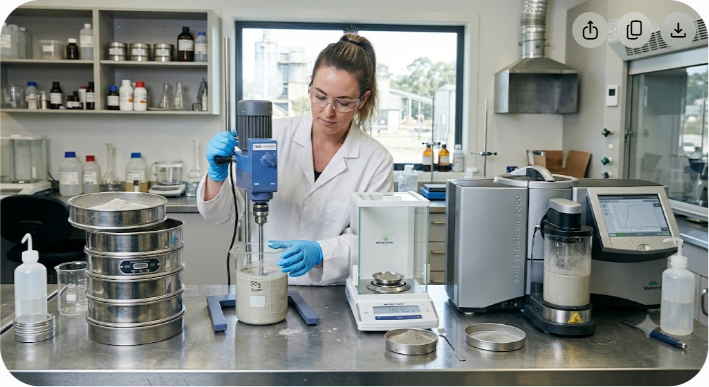
The right way to test bentonite particle size depends on what you need to measure. For coarse or granular bentonite, dry sieve analysis is usually the practical choice. For fine bentonite where the key quality measure is material retained above a specified sieve, wet sieve residue testing is more appropriate. If you need a complete particle size distribution, including fine fractions, laser diffraction can provide a much more detailed result.
That distinction matters because bentonite behaves differently from many conventional mineral powders. Montmorillonite, the main swelling clay mineral in many bentonites, can absorb water, swell, disperse, and form aggregates. A dry powder measurement can therefore describe the size of agglomerated particles, while a wet measurement may describe a substantially different physical state. The test method, sample preparation, dispersion conditions, sieve aperture, and reporting basis all affect the result.
For industrial quality control, particle size should never be treated as an isolated number. It is one part of a broader specification that may also include moisture, swelling behavior, viscosity, filtration or fluid-loss performance, residue, mineral composition, and other application-specific properties.
This guide explains how to test bentonite particle size, how to choose between dry sieving, wet sieving, and laser diffraction, how to calculate and interpret the results, and where testing procedures commonly go wrong.
Particle size affects how quickly bentonite mixes, hydrates, disperses, and interacts with water or another process medium. It can also influence handling characteristics such as dust formation, flowability, screen performance, and the consistency of a finished formulation.
A finer powder generally presents more surface area to the surrounding liquid, which can promote faster hydration and dispersion when the particles are properly dispersed. Coarser particles or granules take longer to hydrate and may be deliberately specified when controlled swelling or low-dust handling is more important than rapid dispersion.
Particle size alone, however, does not determine bentonite performance. Two samples with similar sieve results can behave differently because of differences in montmorillonite content, exchangeable cations, moisture, mineral impurities, processing history, and dispersion chemistry. Sodium bentonite and calcium bentonite are a good example: their hydration and swelling behavior can differ substantially even when their particle-size distributions look similar.
For that reason, particle size testing is best used as a process-control and specification tool rather than as a standalone prediction of performance.
A well-designed particle size test can help answer questions such as:
The answer determines which analytical method makes sense.
Before selecting a test, identify the physical form of the material. A sieve test designed for a granular product is not automatically suitable for a fine bentonite powder, and a laser diffraction result should not be treated as interchangeable with a sieve-residue specification.
Granular bentonite is produced by crushing, drying, screening, or otherwise sizing bentonite into relatively coarse particles. Depending on the product, grades may range from a few millimeters down to several hundred micrometers.
Common uses include sealing materials, geotechnical products, drilling additives, agricultural products, absorbents, and geosynthetic clay liner applications. In these products, the physical granule is often the relevant unit for quality control. Dry sieve analysis can therefore be highly useful because it shows how much material falls into each size fraction.
Moisture is important during testing. Damp granules can stick to one another or to the sieve cloth, while excessive drying can change the physical condition of a product intended for use at a different moisture level. The laboratory should follow the product specification or applicable test method rather than selecting a moisture condition arbitrarily.
Fine bentonite is commonly processed for drilling fluids, foundry binders, pelletizing, construction slurries, and other applications that require rapid dispersion or a controlled fine fraction.
Fine clay powders can be difficult to characterize by conventional dry sieving. Static electricity, residual moisture, cohesive forces, and agglomeration can prevent particles from passing through a fine mesh even when the primary particles are smaller than the aperture.
Wet sieve residue testing can address a different question: how much material remains above a specified screen after controlled dispersion and washing? Laser diffraction can go further by estimating a full particle size distribution under defined dispersion conditions.
The two results should not be assumed to measure the same physical quantity.
Most industrial bentonite particle-size programs rely on one or more of three approaches: dry sieve analysis, wet sieve analysis, and laser diffraction.
Dry sieve analysis separates a dry sample through a stack of test sieves with progressively smaller apertures. The material retained on each sieve is weighed and reported as a percentage of the total sample mass.
It is particularly useful for granular bentonite and for relatively coarse fractions where particles can move through the sieve openings without excessive agglomeration.
Best suited for:
Main limitations:
For very fine bentonite, an air-jet sieve or another validated dispersion technique may be more appropriate than conventional mechanical sieving.
Wet sieve analysis disperses the sample in a liquid and washes it through a selected test sieve. After washing, the material retained on the sieve is recovered, dried, and weighed.
This method is particularly useful when the specification concerns coarse residue in a fine clay product. In drilling-fluid applications, for example, a wet sieve residue test can identify coarse material that remains after the bentonite has been dispersed under the conditions specified by the applicable standard.
Best suited for:
Main limitations:
Wet sieve analysis is therefore not simply a more accurate version of dry sieving. It answers a different analytical question.
Laser diffraction determines particle size from the angular distribution of light scattered by a dispersed sample. Software converts the scattering pattern into a particle size distribution using an optical model and the instrument's configured refractive-index assumptions.
The technique can provide values such as D10, D50, and D90 and can cover a broad size range, depending on the instrument, optical configuration, and dispersion system.
Best suited for:
Main limitations:
For bentonite, the most important question is often not whether laser diffraction can measure the sample, but whether the sample preparation represents the state of the material that the specification is intended to control.
| Testing method | Typical use | Main result | Main advantage | Main limitation |
|---|---|---|---|---|
| Dry sieving | Granular and coarse bentonite | Mass retained or passing by sieve | Simple, inexpensive, easy to audit | Can be unreliable for cohesive fine powders |
| Wet sieving | Fine bentonite residue testing | Mass retained above a selected aperture | Separates coarse residue after controlled dispersion | Usually does not provide a complete PSD |
| Laser diffraction | Fine-powder and R&D characterization | D10, D50, D90 and PSD curve | Detailed distribution over a broad range | Sensitive to dispersion and optical-model assumptions |
For a granular bentonite product, dry sieve analysis is often the most straightforward method. The exact procedure should follow the applicable product specification or validated laboratory method.
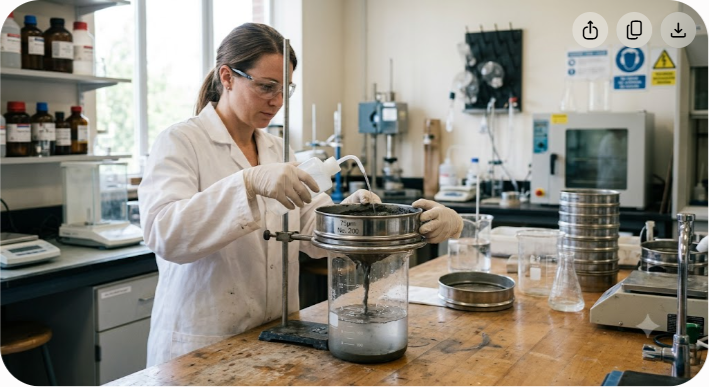
Sampling is one of the easiest parts of the process to underestimate. A perfectly performed sieve analysis can still produce a misleading result if the test portion doesn't represent the batch.
Collect increments from the batch according to the site's sampling plan and combine them when appropriate. Use a sample splitter or another suitable method to reduce the bulk sample without selectively removing large or small particles.
Record the sample identification, batch number, collection point, date, and moisture condition.
The sample should be in the condition required by the test method. If drying is required, use a controlled procedure and avoid overheating the material. If moisture is part of the product specification, determine and record it separately rather than assuming that all samples are sufficiently dry.
Select sieves that bracket the particle-size range of interest. Test sieves should be clean and in suitable condition, with the aperture sizes verified against the relevant standard.
A typical stack might contain several progressively smaller apertures followed by a pan. The largest aperture goes at the top.
Record the initial sample mass as the total test mass. The required mass depends on the particle size and the applicable method. Avoid loading a fine sieve with so much material that particles cannot move freely across the cloth.
Place the stack on the specified mechanical shaker and use the validated shaking time and intensity. Excessive shaking can sometimes create unwanted particle breakdown, while insufficient agitation can leave material incorrectly retained.
After sieving, carefully remove and weigh the material retained on each sieve and in the pan. Minimize material loss during transfer and clean the sieve surfaces using the approved laboratory procedure.
For each sieve, calculate the percentage retained using:
Cumulative percent retained can then be calculated by adding the retained fractions from the largest sieve down to the sieve of interest.
Cumulative percent passing is calculated as:
A useful quality-control check is the mass balance. The sum of the material recovered from all sieves and the pan should be close to the original test mass. A large difference indicates loss during handling or another procedural problem.
Wet sieving is often used when the objective is to quantify coarse residue in a fine bentonite product. The exact sample mass, dispersant, mixing conditions, hydration period, sieve aperture, washing procedure, and acceptance limit should come from the applicable standard or customer specification.
Do not copy a drilling-fluid procedure into another bentonite application simply because both products are made from bentonite. The test conditions need to match the specification being evaluated.
Weigh the specified quantity of bentonite using a calibrated balance. Record the sample mass and moisture condition.
Add the bentonite to the specified liquid under controlled mixing conditions. The purpose is to separate the material sufficiently for the test to distinguish coarse residue from dispersible clay.
The exact mixing speed and time should follow the applicable method. A fixed value such as 11,000 rpm for every bentonite product is not a universal requirement.
Some bentonite tests require a controlled hydration or aging period. This is particularly relevant for sodium bentonite because hydration changes the physical structure of the clay and can affect how the material passes through the screen.
Do not assume that a longer hydration period is always better. Use the period specified by the test method so that results remain comparable between laboratories and batches.
Place the prepared dispersion on the test sieve and wash it according to the applicable method. The aim is to remove the dispersible fine fraction while retaining the material that meets the method's definition of residue.
Avoid excessively forceful spraying. High-pressure washing can damage the sieve cloth or drive material through an opening that should retain it.
Recover the retained material and dry it using the temperature and procedure specified by the test method. If the sieve itself is weighed before and after testing, use the same weighing protocol each time.
The residue percentage can be calculated as:
The result should be reported together with the sieve aperture, test method, sample condition, and other details needed to interpret it.
For example, saying that a sample contains 2% residue is incomplete. A useful report would identify the screen aperture and the method used to obtain that 2% value.
Laser diffraction is useful when you need more information than a single sieve cutoff can provide. It can show how the distribution changes across the measured range and can make batch-to-batch differences easier to identify.
The critical issue is dispersion. A laser analyzer measures the particles presented to the measurement zone. If bentonite remains in soft agglomerates, the instrument can report those agglomerates as larger particles. If aggressive treatment breaks apart structures that are relevant to the intended application, the opposite problem can occur.
Run the instrument's background or blank procedure using the selected dispersant. Check that the optical system and sample-dispersion unit are operating normally.
Water is commonly used for clay suspensions, but the appropriate dispersant depends on the bentonite chemistry and the instrument method. Sodium hexametaphosphate or another dispersing agent may be used when validated for the material.
Do not treat a fixed concentration such as 0.1% sodium hexametaphosphate as a universal requirement. The correct concentration and chemistry should be established by the laboratory method and verified for the particular bentonite.
Laser diffraction software requires optical parameters for the particle and dispersant. Refractive index and absorption assumptions can influence the calculated distribution, especially for fine materials.
Rather than copying a refractive-index value from another laboratory, document the values used by the method and confirm that they are appropriate for the material and instrument.
Introduce a suitable amount of bentonite into the dispersant and mix until the sample reaches the required state. Ultrasonication may be used to break soft agglomerates when the method permits it.
The goal is reproducible dispersion, not simply maximum dispersion energy.
Introduce the suspension into the analyzer according to the instrument manufacturer's procedure. Maintain the optical concentration or obscuration within the instrument's recommended operating range.
Do not assume that one obscuration target applies to every laser diffraction analyzer. The acceptable range depends on the instrument and method.
Replicate measurements can reveal whether the dispersion and sample introduction are stable. Large differences between repeat runs should trigger an investigation rather than being averaged away.
Common outputs include D10, D50, and D90. Depending on the software and reporting convention, these values may be based on volume-equivalent spherical diameters rather than direct measurements of clay platelet dimensions.
That distinction is important. Laser diffraction does not photograph individual bentonite platelets and simply report their physical dimensions. It derives a particle-size distribution from light-scattering behavior under the selected model.
Mesh size and micron size are related, but they aren't interchangeable terms.
Mesh refers to a sieve designation, while micrometers describe a physical aperture or particle-size dimension. The relationship between a mesh designation and aperture depends on the sieve standard and construction, so specifications should identify the applicable sieve system when precision matters.
Common approximate US sieve equivalents include:
| Mesh designation | Approximate aperture |
|---|---|
| 4 mesh | 4.75 mm |
| 10 mesh | 2.00 mm |
| 20 mesh | 850 micrometers |
| 40 mesh | 425 micrometers |
| 100 mesh | 150 micrometers |
| 200 mesh | 75 micrometers |
| 325 mesh | 45 micrometers |
These values are useful for communication, but a laboratory specification should identify the actual sieve standard and aperture rather than relying on a mesh number alone.
A statement such as "200 mesh bentonite" can also be ambiguous. It might describe a milling target, a sieve-passing requirement, or a product grade. A stronger specification says exactly what percentage must pass a specified sieve under a specified method.
Laser diffraction reports are often summarized using percentile values.
D10 is the particle diameter below which 10% of the reported distribution lies, according to the reporting basis used by the instrument. It provides information about the fine end of the distribution.
D50 is the median diameter. Half of the reported distribution is below this value and half is above it, according to the measurement's stated basis.
It is tempting to use D50 as a single quality number for bentonite, but that can hide meaningful changes in the coarse or fine tails. Two samples can have similar D50 values while having noticeably different D10 or D90 values.

D90 indicates the diameter below which 90% of the reported distribution lies. It is useful for monitoring the coarse side of a powder distribution.
A common distribution-width calculation is:
A smaller span generally indicates a narrower measured distribution, while a larger span indicates a broader distribution. The usefulness of span depends on the measurement method and the application's tolerance for fine and coarse fractions.
The best method depends on the question you need the laboratory to answer.
| If you need to know... | Consider using... |
|---|---|
| How much granular material falls into each size fraction | Dry sieve analysis |
| How much coarse residue remains above a specified screen after dispersion | Wet sieve residue testing |
| The broader particle-size distribution of a fine powder | Laser diffraction |
| Whether a coarse product contains excess fines | Dry sieving |
| Whether a fine drilling-grade product meets a specified sieve-residue limit | The applicable wet-residue method |
| How milling changes D10, D50, and D90 | Laser diffraction |
| Whether a fine powder can be screened reproducibly in dry form | A validated dry or air-jet sieve method |
In many plants, these methods complement rather than replace one another. A supplier may use sieve testing for routine release and laser diffraction during process development or troubleshooting.
Even a technically sound instrument can produce poor data if the sample preparation is inconsistent.
Fine bentonite can form agglomerates during dry screening. The sieve may then report the size of agglomerates rather than the size distribution that the laboratory is trying to characterize.
Better approach: Use a validated wet sieve, air-jet sieve, or laser diffraction method suited to the product and specification.
A product described as 200 mesh does not necessarily consist of particles that are all 75 micrometers in diameter. A sieve provides a boundary condition: material either passes through the specified aperture or remains above it under the test conditions.
Better approach: Report the actual percent passing or retained and identify the sieve standard and test method.
Laser diffraction results can shift if one batch receives more mixing, more sonication, or a different dispersant concentration than another.
Better approach: Lock down sample mass, dispersant chemistry, mixing time, sonication conditions, concentration, measurement settings, and reporting parameters in the laboratory SOP.
Hydration is part of some bentonite test methods, but not every particle-size measurement is intended to characterize fully hydrated clay. Hydration can change particle interactions and the physical state being measured.
Better approach: Define what the test is intended to represent before deciding whether hydration is necessary.
Damaged, contaminated, or blinded sieve cloth can produce biased results. Fine particles lodged in the openings reduce the effective open area and can increase apparent retention.
Better approach: Inspect sieves routinely, clean them using an approved procedure, and maintain calibration or verification records as required by the laboratory's quality system.
A particle-size result has little value without its test conditions. "D50 = 20 micrometers" doesn't tell a customer how the sample was dispersed or what optical model was used.
Better approach: Report the method, instrument, sample preparation, dispersant, important settings, and reporting basis alongside the result.
Different bentonite applications place different demands on particle size. There is no single industrial bentonite size distribution that is optimal for every use.
In green sand casting, bentonite acts as a binder around sand grains. Fine, well-dispersing clay can distribute through the molding sand during mulling and contribute to bond development.
However, a universal statement such as "90% must pass 200 mesh" should not be treated as a specification for every foundry bentonite. Foundries often work to supplier, process, or internal specifications that combine particle size with montmorillonite content, moisture, methylene-blue value, compactability, green strength, and other performance measures.
Particle size should therefore be controlled alongside the properties that actually determine mold performance.
Drilling-grade bentonite must disperse sufficiently to contribute to the required rheological and filtration properties of the drilling fluid. Coarse non-clay material can be undesirable because it may contribute to sediment or abrasive wear.
API and ISO specifications for drilling-fluid materials include defined physical and performance requirements. When testing a product for compliance, use the current applicable specification and its prescribed test method rather than substituting a generic sieve procedure.
Bentonite used in diaphragm walls, bored piles, slurry trenching, and related construction work needs to hydrate and disperse in a controlled way. Fine material can support rapid preparation, while the final slurry properties also depend heavily on clay quality, concentration, water chemistry, mixing, and aging.
Particle size is therefore one input into slurry performance, not a substitute for slurry testing.
Granular bentonite is commonly used in geosynthetic clay liner systems and other sealing products because the granules can be processed and distributed before hydration. Product specifications may control granule size, moisture, bentonite type, swell characteristics, fluid loss, and other properties.
The desired size distribution depends on the manufacturing process and product design. A granule that is ideal for one sealing application may not be suitable for another.
Several standards may appear in industrial mineral laboratories, but they don't all serve the same purpose.
API Specification 13A covers oilfield drilling-fluid materials, including bentonite grades, and ISO 13500 addresses petroleum and natural gas industry drilling-fluid materials. The applicable edition and product category should always be checked before using a numerical acceptance limit.
A common mistake is to quote an acceptance value from a secondary source without confirming the current specification, product type, and test procedure. Specifications can change, and different grades can have different requirements.
ASTM C136/C136M is a sieve-analysis method for particle-size distribution of fine and coarse aggregates. It is useful when the material and application fall within its scope, but it should not automatically be presented as the universal bentonite particle-size method.
ASTM E11 specifies requirements for woven-wire test sieve cloth and test sieves. Using properly specified sieves is essential when sieve results are being used for product release or customer specifications.
ISO 13320 provides guidance for particle-size analysis by laser diffraction. It is relevant when laser diffraction is selected for bentonite characterization and should be used together with a documented sample-dispersion procedure.
The key principle is simple: choose a standard because its scope matches the test, not because its name happens to appear on a supplier certificate.
A good particle-size program is more than running a sieve or pressing the start button on a particle-size analyzer. The laboratory needs a repeatable process from sampling through reporting.
Write down exactly what the product must meet. This might be a percentage passing a sieve, a maximum residue, a D50 range, or a broader distribution requirement.
Avoid vague specifications such as "fine powder" or "200 mesh grade" when a measurable acceptance criterion is needed.
Use the same sampling plan across production lots. Sampling variation can easily mask a real process change or create an apparent change that doesn't exist.
For laser diffraction, establish the dispersant, mixing conditions, sonication, concentration, and measurement settings. For sieve testing, establish sample mass, sieve stack, shaking conditions, and handling procedures.
Run replicate tests during method development and periodically as part of quality assurance. Establish what amount of variation is acceptable for the method.
A method that gives slightly different numbers on repeated measurements may still be useful, but the laboratory must understand the expected repeatability before setting narrow product limits.
A useful certificate or internal report should identify the sample, method, test date, relevant equipment, result, units, sieve aperture or particle-size range, and important preparation conditions.
For laser diffraction, include the reporting basis and relevant optical-model information. For sieve analysis, identify the sieve standard and apertures used.
Suppose a fine bentonite sample is tested by laser diffraction and the laboratory reports a D10 of 3 micrometers, a D50 of 18 micrometers, and a D90 of 62 micrometers.
The D50 indicates the midpoint of the reported distribution. The D90 shows that a significant coarse tail extends well beyond the median, while the D10 provides information about the fine end.
Now imagine that a second batch has D10 = 4 micrometers, D50 = 19 micrometers, and D90 = 105 micrometers. The median has changed only modestly, but the coarse tail is substantially different.
That could matter if the application is sensitive to coarse particles. Looking only at D50 would make the two batches appear more similar than they really are.
The correct response isn't automatically to reject the second batch. First investigate the product specification, sampling, dispersion quality, milling conditions, classifier settings, and other process data. Particle-size testing is most useful when it is connected to the manufacturing process and the actual application.
Reliable particle-size testing gives manufacturers a practical way to monitor milling, screening, classification, handling, and batch consistency. The most useful test is not necessarily the most sophisticated one. It is the method that measures the property your specification actually controls and does so repeatably enough to support production decisions.
Consistent bentonite particle size starts with controlled raw material selection, processing, classification, and testing. Axewelledge supplies bentonite products for industrial applications and can work with customers on particle-size requirements suited to their processing and end use.
For buyers comparing suppliers, the most useful questions are straightforward: What sieve or particle-size method is used? What aperture or distribution is specified? How is the sample prepared? How often is each batch tested? Can the supplier provide the relevant test report and specification?
Those details provide a better basis for evaluating consistency than a broad claim such as "fine" or "high quality." When particle size is tied to a documented test method and a clear product specification, it becomes a practical quality-control measure rather than a marketing label.













Have questions about our products? We're here to help!