Axewelledge, a leading exporter from India, specializes in high-quality Bentonite. With a commitment to excellence, we supply premium Bentonite to the Middle East and Southeast Asia markets.


North Angle Complex, 304,
150 Feet Ring Rd, Opposite Ambedkar Nagar BRTS Stop,
Madhav Park, Punit Nagar,
Mavdi, Rajkot, Gujarat 360004
© Axewelledge 2026, All Rights Reserved.
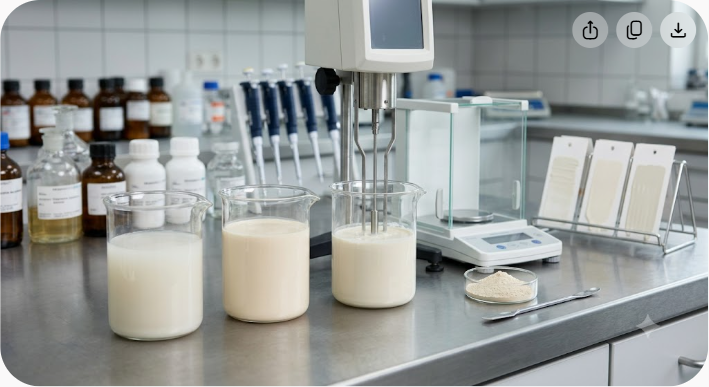
Bentonite can help a water-based paint hold pigments in suspension, resist sag, and develop a more useful flow profile, but it isn't simply a thickener that you add until the viscosity looks right. The grade, dispersion method, hydration time, dosage, water chemistry, and other ingredients all affect the result.
For most water-based paint development work, the practical approach is to select a suitable bentonite grade, pre-disperse or hydrate it in water, add it gradually under adequate agitation, and then evaluate the finished paint at several dosage levels. A useful laboratory screening range is often around 0.5% to 3% bentonite based on total formulation weight, but that range is a starting point rather than a production specification. The appropriate level depends on the clay grade, particle size, binder system, pigment and filler loading, electrolyte concentration, pH, other rheology modifiers, and intended application method.
The objective isn't maximum viscosity. A well-designed paint needs to remain stable in the container, move readily when mixed, spread properly under a brush or roller, spray when required, and resist excessive sag after application. Too little bentonite may provide inadequate structure, while too much can cause heavy application feel, poor leveling, difficult pumping, or an overly textured film.
Bentonite is a naturally occurring clay dominated by smectite minerals, particularly montmorillonite. Suitable grades can hydrate in water and develop a particle network that changes the way the liquid behaves at rest and under shear.
That behavior can be useful in water-based coatings for several reasons:
The important distinction is that bentonite is a structure-building additive, not merely a conventional viscosity booster.
A paint needs different flow characteristics at different stages. In the container, it should resist settling. During mixing, it should move without excessive resistance. Under a brush or roller, it needs to spread evenly. During spraying, it must respond appropriately to the applied shear. After application, it should regain enough structure to resist sag without sacrificing leveling.
A properly selected bentonite can contribute to that balance.
Water-based paints contain water, binder, pigments, extenders, and a range of functional additives. These components have different densities, particle sizes, surface chemistries, and interactions with the liquid phase.
Pigments and mineral fillers are generally denser than water. Without adequate suspension, gravity gradually moves them toward the bottom of the container. Over time, this can produce sediment that is difficult to remix and can change the composition of the material being applied.
Bentonite approaches the problem by changing the structure of the liquid phase. When an appropriate grade hydrates, its plate-like clay particles interact with water and with one another. Depending on the mineral chemistry and formulation environment, those interactions can produce a weak three-dimensional structure that slows the movement of dispersed solids.
The structure is also responsive to shear. Mixing, brushing, rolling, and spraying can disrupt the network temporarily, allowing the paint to flow. When the shear decreases, some of the structure can rebuild.
That combination is useful when a coating needs relatively high structure at rest but easier flow during application. The formulation challenge is finding the point where those properties work together rather than competing with one another.
There isn't one bentonite grade that works automatically for every water-based coating. Grade selection should follow the chemistry of the formulation and the performance you need from the finished paint.
Sodium-rich bentonite is often considered when strong hydration, swelling, and rheological development are required. Calcium-rich bentonite generally has different hydration and swelling behavior and may be useful when its particular mineral and rheological characteristics fit the formulation.
Purity and particle size also matter. A coating can be sensitive to insoluble impurities, coarse particles, soluble salts, moisture content, and variations in mineral composition. A grade that performs well in a simple water dispersion may behave differently once it is exposed to pigments, binders, dispersants, and electrolytes.
For a commercial paint project, ask the supplier for technical information such as:
When comparing two bentonite products, don't select one simply because its powder appears finer or because it gives the highest viscosity in water. The useful grade is the one that produces the required rheological profile in the actual paint system.
A practical laboratory screening range is often approximately 0.5% to 3% bentonite by total formulation weight. That range should be treated as an experimental starting point, not as a universal dosage recommendation.
For example, a formulator could prepare small laboratory batches containing 0.5%, 1.0%, 1.5%, 2.0%, and 3.0% bentonite. The samples can then be compared for viscosity, suspension, sag, leveling, brushability, spray behavior, and appearance.
The amount required depends on factors including:
A heavily pigmented industrial coating may require a very different rheology strategy from a low-solids interior emulsion paint. The same dosage should not be assumed to work across both systems.
For that reason, avoid copying a bentonite level from another paint formula unless the raw materials, processing conditions, and performance requirements are sufficiently comparable.
The way bentonite is introduced can matter almost as much as the amount used. Poor wetting or incomplete hydration can leave partially hydrated particles and agglomerates that don't contribute the intended rheological structure.
Start by identifying the actual problem you want bentonite to address.
Is the issue pigment settling? Excessive sag? Low viscosity at rest? Poor application control? A formulation that becomes difficult to process after storage?
These are different problems, even though they may all be described informally as viscosity problems.
Record the existing paint's viscosity and application behavior before making a change. If suitable equipment is available, measure viscosity under more than one shear condition. A single viscosity value rarely describes the complete rheological behavior of a coating.
Choose a grade intended for the type of aqueous system you're developing. Review the supplier's technical data rather than assuming that every sodium or calcium bentonite will behave in the same way.
For a new formulation, a small screening study with two or more suitable grades can be worthwhile when the performance target is important or the system is particularly sensitive to clay chemistry.
The goal isn't maximum thickening. You're looking for the right balance of suspension, shear thinning, application feel, leveling, and storage stability.
Bentonite hydration can be affected by the composition of the liquid phase. Water containing dissolved salts can behave differently from low-mineral process water.
Use consistent water quality during laboratory development. If production uses treated, softened, or otherwise conditioned water, reproduce that condition during formulation work whenever practical.
This becomes especially important during scale-up. A formula developed with one water source can show a different rheological response after moving to a production water supply with different mineral content or ionic composition.
One of the most controllable approaches is to prepare a bentonite dispersion before incorporating it into the complete paint.
Add the powder slowly to water under agitation rather than dumping the full amount into a stationary liquid. Maintain enough mixing energy to distribute the particles and limit the formation of large wet agglomerates.
Depending on the grade, the clay may require additional hydration or maturation time before it develops its intended rheological contribution. Some laboratory procedures may allow several hours for this stage.
The supplier's recommended hydration and dispersion procedure should take priority over a generic mixing time. Bentonite products aren't interchangeable simply because they share the same broad mineral name.
Gradual addition gives each portion of powder a better opportunity to wet and disperse.
A practical sequence is:
Avoid adding a large quantity of dry bentonite directly to a finished, highly viscous paint. The outside of the particles can hydrate quickly while dry material remains trapped inside, producing lumps that are difficult to break apart.
Once the bentonite dispersion is adequately hydrated, incorporate the remaining formulation components according to the process sequence established for the coating.
The order of addition can affect dispersion quality. Pigments, fillers, dispersants, binders, defoamers, coalescents, preservatives, and other additives can interact with the clay structure and change viscosity or suspension.
For that reason, don't evaluate bentonite only as a water-and-clay mixture and assume the same result will appear in the finished paint. The complete formulation is the product that needs to pass the performance tests.
Measure the formulation after mixing, after the required hydration or maturation period, and after the finished paint has reached its normal equilibrium condition.
If appropriate equipment is available, examine low- and high-shear behavior instead of relying on a single rotational viscosity measurement.
This helps distinguish useful rheology from simple thickening. A paint that becomes much thicker but is difficult to pump, disperse, or apply may not have improved in a practical sense.
A paint can have an acceptable laboratory viscosity and still perform poorly on a surface.
Apply samples to suitable test panels and compare:
The appropriate bentonite concentration is the one that supports the complete performance target, not the one that produces the highest reading on a viscosity meter.
Suspension is one of the main reasons to consider bentonite in a water-based paint.
A pigment particle in a liquid phase is continuously affected by gravity. Smaller particles may remain suspended for extended periods, while larger or denser particles tend to settle more quickly. Increasing the low-shear structure of the liquid can slow that movement.
Hydrated bentonite can increase low-shear viscosity and create a particle-supporting network. This makes it harder for dispersed solids to move through the liquid while the paint is sitting in storage.
There is a trade-off, though. A very strong structure can make the paint difficult to stir, pump, or apply. If the network doesn't break down sufficiently under shear, the coating may feel heavy, show poor leveling, or require excessive application force.
Suspension and application performance therefore need to be evaluated together. A formulation that never settles but is unpleasant to apply isn't necessarily a successful formulation.
Bentonite doesn't necessarily need to replace synthetic or polymeric rheology modifiers. In many formulations, clay and polymeric additives can be used together to create different parts of the desired rheological profile.
| Property | Bentonite | Conventional polymeric thickener |
|---|---|---|
| Main role | Structure, suspension, rheology | Viscosity and rheology control |
| Hydration | Important for many grades | Depends on polymer chemistry |
| Low-shear structure | Can be strong | Depends on polymer type |
| Pigment suspension | Often useful | Can be useful depending on chemistry |
| Shear response | Often thixotropic or shear-thinning | Varies widely |
| Sensitivity to water chemistry | Can be significant | Depends on polymer |
| Formulation compatibility | Must be screened | Must be screened |
| Typical use strategy | Often part of a rheology package | Often part of a rheology package |
The two approaches aren't necessarily competitors. A formulator may use bentonite to establish suspension and low-shear structure, then use another rheology modifier to fine-tune application viscosity or flow.
The right combination depends on the binder, pigment system, application method, solids content, and required film properties.
The sodium-calcium distinction matters because exchangeable ions influence hydration and swelling behavior.
Sodium-rich bentonite generally has stronger water-swelling characteristics than untreated calcium-rich bentonite. That can make suitable sodium-rich grades attractive where substantial aqueous rheological development is required.
Calcium-rich bentonite can also have useful coating properties, depending on its mineral composition, processing, particle size, and the demands of the formulation.
| Factor | Sodium-rich bentonite | Calcium-rich bentonite |
|---|---|---|
| Water swelling | Generally higher | Generally lower |
| Hydration behavior | Stronger in suitable grades | More limited in untreated form |
| Rheology potential | Often high | Depends strongly on grade |
| Paint suitability | Grade-specific | Grade-specific |
| Best selection method | Test in the actual formulation | Test in the actual formulation |
This comparison is a starting point rather than a substitute for product-specific testing. Commercial bentonite grades can be processed or modified, so the broad mineral classification alone doesn't predict final paint performance.
Increasing the clay level can improve suspension up to a point, but excessive bentonite can push the paint outside its useful rheological range.
Common symptoms include:
Overdosing can also hide the original formulation problem. If pigment settles because the dispersant system is inadequate, increasing bentonite may reduce visible settling while leaving the underlying pigment-dispersion issue unresolved.
A better approach is to determine why the solids are settling and then use enough bentonite to provide the required structure without creating unnecessary viscosity.
This can create localized high concentrations and poorly hydrated agglomerates. Pre-dispersion is usually easier to control and gives the clay a better opportunity to hydrate uniformly.
Two products sold as bentonite can behave very differently because of mineral composition, processing, particle size, moisture, exchangeable ions, and other product characteristics.
Viscosity alone doesn't tell you whether the paint will settle, sag, level, brush, roll, or spray correctly. Application and storage tests provide information that a single viscosity reading cannot.
Dissolved salts and other ions can influence clay hydration and rheological development. Use consistent process water during both development and production trials.
If you change bentonite, dispersant, polymer thickener, pigment concentration, and water content simultaneously, it becomes difficult to determine what actually improved or damaged the formulation.
During the initial screening stage, change one major variable at a time whenever practical.
A freshly mixed paint can look excellent and still develop hard settling during storage. Include accelerated and practical storage evaluations appropriate to the product instead of approving a formula based only on its fresh appearance.
A small laboratory disperser can create a very different shear history from a large production vessel. Scale-up should account for equipment geometry, impeller type, mixing speed, batch size, addition rate, and actual power input where relevant.
A useful laboratory evaluation should cover both liquid-state behavior and dry-film performance.
Start by recording the formulation and processing conditions precisely. Note the bentonite grade, moisture condition, water quality, addition rate, mixing speed, mixing time, and maturation time.
Then evaluate the paint for:
For production development, define acceptance criteria before selecting the final formulation. This keeps the development process tied to measurable performance instead of allowing a convenient laboratory result to become an arbitrary production target.
Suppose you're developing a water-based architectural coating with a settling problem and want to determine whether bentonite can improve suspension.
Instead of changing the entire formula, keep the binder, pigment, filler, dispersant, water, and other additives constant. Prepare several small batches with increasing bentonite levels.
For example, test 0.5%, 1.0%, 1.5%, 2.0%, and 3.0% based on total batch weight.
Prepare every sample using the same dispersion, hydration, and mixing procedure. Then compare viscosity, settling, redispersibility, and application behavior. Store the samples under controlled conditions and inspect them at defined intervals.
You may find that the first increase in bentonite produces a meaningful improvement in suspension, while later additions mainly increase viscosity. That result is more useful than choosing a dosage simply because it produces the thickest paint.
The exact optimum will depend on the formulation, but the screening method is broadly useful. It separates the effect of dosage from changes caused by processing or other raw materials.
The application method changes the rheology target. A formula that works well with a brush may not behave the same way through a spray system.
Brush-applied coatings generally need enough structure to resist sag while still spreading without excessive drag. Too much low-shear viscosity can make the paint feel stiff and reduce leveling.
Roller coatings need a balance between pickup, transfer, spreading, and spatter control. A highly structured system may require more effort to distribute evenly and can affect the visual uniformity of the wet film.
Spray coatings require suitable viscosity and shear response under atomization conditions. A bentonite level that works well for brushing may be unsuitable for spraying if the formulation becomes too structured or doesn't recover as intended after shear.
This is why application testing should use the intended equipment whenever possible. A formulation optimized only with a laboratory viscosity reading can behave differently on the production line or during actual coating application.
Yes. Bentonite can be part of a broader rheology system when the formulation benefits from different types of structure or flow control.
The main challenge is interaction. Polymer thickeners, associative thickeners, dispersants, surfactants, defoamers, pigments, and soluble salts can all affect the final clay network.
If you're combining bentonite with another thickener, test the complete combination rather than assuming the effects will simply add together. For example, bentonite may provide suspension and low-shear structure while a polymeric thickener contributes to application viscosity or flow control.
This approach can be useful when the coating needs different viscosity characteristics at rest, during mixing, and during application. The combined system still needs to be evaluated for leveling, sag, storage stability, and ease of processing.
Water-based paints are chemically active systems. Their formulations can contain pH adjusters, dispersants, surfactants, preservatives, defoamers, coalescents, pigments, fillers, and other functional additives.
These components can alter particle interactions and the structure of the liquid phase. Electrolytes are particularly important because dissolved ions can affect clay hydration and rheological development.
If a bentonite dispersion performs well in clean water but poorly in the finished paint, don't immediately assume the clay is defective. Review the formulation chemistry and processing sequence first.
A useful troubleshooting approach is to compare three samples: bentonite in water, bentonite in the paint's liquid phase without pigment, and bentonite in the complete formulation. Comparing these stages can help identify where the rheological change occurs.
If you see lumps, uneven viscosity, or inconsistent batch results, review the dispersion process before increasing the dosage.
Focus on variables such as:
The physical appearance of the dispersion is also useful. A well-dispersed system should not contain obvious dry clay pockets or persistent agglomerates.
Where the product specification permits, establish a standard laboratory dispersion procedure and keep it consistent while screening grades. Otherwise, differences in mixing can be mistaken for differences in bentonite performance.
Consistency is especially important when comparing suppliers. If one sample is mixed more aggressively or hydrated for longer, the test no longer represents a fair grade-to-grade comparison.
The same basic clay principles apply across coating categories, but the performance requirements can be very different.
Architectural paints often place strong emphasis on brushability, roller application, sag resistance, leveling, appearance, and storage stability. A formulation that feels slightly too structured during laboratory testing may become difficult to apply over a large wall area.
Industrial water-based coatings may place greater emphasis on spray application, solids loading, corrosion resistance, film properties, pigment concentration, process stability, or specialized substrate performance.
Those differences change the formulation target. A bentonite grade that performs well in one coating category shouldn't automatically be transferred to another without testing it under the new processing and application conditions.
If bentonite is becoming part of a commercial paint formulation, technical purchasing should go beyond price per kilogram.
Ask the supplier for:
For export supply, also confirm packaging, shipment specifications, lead times, and the documentation required for the destination market.
Axewelledge supplies bentonite for industrial applications and can discuss grade requirements for coating development. The most productive starting point is to provide the coating type, target viscosity or rheology, application method, pigment loading, and current performance problem rather than simply requesting the highest-swelling clay available.
A supplier can make a more useful recommendation when the performance target is clearly defined. A sample should then be evaluated in the complete paint system before a production grade is approved.
Before approving a bentonite grade for a water-based paint, check the following:
If several answers are no, changing the clay dosage alone is unlikely to solve the formulation problem. Review dispersion, pigment stabilization, water chemistry, binder compatibility, and the overall rheology package before making a larger dosage change.
Bentonite can be a useful component in water-based paint because it can contribute to suspension, low-shear structure, thixotropy, and application control. The real formulation work lies in selecting a suitable grade, dispersing it properly, allowing adequate hydration, and evaluating the complete paint rather than judging the clay in isolation.
Start with a small dosage screening study, keep processing conditions consistent, and assess both liquid rheology and actual coating performance. In many cases, the best formula isn't the one with the most bentonite. It's the one that provides stable suspension and controlled application without creating unnecessary structural buildup.
For formulators looking for a consistent industrial bentonite supply, Axewelledge can provide product information and discuss grade requirements based on the intended application. A clear technical specification, followed by testing in the finished coating, is the best starting point for selecting a clay that fits the paint system.













Have questions about our products? We're here to help!