Axewelledge, a leading exporter from India, specializes in high-quality Bentonite. With a commitment to excellence, we supply premium Bentonite to the Middle East and Southeast Asia markets.


North Angle Complex, 304,
150 Feet Ring Rd, Opposite Ambedkar Nagar BRTS Stop,
Madhav Park, Punit Nagar,
Mavdi, Rajkot, Gujarat 360004
© Axewelledge 2026, All Rights Reserved.
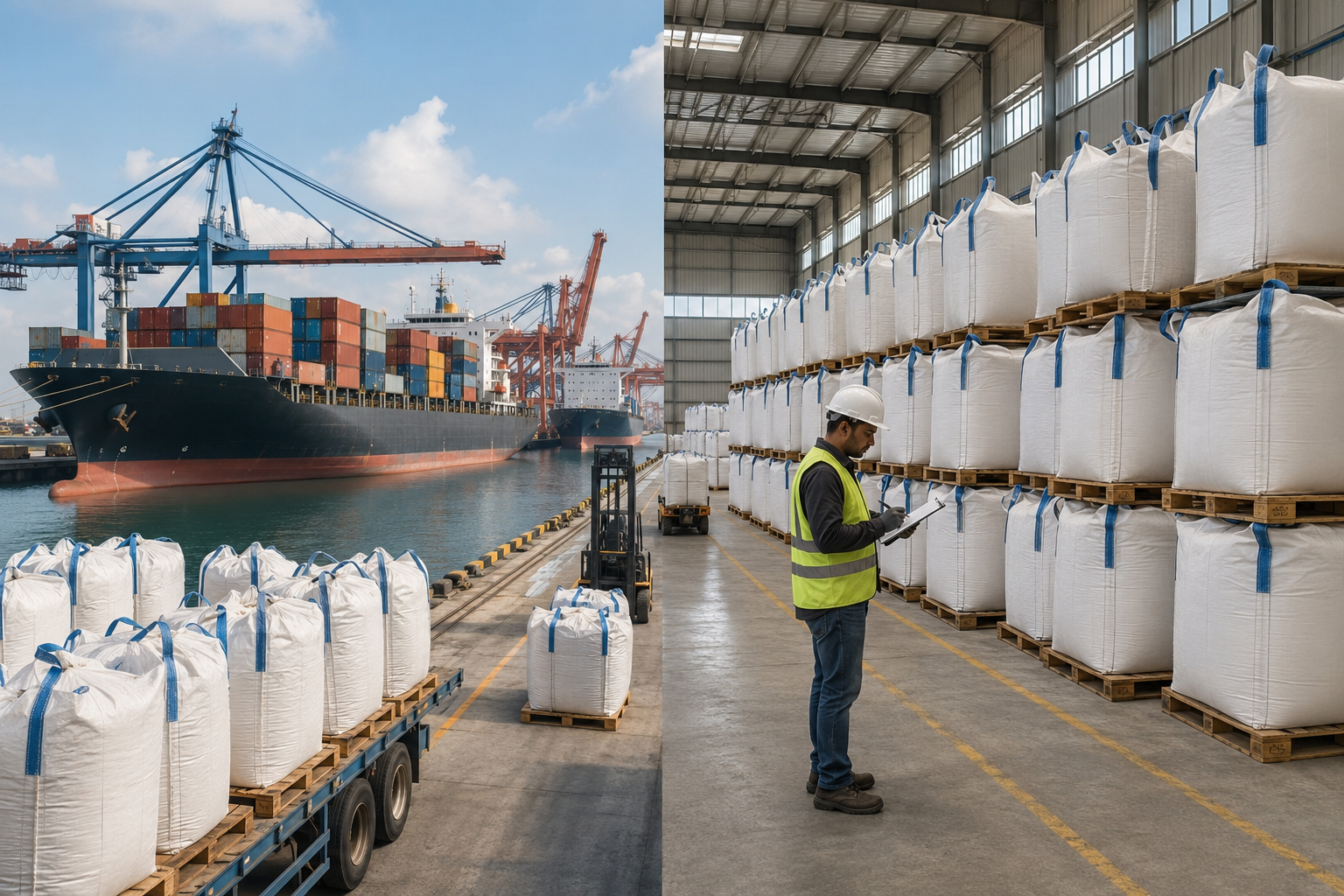
Importing bulk industrial bentonite requires navigating strict quality metrics, testing standards, and ocean freight logistics to ensure supply integrity. Getting raw minerals across international borders without losing batch performance comes down to mastering two core areas: rigorous technical verification before shipment and strategic freight handling at port. Whether you are procuring thousands of tons of sodium bentonite for civil engineering, oilfield drilling, foundry casting, or environmental sealing, a single bad shipment can derail production schedules and drive up costs.
This guide breaks down every step of the bulk bentonite procurement lifecycle. You will learn how to audit technical specification sheets, run independent lab verifications, select optimal bulk packaging, and structure ocean logistics to minimize total landed costs.
Not all bentonite clays behave the same in industrial applications. Bentonite is an aluminum hydrosilicate clay consisting primarily of montmorillonite. Its unique structure gives it high water absorption, swelling ability, and binder capacity. However, its industrial behavior depends heavily on the predominant exchangeable cation within the crystal lattice.
Sodium bentonite contains a high concentration of naturally occurring sodium ions ($Na^+$). When exposed to water, sodium bentonite can expand up to 15 to 20 times its original dry volume. This extraordinary swelling capability creates a dense, low-permeability barrier, making it the preferred choice for specific applications:
Calcium bentonite contains calcium ions ($Ca^{2+}$) as its primary exchangeable cation. It absorbs water but exhibits significantly lower swelling properties compared to sodium bentonite (typically expanding only 2 to 4 times its dry volume). Key uses include:
In regions where natural sodium bentonite reserves are limited, producers treat calcium bentonite with soda ash (sodium carbonate, $Na_2CO_3$) through a process called activation. This ion-exchange process swaps calcium ions for sodium ions, artificially raising the clay's swelling capacity and yield. While sodium-activated bentonite meets standard specifications for many industrial uses, procurement teams must verify thermal stability and long-term ion stability, as activated clays can degrade faster under high-heat or high-salinity conditions than naturally occurring sodium bentonite.
When evaluating a supplier's Technical Data Sheet (TDS) or Certificate of Analysis (COA), looking at basic purity is not enough. You need to review performance-based physical and chemical metrics that dictate how the clay behaves in your production process.
Measured according to ASTM D5890 or ISO standards, the swelling index reflects the volume (in milliliters) that 2 grams of dried, finely ground bentonite expands to when added gradually to 100 mL of distilled water.

The Methylene Blue test measures the cation exchange capacity (CEC) of the clay, providing a direct measurement of active montmorillonite content. Higher MBV numbers indicate a higher percentage of pure, active smectite clay and lower concentrations of inert grit, quartz, or feldspar.
For drilling mud and civil foundation applications, bentonite must comply with American Petroleum Institute (API) Specification 13A or Oil Companies Materials Association (OCMA) guidelines.
Moisture levels dictate both shelf stability and processing capability. Standard bulk bentonite leaves the processing plant at 8% to 12% moisture content by weight. If moisture drops below 6%, the crystalline structure can become over-dried, reducing swelling performance. If moisture exceeds 14%, the powder forms clumps, causing flowability issues in bulk silos and clogging pneumatic unloading lines.
Depending on your processing equipment, mesh size matters:
To help your procurement team specify the right product, review this comparison matrix across major industrial applications:
| Application | Primary Grade Requirement | Key Metric Target | Critical Test Standard |
|---|---|---|---|
| Oilfield & Horizontal Drilling | API 13A Section 9 / OCMA | Yield $\ge 91\text{ bbl/ton}$, Filtrate $< 15\text{ mL}$ | API RP 13B-1 |
| Foundry Green Sand | High-Thermal Sodium Bentonite | Wet Tensile Strength $> 0.25\text{ N/cm}^2$, MBV $> 320\text{ mg/g}$ | AFS Mold & Core Handbook |
| Civil & Environmental Liners | Natural High-Swell Sodium | Swelling Capacity $\ge 24\text{ mL}/2\text{g}$, Permeability $< 1\times 10^{-9}\text{ cm/s}$ | ASTM D5890 / ASTM D5084 |
| Iron Ore Pelletizing | Fine Sodium/Activated Grade | Water Absorbency $\ge 600\%$, Mesh Size $90\% < 75\,\mu\text{m}$ | ISO 9001 / Internal Smelter Spec |
| Civil Construction Slurry | OCMA / High-Yield Civil | Viscosity Index $600\text{ RPM} \ge 30$, Marsh Funnel $> 40\text{s}$ | EN 1538 / API 13A |
When buying bulk minerals internationally, buying directly from mine owners or fully integrated processor-exporters eliminates intermediary markups and guarantees long-term material consistency. Major global exporters—including producers from India's mineral-rich Kutch region—operate large-scale reserves capable of supplying consistent batches for multi-year projects.
Here is how to audit an international producer before issuing a Purchase Order (PO):
Does the supplier own their mining concessions, or do they purchase raw lump clay from third-party artisanal miners? Integrated producers like Axewelledge manage raw ore selection, solar drying, crushing, activation, fine pulverization, and export packaging under a single quality control system. This ensures the batch you test in January matches the batch that arrives in November.
Require the supplier to demonstrate lot-by-lot lab tracking. Every export container or bulk vessel shipment should carry a certificate of quality matched to specific batch numbers taken directly from the packaging line.
Always mandate third-party inspection (such as SGS, Intertek, or Bureau Veritas) at the loading port. The inspector should sample bags according to ISO 2859-1 standards, verifying:
Choosing how to package bulk bentonite impacts your freight costs, port handling fees, and storage footprint. The three main options depend on your shipment size and unloading facility capabilities.
This is the most common option for international trade. High-density woven polypropylene bags hold between 1.0 to 1.25 metric tons of bentonite powder or granules.
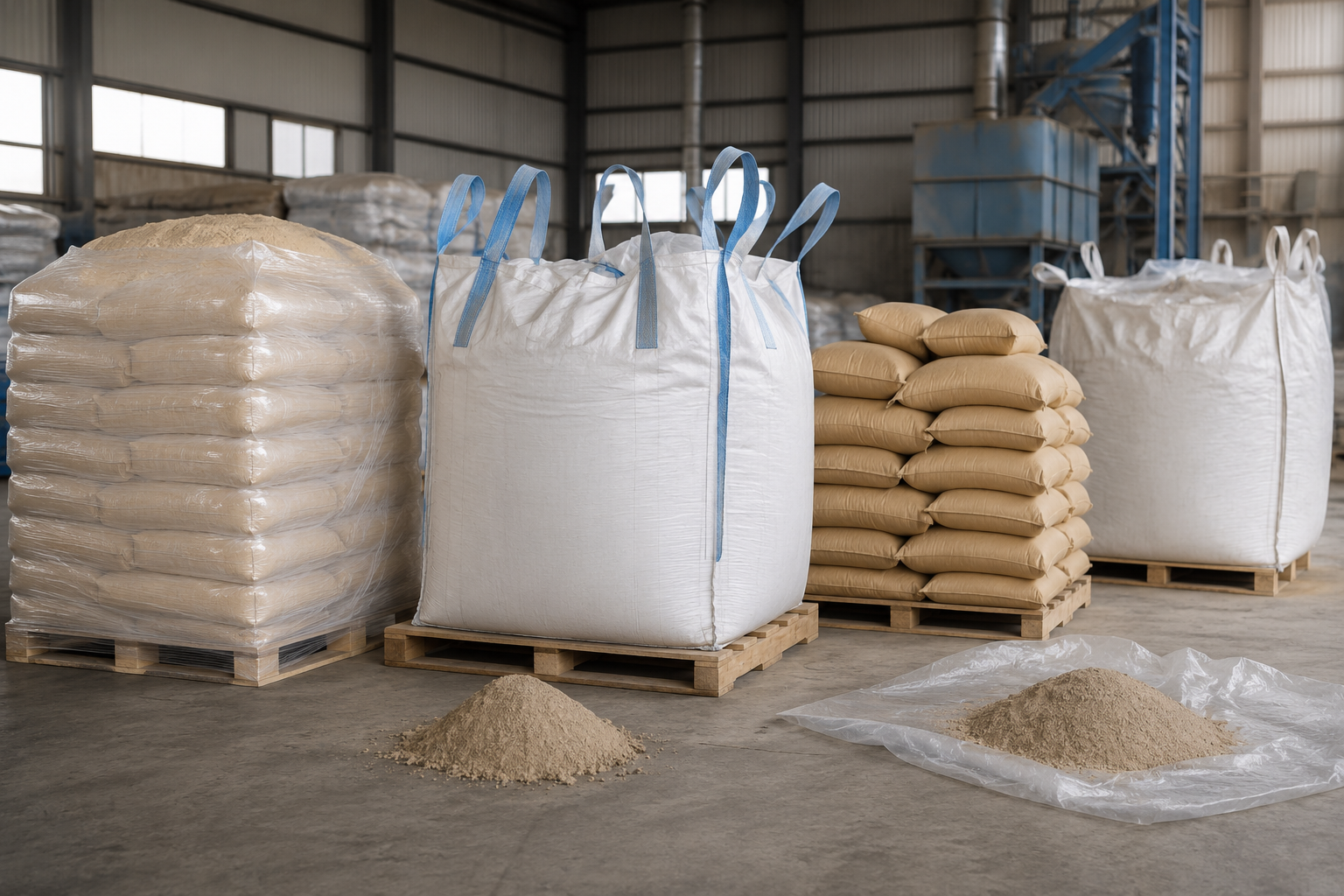
For buyers without overhead cranes or hopper systems, smaller 25 kg or 50 lb paper bags offer easy manual handling.
Large buyers—such as iron ore pelletizing plants or major civil contractors—import bentonite in full vessel holds carrying 5,000 to 25,000 metric tons of unbagged or bulk-bagged material.
Moving heavy industrial minerals across ocean trade lanes involves precise logistics management. Freight cost frequently represents 30% to 50% of the total landed price per ton. Minimizing expenses requires selecting the right Incoterms and managing port logistics carefully.
Bentonite is a heavy, dense commodity. Because of vessel weight limits, bentonite almost always maxes out container weight capacity before filling its volume capacity ("weighing out" rather than "spacing out").
Industrial minerals often experience delays during port customs clearance, toxic substance compliance reviews, or inland freight booking. Request extended container free time upfront:
Even experienced procurement directors encounter costly oversights when sourcing raw minerals internationally. Avoid these common mistakes:
Buying activated calcium bentonite when your project specifies natural sodium bentonite can lead to product failure over time. Activated bentonite can lose its swelling capability when exposed to heat, mechanical shear, or saline groundwater. Always request X-ray Diffraction (XRD) analysis to verify natural smectite structures when long-term performance is required.
Container ships travel through changing temperature zones, causing condensation inside sealed steel containers ("container rain"). Without internal PE liners or desiccants, dry bentonite powder near the outer bag edges will absorb moisture, leading to clumping or bag ruptures.
While a 20ft container can hold 27 metric tons of clay at the loading port, local road regulations in destination regions (such as US DOT bridge laws or European axle limits) may restrict gross vehicle weights. Overweight containers lead to heavy port fines, double-handling fees, or forced transloading onto separate trailers.
Follow this streamlined process to structure your next bulk bentonite order:
Importing bulk industrial bentonite requires balancing chemical purity with smart ocean freight strategy. By defining explicit physical metrics, verifying mine-to-export batch consistency, and choosing moisture-resistant packaging, procurement teams can protect product performance while reducing landed costs.
If you need high-purity natural sodium bentonite, API/OCMA certified drilling clays, or custom-milled industrial bentonite, working with fully integrated producers ensures consistent quality across every shipment.
Contact Axewelledge today to request technical spec sheets, order certified lab samples, or discuss direct vessel and container logistics for your operational needs.













Have questions about our products? We're here to help!