About Us

Axewelledge, a leading exporter from India, specializes in high-quality Bentonite. With a commitment to excellence, we supply premium Bentonite to the Middle East and Southeast Asia markets.


Contact Info

  • Address

    North Angle Complex, 304,
    150 Feet Ring Rd, Opposite Ambedkar Nagar BRTS Stop,
    Madhav Park, Punit Nagar,
    Mavdi, Rajkot, Gujarat 360004

  • Email

    info@axewelledge.com

© Axewelledge 2026, All Rights Reserved.
Pitch Control in Paper Mills: How Bentonite Clay Works | Axewelledge – Leading Bentonite Exporter from India | Quality Bentonite for USA & Europe
Pitch Control in Paper Mills: How Bentonite Clay Works
  • Aug 03, 2026

Pitch Control in Paper Mills: How Bentonite Clay Works

Why Pitch Control Dictates Paper Mill Profitability

Unplanned paper machine downtime costs modern mills between 5,000 and $20,000 per hour, and sticky hydrophobic deposits are among the leading causes of those emergency stops. If you manage wet-end chemistry or machine operations, wood pitch and synthetic stickies are constant threats. They blind forming wires, plug press felts, build up on dryer cylinders, and trigger sudden sheet breaks that halt production.

How do you stop tacky, hydrophobic particles from ruining paper machine runnability? Bentonite clay controls pitch by passivating particle surfaces, absorbing colloidal wood resins, and agglomerating hydrophobic contaminants into the sheet via microparticle retention systems. When hydrated and dispersed properly, high-swelling sodium bentonite acts as a mineral sponge with hundreds of square meters of active surface area per gram, neutralizing sticky pitch before it adheres to equipment.

Managing pitch requires a practical understanding of mineral surface charge, shear-resistant flocculation, and stock system dynamics. In this guide, we break down the exact mechanism of bentonite clay pitch control, compare it against talc and chemical additives, outline dosage and slurry preparation guidelines, and provide a systematic troubleshooting framework for your mill.


Understanding Pitch: Where It Comes From and Why It Sticks

To control pitch, you must first understand its chemical origin. In papermaking, the term "pitch" broadly describes water-insoluble, hydrophobic organic compounds originating from natural wood extractives or recycled papermaking raw materials.

The Three Categories of Sticky Contaminants

  1. Natural Wood Pitch: Released during mechanical or chemical pulping. It consists of resin acids (such as abietic acid), fatty acids, triglycerides, sterol esters, and unsaponifiables. Softwood furnishes contain higher concentrations of resin acids, whereas hardwoods yield higher proportions of fatty acid esters.
  2. Synthetic Stickies (Recycled Fiber): Introduced through recovered paper streams like Old Corrugated Containers (OCC) or Deinked Pulp (DIP). Stickies originate from pressure-sensitive adhesives, hot-melt glues, waxes, and latex binders. Though chemically different from wood resin, stickies behave identically on the paper machine by forming tacky deposits.
  3. White Pitch: Originates from coated paper recycling or broke re-pulping. It consists of synthetic latex binders (such as styrene-butadiene rubber or polyvinyl acetate) combined with inorganic coating pigments like calcium carbonate.

The Thermodynamics of Deposit Formation

In a pulp suspension, colloidal pitch droplets typically measure between 0.1 and 2.0 microns in diameter. These droplets remain temporarily suspended because their surface carries a weak negative charge. However, when the pulp slurry encounters changes in pH, temperature spikes, high shear, or shifts in ionic strength, this protective charge barrier breaks down.

Once destabilized, hydrophobic droplets aggregate to minimize their surface contact with water. They adhere to non-polar machinery surfaces—including polyester forming fabrics, polyurethane press rolls, synthetic felts, and dryer cans. After an initial layer attaches, it catches more pitch, fines, and mineral fillers, rapidly growing into a troublesome deposit.


How Bentonite Clay Neutralizes Pitch: The 3-Step Mechanism

Bentonite is a natural smectite clay composed primarily of montmorillonite. Its layered crystal structure provides unique physical and chemical capabilities for wet-end deposit control.

1. Hydration and Delamination

Montmorillonite features a 2:1 layered silicate structure consisting of an aluminum octahedral sheet sandwiched between two silicon tetrahedral sheets. When sodium bentonite is mixed with fresh water under high shear, water molecules penetrate between the layers, forcing them apart.

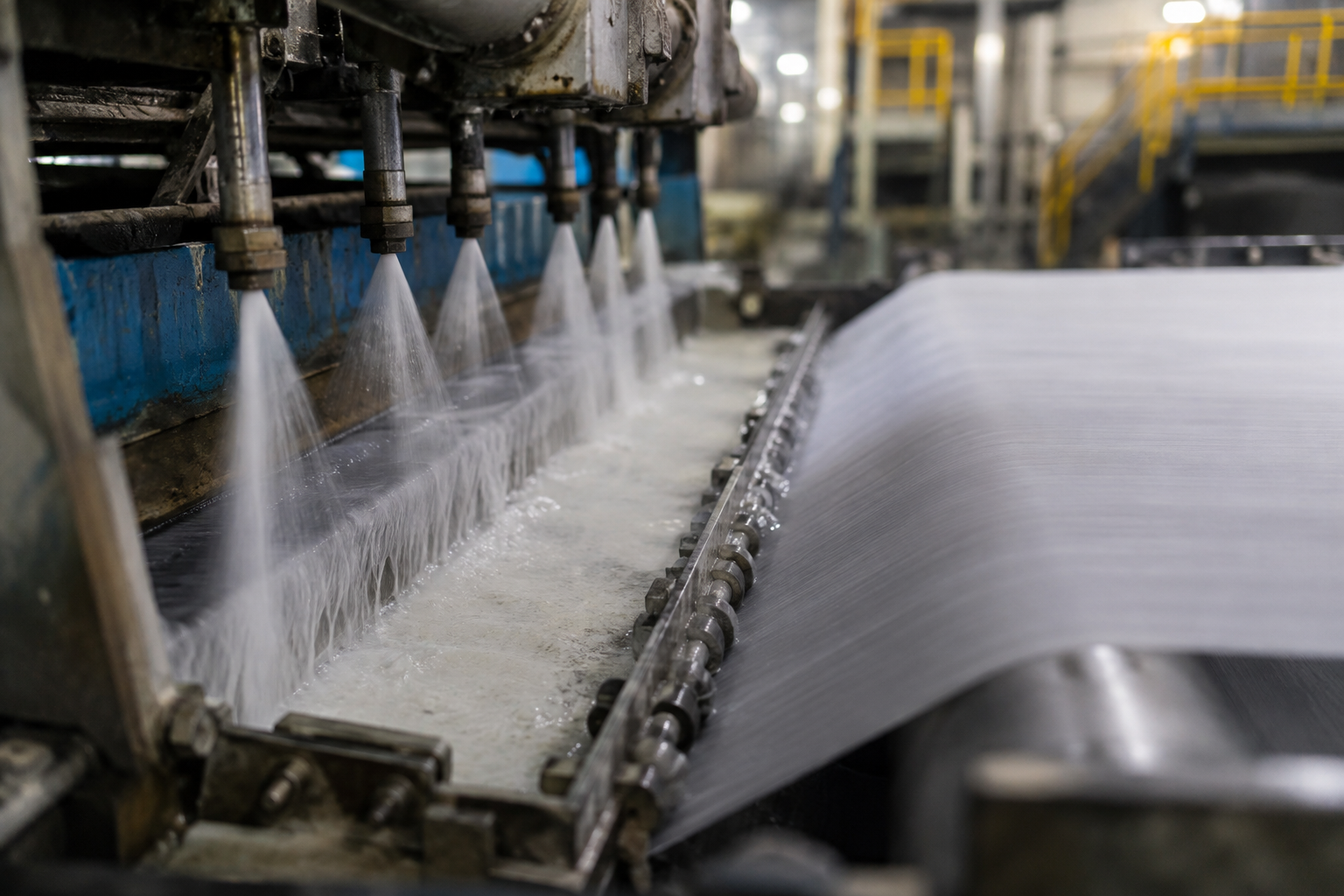
Full delamination separates the clay into individual planar sheets just 1 nanometer thick. This exposes an active surface area of 700 to 800 square meters per gram of dry clay. For perspective, a single kilogram of fully dispersed sodium bentonite offers roughly 750,000 square meters of surface area—equivalent to more than 100 soccer fields.
Pitch Control in Paper Mills: How Bentonite Clay Works

2. Surface Passivation and Physical Adsorption

Delaminated bentonite sheets possess a dual charge: the broad planar faces carry a permanent negative charge, while the thin edges carry a slight positive charge depending on slurry pH. When introduced to the pulp stock, colloidal pitch droplets bind directly to the expansive planar surfaces of the clay sheets.

  • Passivation: The clay platelets envelope the pitch droplet, creating a mineral outer shell that eliminates its tacky exterior.
  • Encasement: Coated pitch droplets can no longer coalesce with neighboring droplets to form larger macro-stickies.

3. Microparticle Agglomeration and Retention

Passivating pitch prevents equipment buildup, but removing the contaminant from the water loop is essential for long-term system stability. Bentonite achieves this through a dual-component microparticle retention process:

  1. High-Molecular-Weight Cationic Polymer: Added first to the pulp stock (typically cationic polyacrylamide or CPAM). It binds fibers, fines, and pitch droplets into large, loose flocs.
  2. High-Shear Zone: As the stock passes through fan pumps or pressure screens (centriscreens), the high shear breaks these polymer flocs into smaller, highly charged fragments.
  3. Bentonite Addition: Added immediately after the high-shear screen. The highly anionic bentonite platelets cross-link the sheared polymer fragments, forming small, dense, shear-resistant flocs.

These micro-flocs trap the passivated pitch particles inside the paper web. The pitch is safely carried out of the machine in the finished paper sheet, keeping the white water loop clean.


Bentonite vs. Alternative Pitch Control Solutions

Paper mills evaluate several mineral and chemical options for managing deposit risks. The table below compares their mechanisms and operational characteristics:

Control MethodPrimary MechanismActive Surface Area ($m^2/g$)Retention EfficiencyOperational ImpactKey Limitations
Sodium BentoniteSurface Adsorption + Microparticle Agglomeration700 – 800High (binds pitch into sheet)Improves drainage and sheet drynessRequires dedicated high-shear make-down system
TalcHydrophobic Surface Adsorption10 – 30Low to ModerateNeutral to slightly abrasiveLower surface area; can settle in low-velocity piping
Synthetic DispersantsSurfactant EmulsificationN/A (Liquid)Zero (retains pitch in liquid phase)May cause foam; increases system organic loadAccumulates pitch in closed white water loops
Cationic FixativesCharge NeutralizationN/A (Liquid)ModerateNeutralHigh chemical cost; sensitive to charge over-fixation
Enzymes (Esterases)Enzymatic Cleavage of TriglyceridesN/AN/ASpecific to triglyceride pitchIneffective against resin acids and synthetic stickies

Why Bentonite Outperforms Talc

Talc has historically served as a popular pitch control mineral because its hydrophobic faces bind organic resins. However, standard papermaking talc provides only 10 to 30 $m^2/g$ of surface area. Sodium bentonite delaminates into nanometer-thin sheets, delivering over 20 times the active surface area per dry ton.

Additionally, talc does not participate in microparticle retention. When paired with cationic polymers, sodium bentonite accelerates stock dewatering on the wire and improves press section efficiency, supporting higher machine speeds.

Passivation vs. Chemical Dispersion

Chemical dispersants use surfactants to break pitch into smaller droplets and keep them suspended in water. While this prevents immediate buildup in the headbox, it retains pitch inside the white water loop. As mills close their water circuits to reduce fresh water consumption, dispersed pitch accumulates until surfactant capacity is exceeded, leading to sudden downstream deposition. Bentonite eliminates this risk by binding passivated pitch directly into the sheet.

Real-World Case Studies: Bentonite Pitch Control in Action

Case Study 1: High-Speed Newsprint Mill Using Mechanical Pulp

  • The Challenge: A newsprint mill running a 70% thermo-mechanical pulp (TMP) and 30% recycled furnish experienced severe pitch blinding on triple-layer forming fabrics. Unplanned sheet breaks averaged 4.2 per day, causing significant yield losses.
  • The Solution: The mill replaced its surfactant program with a microparticle system comprising a medium-charge cationic polyacrylamide ($0.25 ext{ kg/ton}$) and sodium bentonite ($2.0 ext{ kg/ton}$) added after the centriscreen.
  • The Results:
  • Forming fabric deposits decreased by 78% within 48 hours.
  • Sheet breaks dropped from 4.2 to 0.8 per day.
  • First-Pass Retention (FPR) increased from 62% to 71%.
  • Net annual savings reached $340,000 USD through reduced downtime and optimized additive spending.

Case Study 2: Recycled Packaging Board Mill (100% OCC Furnish)

  • The Challenge: A packaging mill processing 100% Old Corrugated Containers suffered from hot-melt adhesive buildup on press felts, resulting in sheet picking and surface defect holes.
  • The Solution: The technical team implemented a dual addition strategy: sodium bentonite was added to the pulper ($1.5 ext{ kg/ton}$) for early stickies passivation, followed by wet-end microparticle addition ($1.0 ext{ kg/ton}$) post-secondary screening.
  • The Results:
  • Press felt chemical wash intervals extended from every 8 hours to once every 72 hours.
  • Dryer steam usage dropped by 4.5% due to higher dryness leaving the press section.
  • Quality rejections from sticky spots were eliminated.

Practical Dosage, Application Points, and Slurry Preparation

Pitch Control in Paper Mills: How Bentonite Clay Works

Achieving consistent results with bentonite clay requires proper dosage control, strategic addition points, and effective hydration.

Typical Dosage Rates

  • Virgin Mechanical Pulp (TMP/CTMP): $1.5 ext{ to }3.5 ext{ kg}$ per metric ton ($3.0 ext{ to }7.0 ext{ lbs/ton}$) of dry pulp.
  • Recycled Pulp (OCC/DIP): $1.0 ext{ to }3.0 ext{ kg}$ per metric ton ($2.0 ext{ to }6.0 ext{ lbs/ton}$) of dry pulp.
  • Bleached Chemical Pulp (Kraft): $0.5 ext{ to }1.5 ext{ kg}$ per metric ton ($1.0 ext{ to }3.0 ext{ lbs/ton}$) of dry pulp.

Where to Inject Bentonite

  1. Pulper / Thick Stock (Early Passivation): Dosing bentonite into the pulper gives the clay maximum residence time with raw wood resins or recycled stickies, passivating them before high shear disperses them into tiny colloidal droplets.
  2. Post-Centriscreen (Microparticle Retention): For drainage and retention benefits, inject bentonite immediately after the final pressure screen before the headbox. This allows the clay sheets to re-flocculate the sheared polymer-pulp mixture.

Step-by-Step Bentonite Slurry Preparation

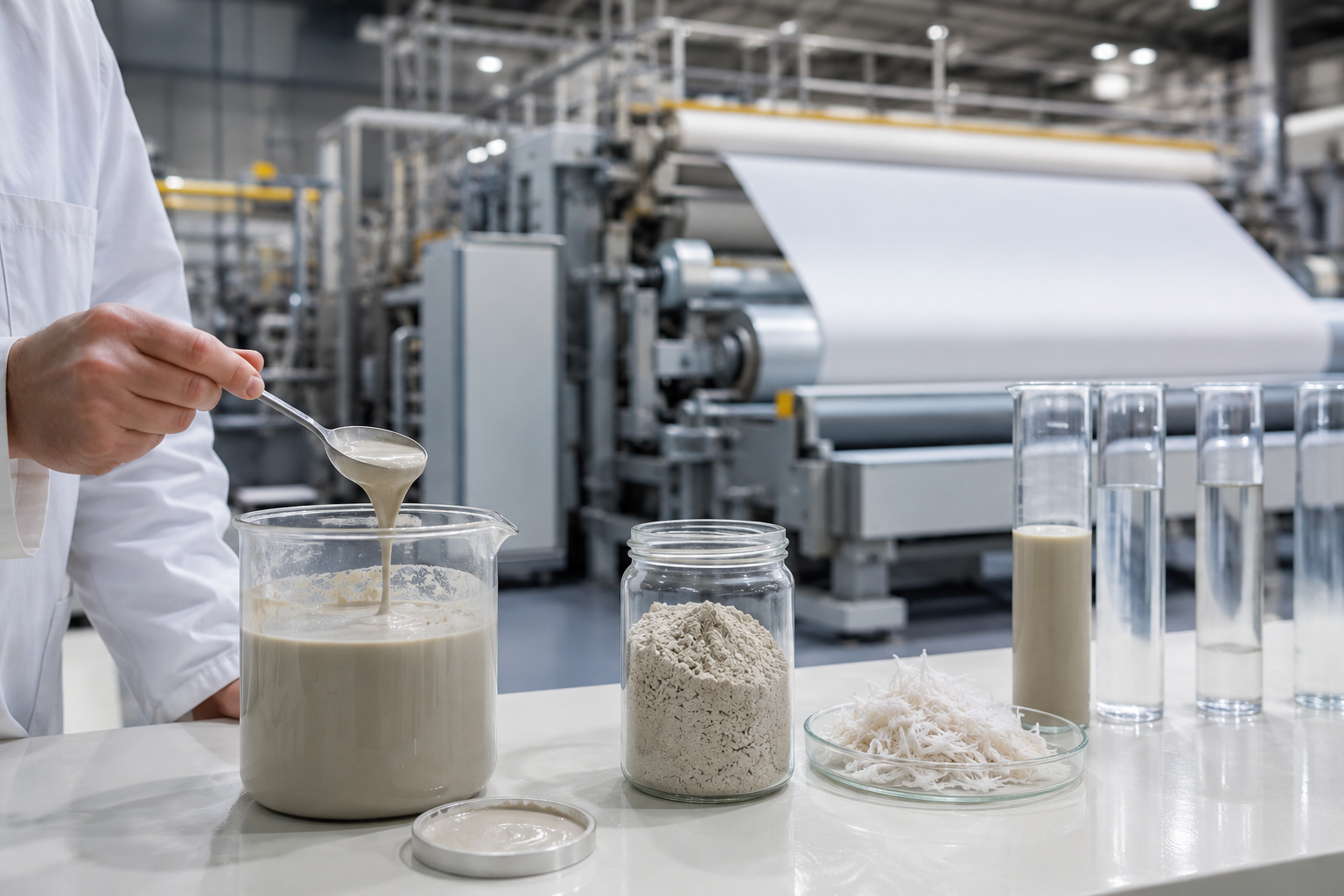
  1. Target Concentration: Prepare the stock slurry at 3.0% to 5.0% solids by weight. Concentrations above 5% become overly viscous, while lower concentrations increase water handling requirements.
  2. High-Shear Mixing: Slowly feed dry bentonite powder into the vortex of a high-shear make-down unit filled with fresh water (ideally below 40°C / 104°F). High shear is required to separate individual clay sheets.
  3. Hydration Residence Time: Allow the slurry to age in a hydration tank for 15 to 20 minutes before dosing. Full hydration ensures maximum swelling and surface area exposure.
  4. Inline Dilution: Dilute the slurry inline to 0.5% to 1.0% solids right before injection to ensure rapid, uniform mixing in the stock line.

Common Operational Errors with Bentonite

  • Dosing Before High-Shear Screens in Microparticle Mode: Adding bentonite before the fan pump or centriscreen destroys the delicate micro-flocs formed between clay platelets and polymer, negating retention and dewatering gains.
  • Using Hard or Saline Make-Down Water: High levels of calcium ($ ext{Ca}^{2+}) or magnesium (Mg

2+ ) ions in make-down water replace sodium ions in the clay lattice. This converts high-swelling sodium bentonite into low-swelling calcium bentonite, reducing active surface area by up to 60%. Always use low-hardness fresh water for slurry preparation.

  • Insufficient Cationic Charge: Because bentonite is strongly anionic, it requires adequate cationic sites (from fiber, alum, fixatives, or cationic polymers) to attach to the sheet. An overly anionic wet end causes bentonite to remain in the water phase and pass into wastewater effluent.
  • Selecting Low-Purity Clay Grades: Construction or drilling-grade clays contain sand, quartz, and lower montmorillonite content. Papermaking applications require refined, high-purity sodium bentonite with at least 85–90% montmorillonite to prevent wire wear and nozzle clogging.

Troubleshooting Wet-End Pitch and Deposit Issues

When pitch spots or fabric blinding occur on your machine, follow this diagnostic process to resolve the issue:

  1. Identify the Deposit Chemistry: Perform solvent extraction and FTIR analysis on deposit samples to confirm whether the material is wood pitch, synthetic stickies, white pitch, or inorganic scale (CaCO

3 ?

, barium sulfate).

  1. Verify Bentonite Slurry Quality: Sample the prepared bentonite slurry and check for unswollen lumps using a 100-mesh screen test. If aggregates remain, increase mixing shear or extend hydration residence time.
  2. Check System Charge Balance: Test the cationic demand of the clear filtrate using a charge analyzer. If anionic trash has accumulated, adjust cationic fixative dosage so the microparticle system can bridge effectively.
  3. Inspect Injection Hardware: Confirm that cationic polymer is added far enough ahead of the pressure screen for complete mixing, and that bentonite enters immediately after the screen exit header.

Environmental and Economic Benefits

  • Zero VOCs: As an inert natural mineral, bentonite introduces no volatile organic compounds or non-biodegradable surfactants into mill wastewater.
  • Energy Reduction: Enhanced wet-end dewatering increases sheet dryness leaving the press section. A 1% increase in dryness after the press reduces dryer steam consumption by roughly 4%.
  • Expanded Furnish Options: Effective stickies passivation allows mills to incorporate higher ratios of lower-cost recycled fibers without compromising machine efficiency.
  • Chemical Cost Efficiency: Due to its high surface area per unit weight, replacing complex synthetic chemical programs with a bentonite-based approach often reduces total wet-end chemical costs by 15% to 30%.

Securing Machine Efficiency with High-Purity Minerals

Managing pitch and stickies is about controlling deposit chemistry so hydrophobic contaminants pass through the paper machine cleanly and invisibly. By utilizing the expansive surface area, surface passivation, and microparticle retention properties of sodium bentonite clay, mills can protect equipment, reduce downtime, and improve final product quality.

Reliable Mineral Supply from Axewelledge

Consistent wet-end performance requires mineral products backed by reliable quality control and secure supply chains. Axewelledge is a global mineral exporter controlling over 60 million tons of premium bentonite reserves. As India's largest mine owner and exporter of industrial bentonite, Axewelledge supplies refined sodium bentonite processed to strict international standards for pulp and paper manufacturers worldwide.

Whether you need to upgrade an existing deposit control program or design a modern microparticle retention system, partner with Axewelledge for consistent mineral purity, steady global delivery, and technical application support.


×

We'd Love to Hear from You










