About Us

Axewelledge, a leading exporter from India, specializes in high-quality Bentonite. With a commitment to excellence, we supply premium Bentonite to the Middle East and Southeast Asia markets.


Contact Info

  • Address

    North Angle Complex, 304,
    150 Feet Ring Rd, Opposite Ambedkar Nagar BRTS Stop,
    Madhav Park, Punit Nagar,
    Mavdi, Rajkot, Gujarat 360004

  • Email

    info@axewelledge.com

© Axewelledge 2026, All Rights Reserved.
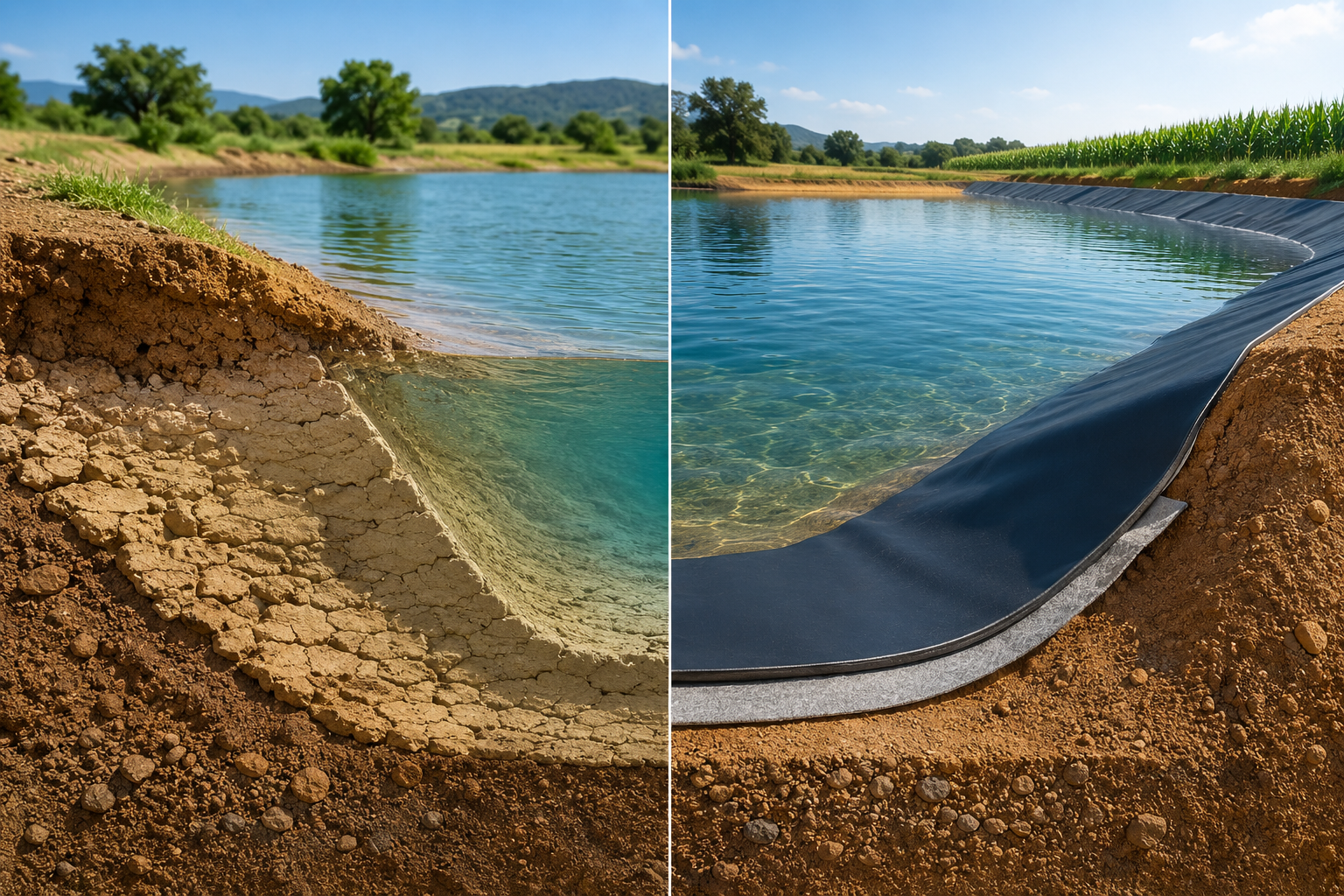
Pond Sealing Cost: Sodium Bentonite vs Synthetic Liners | Axewelledge – Leading Bentonite Exporter from India | Quality Bentonite for USA & Europe
Pond Sealing Cost: Sodium Bentonite vs Synthetic Liners
  • Aug 06, 2026

Pond Sealing Cost: Sodium Bentonite vs Synthetic Liners

Sodium bentonite clay costs $0.50 to $1.50 per square foot for raw materials, while synthetic pond liners like HDPE and EPDM range from $0.45 to $1.50 per square foot for material alone. When you factor in professional installation, earthwork, subgrade preparation, and lifetime maintenance, total installed project costs for both methods average between $1.00 and $4.50 per square foot.

However, focusing solely on the initial invoice is one of the most expensive mistakes a landowner, civil engineer, or agricultural producer can make. A synthetic membrane provides an immediate, absolute physical barrier, but it comes with a strict lifespan countdown, high puncture vulnerability, and high replacement costs. Sodium bentonite clay creates a permanent, natural geological seal that swells when wet and self-heals when damaged, but it requires specific soil chemistry and proper compaction to succeed.

This breakdown analyzes total project economics, technical mechanics, site preparation demands, and lifetime value so you can choose the right sealing strategy for your basin.

Understanding the Core Technologies

Before evaluating costs, it is essential to understand how these two sealing philosophies function under hydrostatic pressure.

What is High-Swelling Sodium Bentonite?

Sodium bentonite is a natural, non-toxic sodium montmorillonite clay formed from volcanic ash deposits. Its unique chemical architecture allows it to absorb water and expand to 12 to 15 times its dry volume, creating a high-density, low-permeability gel mass.

When incorporated into the soil bed of a pond, granular or powdered sodium bentonite fills the void spaces between aggregate soil particles. Once hydrated, the swelling gel exerts expansive pressure within the soil matrix, dropping hydraulic conductivity down to less than 1×10 ?7 cm/s—the standard benchmark for municipal containment and agricultural reservoirs.

Sodium bentonite is applied through four primary methods:

  • Pure Layer Method: Applying a dedicated 1-inch to 3-inch layer of pure clay over the basin floor before covering it with protective soil.
  • Soil-Mixed (Mixed-In) Method: Blending granular or powdered bentonite into the top 4 to 6 inches of native subsoil using a rototiller or disk harrow, followed by heavy roller compaction.
  • Sprinkle / Blanket Method: Dropping granular clay directly through the water column of an existing, filled pond that is suffering from minor seepage.
  • Geosynthetic Clay Liners (GCLs): Factory-manufactured blankets containing a uniform layer of sodium bentonite encapsulated between two geotextile fabrics.

What Are Synthetic Liners?

Synthetic liners are flexible or rigid geomembranes manufactured from petroleum-derived polymers. They form a continuous, impermeable sheet across the pond bottom, physically separating stored water from the surrounding subgrade.

The three primary synthetic materials used for pond construction are:

  • HDPE (High-Density Polyethylene): Highly durable, stiff, and chemical-resistant. HDPE is widely used in commercial aquaculture, industrial wastewater lagoons, and large agricultural reservoirs. It requires specialized thermal wedge welding during installation.
  • EPDM (Ethylene Propylene Diene Monomer): A highly flexible, rubber-like membrane favored for decorative water gardens, golf course features, and irregular pond geometries. It conforms easily to subgrade contours but carries a higher material price tag.
  • LLDPE / PVC (Linear Low-Density Polyethylene / Polyvinyl Chloride): Mid-tier options providing better flexibility than HDPE and lower costs than EPDM, though generally exhibiting lower UV resistance and overall lifespan.

Upfront Cost Breakdown: Materials and Application

When comparing material expenses, raw price tags tell only part of the story. Application density for bentonite and membrane thickness for synthetics significantly alter upfront investments.

Cost FactorHigh-Swelling Sodium BentoniteHDPE Synthetic Liner (40-60 mil)EPDM Rubber Liner (45 mil)
Raw Material Cost (per sq. ft.)$0.50 – $1.50$0.45 – $0.90$0.90 – $1.60
Application / Material Rate3.0 – 6.0 lbs / sq. ft.Single continuous sheetSingle continuous sheet
Subgrade Prep Cost (per sq. ft.)$0.20 – $0.50 (grading)$0.40 – $1.00 (underlayment)$0.30 – $0.80 (underlayment)
Installation Labor (per sq. ft.)$0.30 – $1.00 (tilling/compaction)$0.50 – $1.50 (seam welding)$0.40 – $1.00 (tape/seaming)
Total Installed Cost (per sq. ft.)$1.00 – $3.00$1.35 – $3.40$1.60 – $3.40

Material Cost Factors for Sodium Bentonite

The price of raw sodium bentonite depends heavily on purity, mesh size, packaging, and freight. High-purity natural sodium bentonite with a swell index exceeding 24 mL/2g commands higher prices than blended or calcium-treated clays, but requires lower application rates per square foot.

Application rates vary based on native soil texture:

  • Sandy Clay / Loam: 3.0 to 4.0 lbs per square foot ($0.50 – $0.85 / sq. ft. material cost)
  • Silty Sand: 4.0 to 5.0 lbs per square foot ($0.70 – $1.10 / sq. ft. material cost)
  • Coarse Sand / Fine Gravel: 5.0 to 8.0 lbs per square foot ($0.95 – $1.60 / sq. ft. material cost)

Bulk procurement in super sacks (1-ton jumbo bags) or loose pneumatically loaded trucks cuts raw material costs by 20% to 35% compared to purchasing individual 50-lb paper bags.

Material Cost Factors for Synthetic Liners

Synthetic liner prices scale with polymer quality, sheet thickness (measured in mils or millimeters), and panel dimensions:
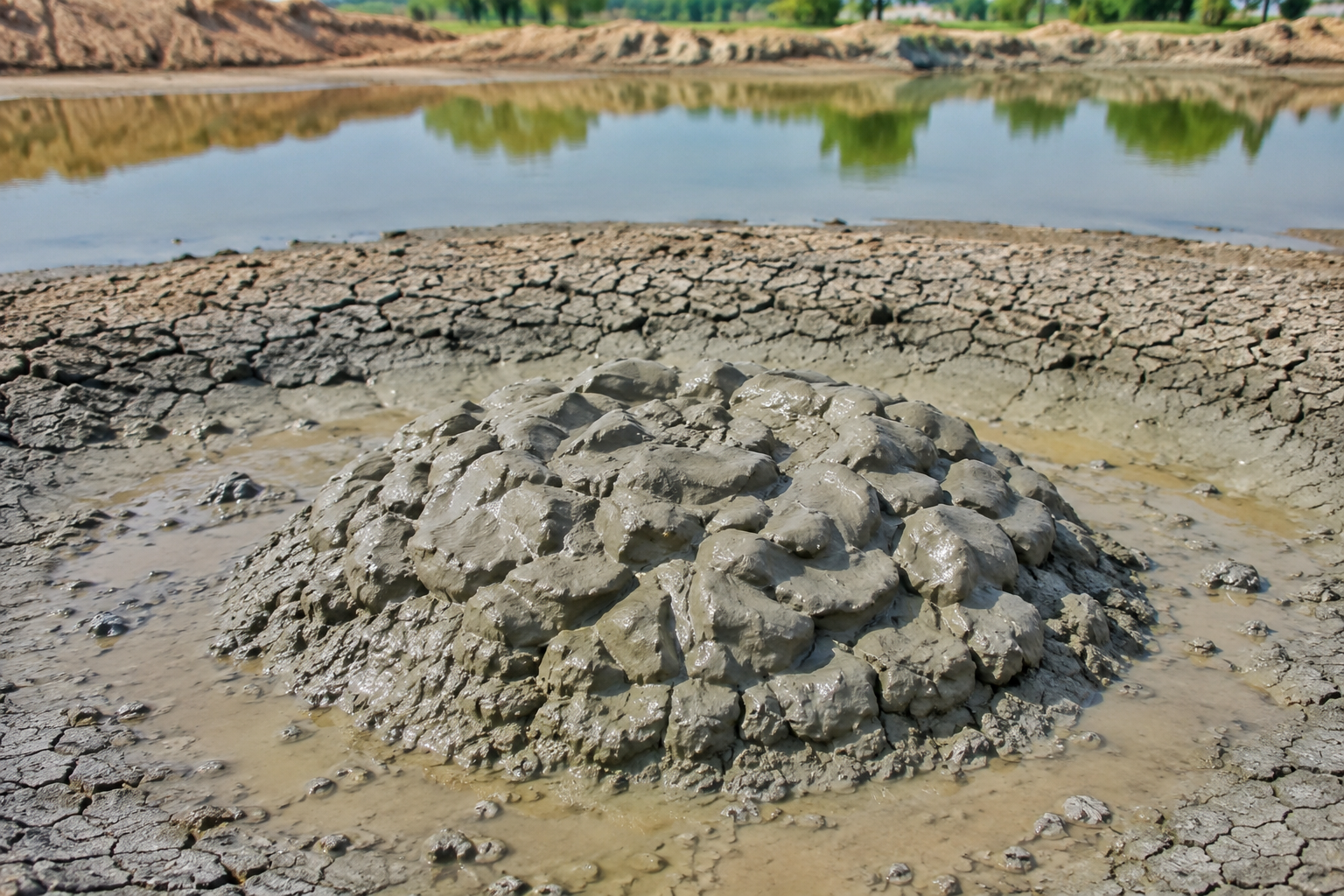
Pond Sealing Cost: Sodium Bentonite vs Synthetic Liners
  • 40-mil HDPE: Entry-level industrial liner ($0.45 – $0.65 / sq. ft.)
  • 60-mil HDPE: Heavy-duty agricultural and mining standard ($0.70 – $0.95 / sq. ft.)
  • 45-mil EPDM: Flexible standard for decorative and livestock ponds ($0.90 – $1.40 / sq. ft.)

Unlike bentonite, synthetics require mandatory accessories. You must factor in protective geotextile underlayment ($0.20 – $0.35 / sq. ft.) to prevent sharp rocks from puncturing the membrane, seam tape or extrusion welding rods, and anchor trench excavation around the perimeter.

Site Preparation and Equipment Requirements

Earthwork requirements differ dramatically between clay incorporation and synthetic membrane placement.

Preparing a Site for Sodium Bentonite

Sealing a pond with sodium bentonite relies on standard earthmoving equipment that most agricultural operations or excavation contractors already possess. The installation workflow includes:

  1. Subgrade Excavation: Clearing roots, large rocks, and debris from the basin floor.
  2. Soil Mixing: Spreading bentonite evenly across the surface and blending it into the top 4 to 6 inches of soil using a tractor-pulled disk or tiller.
  3. Moisture Conditioning: Adding water to achieve optimum moisture content (typically 12% to 18%) for maximum clay expansion.
  4. Compaction: Compacting the treated layer with a smooth-drum or sheepsfoot roller in 2-inch to 3-inch lifts to achieve at least 95% Standard Proctor Density.
  5. Soil Cover: Placing a 6-inch protective cover layer of un-amended native soil over the compacted zone to prevent erosion and drying.

Equipment needed: Tractors, disk harrows/rototillers, water trucks, and heavy vibratory rollers.

Preparing a Site for Synthetic Liners

Installing a synthetic liner requires rigorous subgrade prep to protect the thin membrane:

  1. Subgrade Smooth-Grading: Removing all rocks, sticks, and sharp objects larger than 0.25 inches.
  2. Underlayment Deployment: Rolling out non-woven geotextile fabric over the entire basin floor and side slopes.
  3. Anchor Trench Excavation: Digging a continuous 1.5-foot-deep trench around the perimeter to hold the liner edges.
  4. Panel Deployment & Seaming: Unrolling massive rolls of plastic or rubber, overlapping seams by 4 to 6 inches, and field-welding (for HDPE) or tape-seaming (for EPDM) every joint.
  5. Non-Destructive Testing: Performing air-lance or spark testing across all field seams to verify air-tight integrity.

Equipment needed: Specialized roll-handling equipment, hot-wedge thermal welding rigs, pressure testing tools, and certified geomembrane installation technicians.

Durability and Lifespan: The 50-Year Cost Equation

Evaluating long-term costs requires analyzing how each material degrades over decades under field conditions.

Life-Cycle Process of Sodium Bentonite

  1. Hydration Phase: Clay absorbs water and expands up to 15 times its dry volume.
  2. Matrix Integration: Expended clay seals interstitial voids within native soil.
  3. Permanent Geological Barrier: Forms an indefinite geological seal (50–100+ years) unaffected by UV, freeze-thaw cycles, or surface punctures.

Life-Cycle Process of Synthetic Geomembranes

  1. Initial Installation: Continuous polymer sheet provides immediate containment.
  2. Environmental Stressing: UV radiation, thermal expansion, and mechanical shear stress weaken polymer bonds over time.
  3. Material Degradation: Membrane becomes brittle and subject to seam failures or punctures within 15 to 30 years.

Sodium Bentonite: Indefinite Natural Permanence

Sodium bentonite is an inorganic natural mineral. It does not contain polymers, plasticizers, or organic compounds that break down over time. Once hydrated and buried under a protective soil layer, sodium bentonite lasts for the life of the land formation—50 to 100+ years without chemical degradation.

Key physical advantages include:

  • Immunity to UV Radiation: Sun exposure cannot dry out or degrade buried clay layers.
  • Freeze-Thaw Resilience: When hydrated bentonite freezes and thaws, it re-hydrates and re-expands without losing its sealing capability.
  • Self-Healing Mechanics: If roots, fence posts, or animal hooves penetrate a bentonite-sealed layer, surrounding clay swells into the newly formed void when exposed to water, closing the leak automatically.

Synthetic Liners: Finite Operational Lifespans

Synthetic geomembranes deteriorate due to environmental exposure, physical stress, and chemical oxidation:

  • HDPE Lifespan: 20 to 35 years (exposed) or 40 to 50 years (buried under deep earth cover).
  • EPDM Lifespan: 15 to 25 years (exposed) or 30 to 40 years (buried).
  • Failure Points: Over 85% of synthetic liner leaks stem from field seam degradation, stress cracking along bank folds, punctures from livestock or falling branches, and UV degradation above the waterline.

Replacing a failed synthetic liner requires draining the basin, pulling up hundreds of pounds of degraded plastic, re-grading the subgrade, and purchasing a brand-new lining system. This turns an initial $2.00/sq. ft. installation into a recurring capital expense every 20 to 30 years.

Environmental and Operational Considerations

A head-to-head comparison reveals clear differences across practical operational parameters.

Environmental Impact and Water Chemistry

Sodium bentonite is chemically inert, non-toxic, and environmentally safe. It does not leach synthetic plasticizers, phthalates, or chemical stabilizers into the water column, making it ideal for:

  • Livestock drinking water ponds
  • Organic agricultural irrigation reservoirs
  • Fish hatcheries, aquaculture basins, and natural swimming ponds
  • Wildlife conservation habitats

Synthetic liners, particularly low-grade PVC or non-food-grade HDPE formulations, can leach trace compounds or absorb pesticides from runoff. Exposed dark synthetic sheets also absorb solar heat, raising water temperatures by 3°F to 8°F during hot summers. Higher water temperatures reduce dissolved oxygen levels, promoting harmful algal blooms and stressing aquatic life.
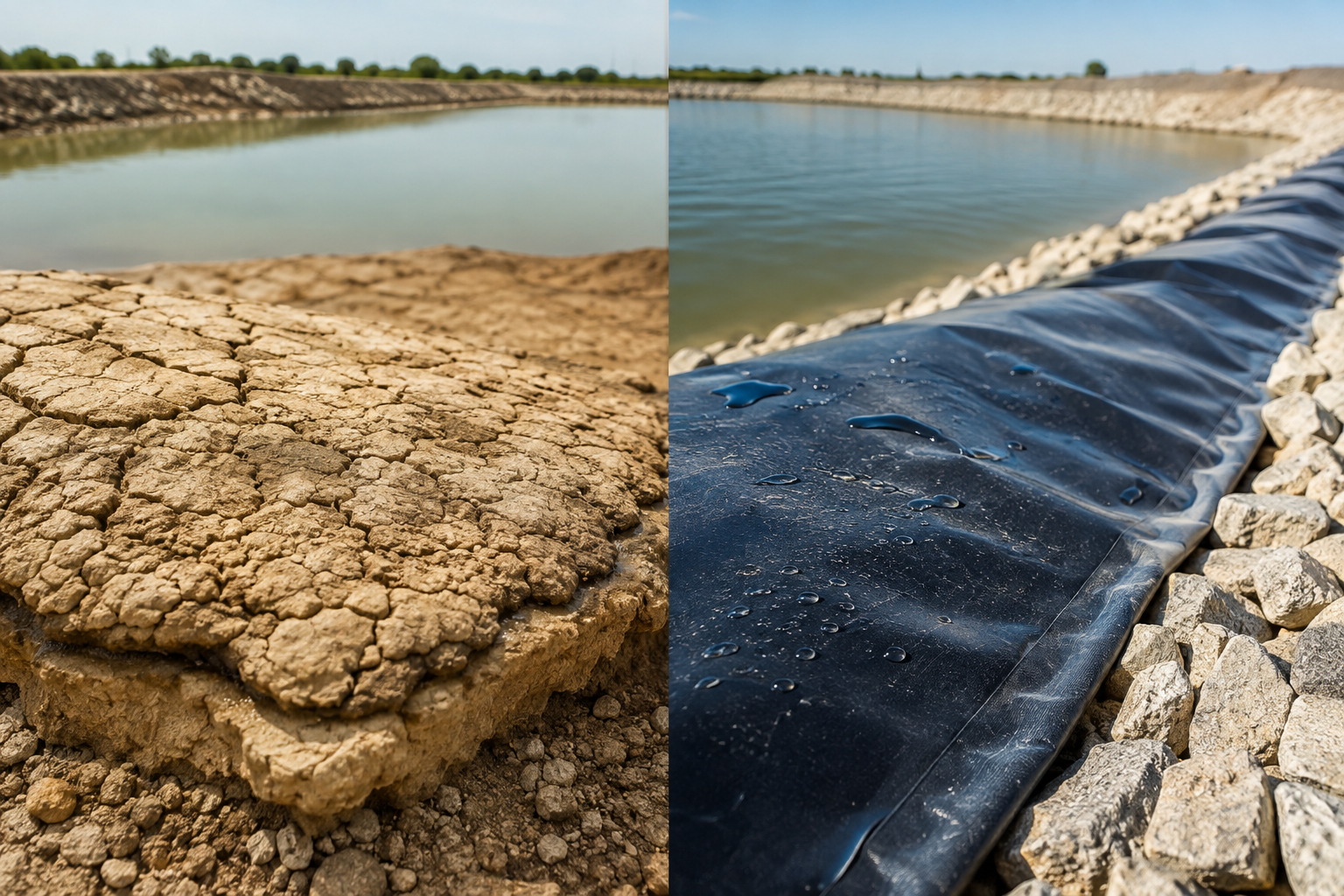
Pond Sealing Cost: Sodium Bentonite vs Synthetic Liners

Maintenance and Repair Realities

When a leak occurs in a synthetic liner, finding the point of failure beneath thousands of gallons of murky water is notoriously difficult. Repairs require underwater patch kits, professional divers, or complete basin drawdowns.

With sodium bentonite, spot maintenance is simple. If a localized seep develops along a bank, granular bentonite can be sprinkled over the water surface directly above the leak zone. The water current pulls the dense clay particles down into the fissure, where they swell and seal the seepage pathway without draining the pond.

Soil Suitability and Chemical Limitations

Sodium bentonite is not a universal solution for every soil type or water chemistry. Understanding site limitations prevents costly project failures.

Site Assessment Steps

  1. Evaluate Soil Texture: Determine if the subgrade contains over 50% coarse gravel or rock. If so, a synthetic liner or Geosynthetic Clay Liner (GCL) is required. If the soil consists mainly of sand, silt, or light clay, proceed to water testing.
  2. Analyze Water Chemistry: Test for high calcium concentrations (above 300 ppm) or high electrical conductivity (EC above 4.0 dS/m). High calcium triggers cation exchange, displacing sodium ions and reducing clay swell by up to 60%. If water is high in calcium or salinity, select HDPE/EPDM liners or use polymer-treated bentonite. If fresh water is present, high-swelling sodium bentonite remains the optimal choice.

When Sodium Bentonite Works Best

Bentonite excels in soils containing a balance of sand, silt, and fine aggregates (sandy loams, silty clays, and fine sands). The clay swelling fills inter-particle spaces, binding native soil into a monolithic hydraulic barrier.

Cation Exchange and Water Salinity Risks

High concentrations of dissolved calcium, magnesium, or extreme salinity in the water supply can compromise sodium bentonite performance. Calcium ions displace sodium ions on the montmorillonite clay structure in a process called cation exchange.

When calcium replaces sodium, the clay loses its high-swelling capacity, converting into low-swelling calcium bentonite. This reduces expansion by up to 60% and increases permeability.

If your water test reveals high hardness (calcium levels above 300 ppm) or high electrical conductivity, you must either:

  • Apply higher dosages of sodium bentonite (1.5x standard rates).
  • Use chemically modified, polymer-treated bentonite designed for saline environments.
  • Select a synthetic HDPE geomembrane.

When Synthetic Liners Are Mandatory

Synthetic membranes are the superior choice when:

  • The site subgrade consists of fractured bedrock, open-graded gravel, or pure coarse aggregate with zero fine particles.
  • The basin holds harsh industrial chemicals, high-salinity brine, or acidic mining runoff.
  • The water level fluctuates rapidly and repeatedly, leaving upper banks exposed to extreme drying conditions for months at a time.

Cost Comparison Scenarios: 1-Acre Pond Case Study

To visualize the total cost of ownership, consider a standard 1-acre (43,560 sq. ft.) agricultural irrigation pond with 3:1 side slopes.

Scenario A: High-Swelling Sodium Bentonite (Mixed-In Method)

  • Material: 4 lbs/sq. ft. sodium bentonite (87 tons total) = $17,400
  • Freight & Logistics: $3,500
  • Site Prep & Earthwork: Earth-moving tractor, disking, moisture conditioning = $6,500
  • Compaction: Vibratory smooth-drum roller = $4,000
  • Protective Cover Layer: $3,000
  • Initial Project Total: $34,400 ($0.79 / sq. ft.)
  • 30-Year Maintenance / Repairs: $1,500 (spot treatment clay)
  • 30-Year Total Cost of Ownership: $35,900

Scenario B: 60-Mil HDPE Synthetic Liner System

  • Material: 45,000 sq. ft. 60-mil HDPE geomembrane = $36,000
  • Underlayment: 8 oz non-woven geotextile fabric = $11,250
  • Freight & Logistics: $2,800
  • Subgrade Prep & Fine Grading: Rock removal and smoothing = $8,000
  • Professional Seaming Labor & Certification: $12,500
  • Anchor Trenching & Backfill: $3,500
  • Initial Project Total: $74,050 (1.70 / sq. ft.)
  • 30-Year Maintenance / Liner Replacement (1 cycle): $65,000
  • 30-Year Total Cost of Ownership: $139,050

In standard soil conditions, a properly installed sodium bentonite clay seal delivers over 60% savings on initial capital expenditure and over 70% savings in long-term total cost of ownership compared to synthetic membranes.

How to Choose the Right Solution for Your Project

Use this practical checklist to match your project specifications with the correct sealing method.

Choose High-Swelling Sodium Bentonite If:

  • Your subgrade soil contains a mix of sand, silt, or light clay.
  • You want a permanent, self-healing seal that never needs full structural replacement.
  • The pond will support livestock, aquaculture, fish, or wildlife.
  • You have access to standard farm or excavation machinery (tractors, tillers, rollers).
  • You want to minimize upfront capital outlays while achieving long-term performance.

Choose Synthetic Liners If:

  • The site sits on porous gravel, fractured rock, or coarse subgrade with no fines.
  • Water chemistry contains extreme calcium levels or high industrial salinity.
  • The containment holds hazardous materials or industrial process wastewater requiring double-containment leak detection.
  • You require immediate 100% water retention without waiting for clay hydration and compaction cycles.

Sourcing Quality Materials for Permanent Pond Sealing

Project success hinges on material specification. Low-grade or contaminated clay leads to seepage, water loss, and unexpected repair costs.

When sourcing sodium bentonite, verify that the supplier provides pure, non-treated sodium montmorillonite with:

  • A minimum free swell index of 24 mL/2g
  • High montmorillonite content ($ge 85\%)
  • Consistent particle sizing for uniform soil blending

Axewelledge provides high-swelling Sodium Bentonite directly from strategic mining reserves, ensuring consistent purity, superior expansion ratios, and reliable long-term performance for agricultural, civil, and industrial water containment projects worldwide.

Step-by-Step DIY Bentonite Pond Sealing Guide

For small to medium pond projects (under 20,000 sq. ft.), landowners can successfully install sodium bentonite using the soil-mixed method:


  1. Drain and Dry: Empty the basin completely and allow the soil to dry until equipment can operate without rutting.
  2. Clear the Subgrade: Remove roots, trees, brush, and rocks larger than 1.5 inches.
  3. Calculate Quantity: Multiply your pond floor and slope surface area (in sq. ft.) by your target application rate (e.g., 4 lbs/sq. ft.).
  4. Distribute Bentonite: Lay out bags or spread bulk clay evenly across the pond basin.
  5. Disk and Blend: Rototill or disk the clay into the top 4 to 6 inches of soil until thoroughly mixed.
  6. Moisten and Compact: Lightly mist the soil mixture with water and compact heavily using a roller or wheel-loader, making at least 4 passes.
  7. Add Cover Layer: Spread 4 to 6 inches of un-amended topsoil over the compacted seal to prevent erosion.
  8. Fill Slowly: Introduce water slowly over a splash plate or rock apron to avoid scouring the bottom cover layer.
×

We'd Love to Hear from You










