Axewelledge, a leading exporter from India, specializes in high-quality Bentonite. With a commitment to excellence, we supply premium Bentonite to the Middle East and Southeast Asia markets.


North Angle Complex, 304,
150 Feet Ring Rd, Opposite Ambedkar Nagar BRTS Stop,
Madhav Park, Punit Nagar,
Mavdi, Rajkot, Gujarat 360004
© Axewelledge 2026, All Rights Reserved.
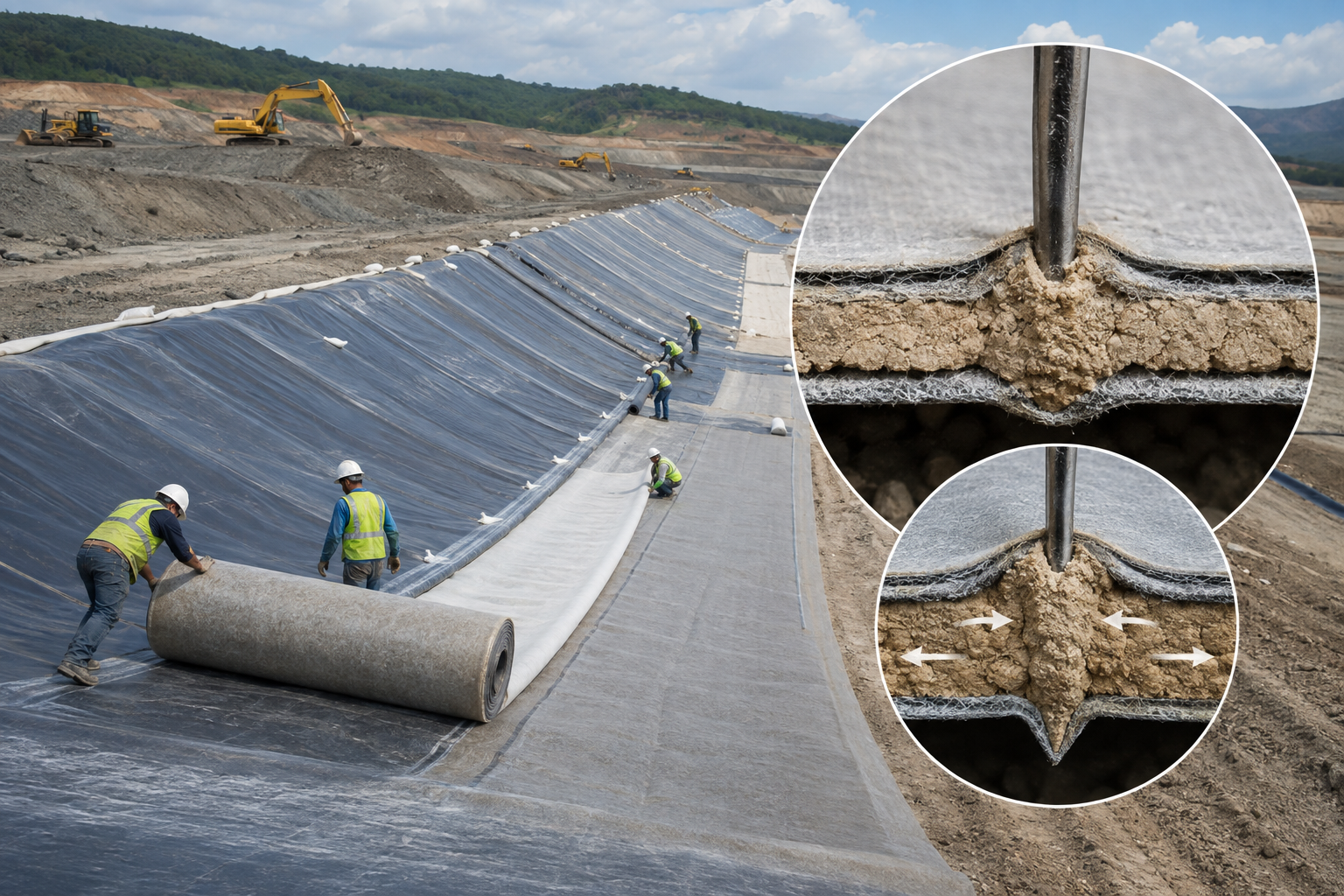
Conventional compacted clay liners fail when mining operations face seismic shifts, heavy equipment loads, or chemical weathering. A single puncture in a tailings storage facility (TSF) can release toxic slurry, acidic leachates, and heavy metals directly into nearby aquifers. Self-healing geosynthetic clay liners (GCLs) solve this vulnerability by combining synthetic carrier geotextiles with high-swelling sodium bentonite clay. When hydration occurs, the sodium bentonite swells up to 15 times its dry volume, expanding into punctures, tears, or seam gaps to automatically restore hydraulic integrity.
For mine operators, engineers, and environmental managers, self-healing GCLs provide an engineered barrier that significantly reduces leak risks while lowering installation costs compared to traditional thick clay layers.
To understand why self-healing GCLs work under extreme tailings conditions, you must examine the mineral structure of sodium bentonite. Unlike calcium bentonite, which features limited swelling capabilities, high-purity sodium bentonite consists primarily of sodium montmorillonite.
When water molecules contact the sodium montmorillonite lattice, they penetrate the interlayer spaces between microscopic clay platelets. The exchangeable sodium cations (Na + ) draw hydration water into the crystal structure, forcing the platelets apart. This microscopic expansion creates a gelatinous mass that exerts swelling pressure against surrounding media.
The self-healing hydraulic sealing sequence operates across four physical stages:
In a GCL, this bentonite layer sits encapsulated between two geotextiles held together by dense needle-punching or stitching. When a sharp aggregate or installation tool punctures the outer geotextile, the exposed sodium bentonite hydrates immediately upon contact with moisture. The swelling clay flows directly into the breach. As long as the GCL is under physical overburden stress (confinement pressure from tailings or soil layers), the expanding gel compresses into a dense, impervious plug with a hydraulic conductivity often lower than 1×10 ?11 meters per second.
Self-healing capabilities depend heavily on the nature of the breach and the surrounding environment:
2+ or magnesium Mg 2+ ) in acidic mine drainage can replace sodium ions. This cation exchange suppresses swelling. Mine operators must specify polymer-modified bentonite when dealing with aggressive, highly saline, or low-pH tailings.
Tailings storage facilities hold millions of tons of waste slurry containing heavy metals, process chemicals like cyanide or sulfuric acid, and fine solids. Historically, mines relied on Compacted Clay Liners (CCLs) or standalone Geomembranes (HDPE liners). Both approaches carry inherent weaknesses when used alone.
Constructing a CCL requires sourcing thousands of cubic meters of natural clay, hauling it to the site, laying down 300 to 900 millimeters of material, and compacting it in meticulous lifts. In arid mining regions like Western Australia, the Atacama Desert, or the American Southwest, high-quality clay is rarely available nearby. Hauling clay generates massive carbon emissions and elevated capital expenditure.
Furthermore, CCLs are rigid. Ground settlement beneath a TSF causes CCLs to crack. Freeze-thaw cycles and desiccation during dry seasons create micro-fissures that permanently ruin the liner's hydraulic conductivity.
High-density polyethylene (HDPE) geomembranes offer excellent chemical resistance and near-zero permeability. However, they lack self-healing capacity. A construction vehicle driving over an un-cushioned geomembrane, a sharp rock in the subgrade, or a bad field weld creates an unsealed hole. Driven by heavy hydraulic head from tailings liquid, fluid shoots through small punctures at extreme velocities—a phenomenon known as high-velocity leak piping.
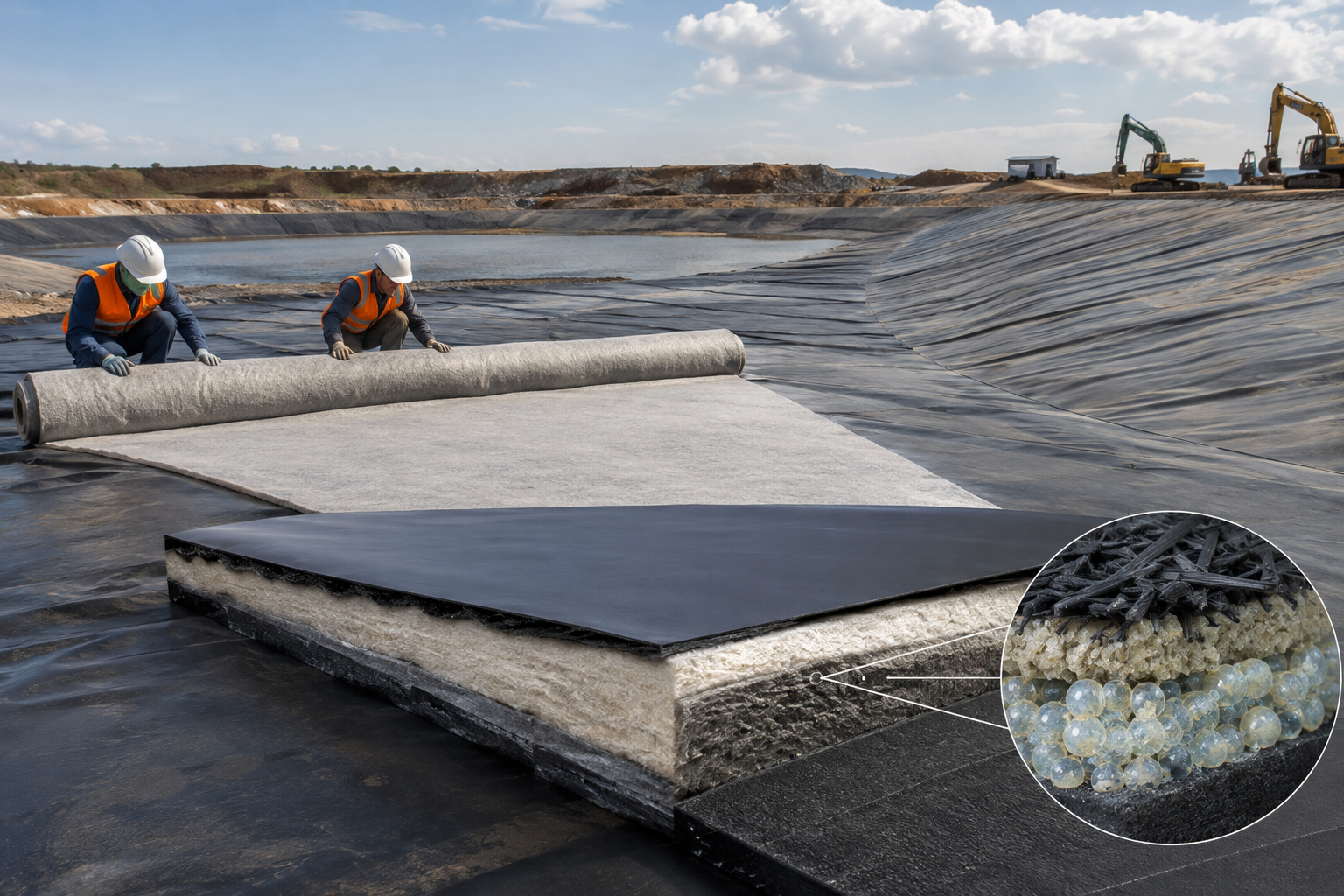
Modern mining regulations increasingly mandate a composite lining system: an HDPE geomembrane installed directly over a self-healing GCL.
When a puncture occurs in the HDPE layer, liquid passes through the hole and immediately contacts the GCL below. The sodium bentonite hydrates, swells, and seals the underside of the geomembrane puncture. This dynamic interaction blocks fluid flow even under high hydraulic heads, reducing total leakage rates across the TSF footprint by over 99.9% compared to standalone liners.
| Technical Feature | Compacted Clay Liner (CCL) | Standalone HDPE Geomembrane | Self-Healing GCL Composite |
|---|---|---|---|
| Typical Thickness | 300 mm – 900 mm | 1.5 mm – 3.0 mm | 5.0 mm – 10.0 mm |
| Hydraulic Conductivity | 1×10 ?9 m/s | Impermeable (until punctured) | 1×10 ?11 m/s (self-healing) |
| Resistance to Differential Settlement | Poor (cracks easily) | Moderate (can stretch, but tears under sharp stress) | Excellent (flexes and self-seals) |
| Puncture Self-Repair | None | None | High (seals punctures up to 25 mm) |
| Airspace/Volume Impact | Consumes massive TSF storage volume | Minimal volume loss | Minimal volume loss |
| Sensitivity to Desiccation | High (cracks permanently) | N/A | Low (re-heals upon rewetting under load) |
| On-Site Freight/Installation | Very High (thousands of truckloads) | Moderate (specialized welding required) | Low (rolls ship easily, fast roll deployment) |
Not all bentonite liners handle aggressive mining fluids equally well. Raw, untreated sodium bentonite excels in neutral, freshwater environments. However, mine tailings liquids often exhibit extreme chemical profiles:
When divalent cations like Ca 2+ or Mg 2+ present in tailings liquor infiltrate standard sodium bentonite, they displace the single-charged Na + ions on the clay platelet surfaces. This process, called cation exchange, shrinks the electrical double layer surrounding each clay particle. The clay loses its swelling pressure, converting the sodium bentonite into a higher-permeability calcium-like bentonite.
To counter cation exchange, mineral engineers utilize two specialized technical strategies:
When specifying a GCL for tailings containment, mine operators should always require ASTM D6766 testing (Fluid Permeability of Hydraulic Barriers using Site-Specific Liquids) rather than relying solely on freshwater test data (ASTM D5887).
Even the highest-grade self-healing liner will fail if mishandled during deployment. Follow this step-by-step installation protocol to guarantee long-term performance in high-stress mining environments.
Remove all organic material, sharp rocks, vegetation, and debris larger than 15 millimeters from the subgrade. Compact the foundation surface to at least 95% Standard Proctor Density. The subgrade must be smooth, uniform, and free of sudden elevation changes or standing water.
Deploy GCL rolls using a core bar and spreader beam attached to an excavator or front loader. Avoid dragging rolls directly across rough soil, which can damage the outer geotextile. Align panels along the slope fall-line (down hill) rather than across slopes to prevent seam tension.
Ensure a minimum longitudinal panel overlap of 300 millimeters (12 inches) and end-of-roll overlap of 1500 millimeters (20 inches). Keep overlap zones clean of loose dirt, rocks, or mud prior to sealing.
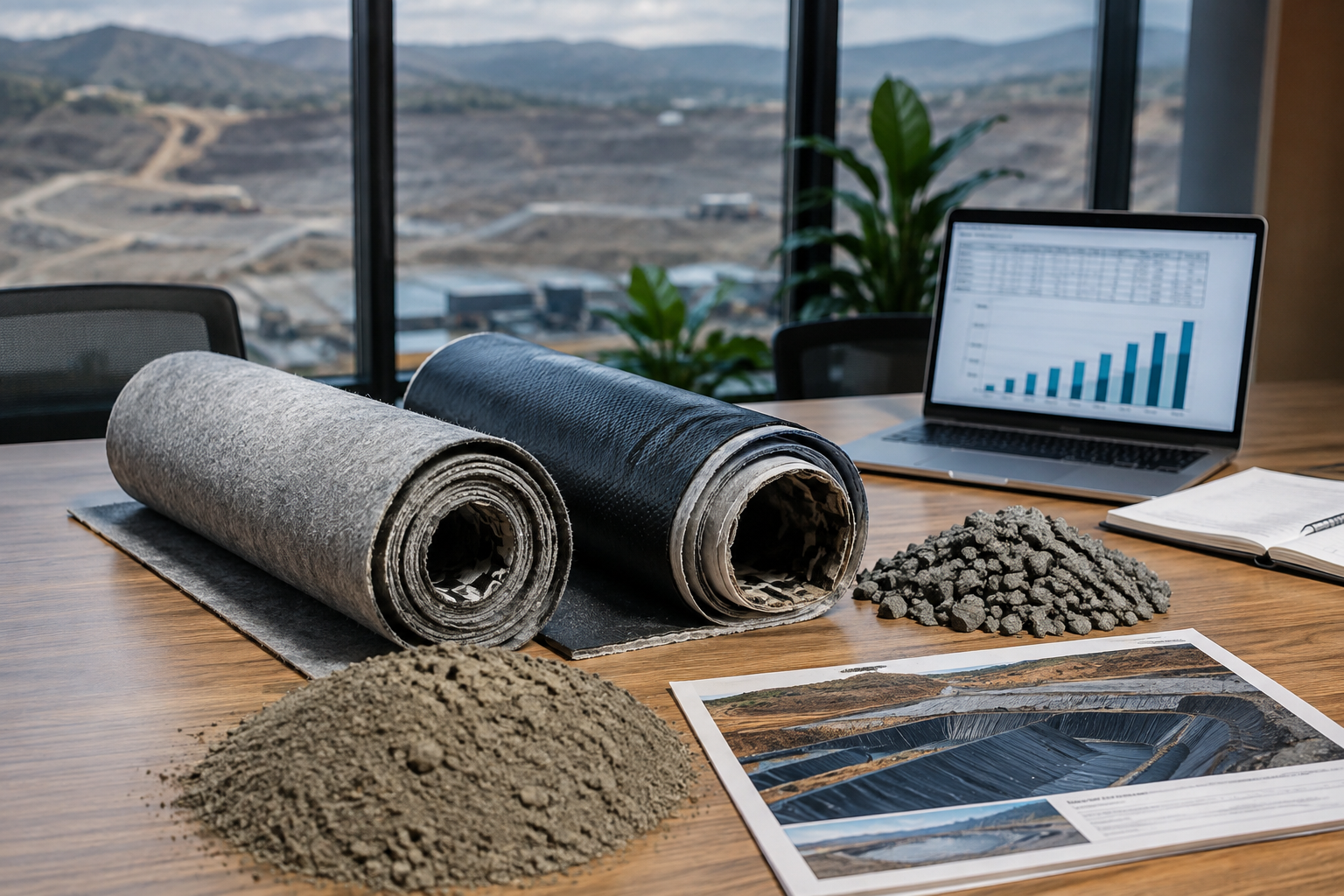
Along all longitudinal and transverse seams, apply a continuous bead of high-purity granular sodium bentonite between the overlapping panels at a minimum rate of 0.4 to 0.5 kilograms per linear meter. This supplemental bentonite guarantees a self-healing seal along seam edges.
Cover the deployed GCL with an HDPE geomembrane or a protective soil layer on the same day it is laid down. Do not leave deployed GCL panels exposed to rain or premature hydration without adequate confinement pressure. Premature swelling without overburden stress degrades the bentonite structure.
Perform continuous visual inspection during panel deployment. Check for thin spots, torn geotextiles, or improper overlaps. Document every panel placement on an as-built QA/QC map.
Evaluating containment liner costs requires calculating several interdependent components:
| Line Item | Compacted Clay Liner (CCL) | Geosynthetic Clay Liner (GCL) |
|---|---|---|
| Raw Material Sourcing | High (requires local clay pits) | Moderate (factory-manufactured rolls) |
| Freight & Shipping | Very High (hundreds of dump truck runs) | Low (compact rolls on standard flatbeds) |
| Earthmoving & Field Labor | High (multiple compacted lifts) | Low (rapid mechanical roll deployment) |
| Consumed TSF Storage Volume | Massive (300 mm – 900 mm profile) | Minimal (5 mm – 10 mm profile) |
| Contingency & Remediation Risk | High (cracking from settlement) | Low (self-healing bentonite core) |
A single flatbed trailer carrying rolled GCLs covers approximately 4,000 to 5,000 square meters of liner area. Providing the equivalent hydraulic protection using a 600-millimeter-thick Compacted Clay Liner requires over 300 dump-truck loads of select clay soil.
In remote mining operations—such as those in northern Canada, inland Western Australia, or high-altitude South American ranges—the freight cost savings from using compact GCL rolls often covers the entire purchase price of the geosynthetic material.
Tailings storage capacity is a finite revenue driver for mine owners. Every vertical meter occupied by thick soil liners is a meter that cannot store mineral processing waste.
A composite GCL/Geomembrane system measures under 15 millimeters thick, compared to a 600-to-900-millimeter compacted clay layer. Replacing a thick clay liner with a GCL reclaims hundreds of thousands of cubic meters of valuable containment volume within the TSF footprint, extending mine lifespan without expanding the physical footprint.
Regulatory penalties and remediation expenses for ground-water contamination from leaking tailings facilities run into millions of dollars. The self-healing property of sodium bentonite provides an active, dynamic insurance policy against subgrade settling, seismic cracking, and pinhole punctures that occur post-closure.
Environmental protection agencies worldwide are tightening containment standards for mining operations to prevent catastrophic dam failures and toxic seepage.
Under Subtitle D and mining-specific RCRA guidelines, the US EPA encourages composite liner systems for industrial waste holding ponds. GCLs meeting ASTM D5887 permeability standards and ASTM D5890 swell index metrics are widely accepted as functional equivalents to traditional clay layers.
In high-seismic zones across the Andes, regulators heavily favor GCL composite liners over rigid compacted clay layers. Flexible GCLs withstand earthquake-induced ground displacements without cracking, protecting vulnerable mountain watersheds.
State environmental authorities in Western Australia and Queensland require rigorous chemical compatibility verification before approving liner systems for hypersaline or highly acidic mine residues. Polymer-enhanced GCLs have become the standard solution for dry-stack tailings and evaporative containment ponds.
Working with mine design engineers reveals several common mistakes during TSF liner selection and installation:
At Axewelledge, we supply premium sodium bentonite reserves that serve as the functional core for advanced geosynthetic clay liners globally. With over 60 million tons of high-grade reserves, advanced mineral processing technology, and strict quality controls, our bentonite delivers the high swelling capacity, chemical resilience, and self-healing performance demanded by severe industrial and mining containment projects.
Whether you are designing a new tailings storage facility, capping an abandoned mine site, or building secondary containment for heap leach pads, choosing high-purity sodium bentonite ensures your liner self-heals under pressure and protects surrounding ecosystems for generations.
Ensure your containment system stands up to real-world mining conditions. Contact the mineral engineering specialists at Axewelledge to request technical data sheets, chemical compatibility testing, or high-purity bentonite samples for your next project.













Have questions about our products? We're here to help!