Axewelledge, a leading exporter from India, specializes in high-quality Bentonite. With a commitment to excellence, we supply premium Bentonite to the Middle East and Southeast Asia markets.


North Angle Complex, 304,
150 Feet Ring Rd, Opposite Ambedkar Nagar BRTS Stop,
Madhav Park, Punit Nagar,
Mavdi, Rajkot, Gujarat 360004
© Axewelledge 2026, All Rights Reserved.
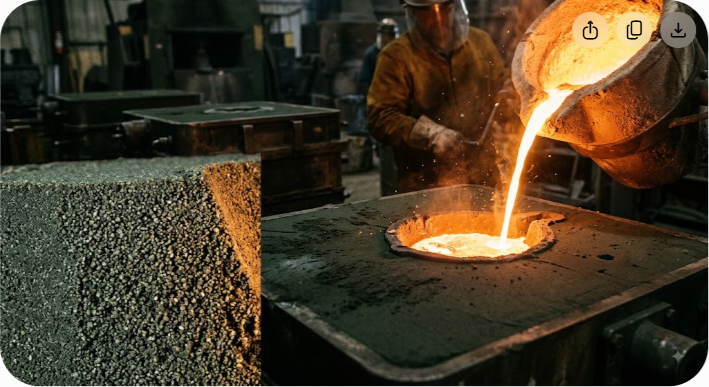
Scabs and rat-tails cost foundries thousands of dollars every week in scrap and post-casting rework, yet both stem from a single predictable physical event: the sudden thermal expansion of silica sand when hit by molten metal. When liquid iron or steel at 2,500 degrees Fahrenheit pours into a greensand mold, quartz grains instantly undergo a phase transformation, expanding by roughly 1.5% in volume. If the sand face cannot cushion or accommodate that expansion, the upper layer buckles, peels, or shears off, leaving ugly fins, ridges, or metal-crusted projections on your casting.
Fixing these expansion defects does not require complex alchemy. It requires managing three tightly linked factors: quartz thermal dynamics, bentonite binder elasticity, and mold compaction density. This guide breaks down the exact failure mechanisms behind scabs and rat-tails, walks through live diagnostic methods, and provides a clear blueprint to eliminate expansion defects entirely.
Greensand mold expansion defects are surface or sub-surface casting anomalies caused by the rapid, non-uniform volumetric growth of sand grains at elevated temperatures. When hot metal fills the mold cavity, extreme radiant heat transfers into the sand face within milliseconds. This creates a sharp temperature gradient between the burning hot surface layer and the cooler sand just half an inch behind it.
As the surface sand expands against the cooler, rigid backing sand, immense compressive stress develops parallel to the mold face. If these compressive forces exceed the hot strength or shear strength of the sand mixture, the mold surface ruptures. Liquid metal then flows into or underneath the fractured sand layer.
Foundries categorise these failures into three main stages based on severity:
While they look different during quality inspection, rat-tails, buckles, and expansion scabs are members of the exact same defect family. A rat-tail is simply a scab that did not fully break away.
To prevent expansion defects, you must understand what happens inside the sand matrix during the first few seconds of pouring. The primary driver is the crystalline phase transformation of silica.
Standard foundry silica sand consists mainly of alpha-quartz. As alpha-quartz heats up, its crystal lattice expands gradually. However, when the temperature reaches 1,076 degrees Fahrenheit (573 degrees Celsius), alpha-quartz undergoes a rapid phase change into beta-quartz. This transformation is instantaneous and comes with a sudden linear expansion of roughly 0.45% to 0.60%, which translates to a volumetric jump near 1.5%.
Alpha-Quartz (Cool Sand) ---> [Heats to 1,076 deg F / 573 deg C] ---> Beta-Quartz (Expanded Sand)
This rapid shift creates two competing zones in the mold wall:
When the expanding surface layer tries to push outward, it encounters resistance from the rigid backing sand. Trapped in a fixed volume, the surface sand undergoes severe lateral compression. If the weak wet zone behind it cannot sustain the shear stress, the hot surface layer buckles or shears free. Molten metal instantly fills the gap behind the sheared shell, freezing into a classic scab.
Although rat-tails and scabs originate from the same mechanical breakdown, identifying which one is occurring tells you how close your sand system is to catastrophic failure.
| Attribute | Rat-Tail Defect | Expansion Scab Defect |
|---|---|---|
| Visual Appearance | Shallow, linear depression or low ridge with clean, sharp edges | Rough, irregular metal slab protruding from the casting surface |
| Defect Depth | Typically 0.5 mm to 3 mm deep | Variable; can range from 3 mm to over 15 mm thick |
| Sand Involvement | Sand layer cracks but remains attached to the mold wall | Sand crust completely detaches and gets embedded or surrounded by metal |
| Root Mechanical Failure | Compressive yield of the surface layer without complete shear detachment | Complete shear failure at the condensation zone followed by metal penetration |
| Post-Casting Rework | Moderate grinding or shot blasting required to smooth the line | Extensive grinding, gouging, or complete scrapping of the part |
| System Indication | Early warning sign: sand expansion is marginally exceeding elasticity | Critical warning sign: severe lack of cushion or dangerously low wet tensile strength |
If you start seeing rat-tails on flat, cope-side casting surfaces, your mold sand is sending an early alarm. Ignoring rat-tails on simple jobs almost guarantees severe scabbing when you move to larger, thicker-walled castings with longer pour times.

Expansion defects rarely happen due to a single bad variable. They are almost always the result of compounding errors across sand grain selection, binder balance, water control, and molding parameters.
Unimodal, uniform sand with a high concentration of grains on a single sieve expands uniformly in all directions at the exact same moment. This synchronized expansion produces massive lateral stress. Conversely, sands with a wide grain distribution allow smaller grains to shift into voids between larger grains during heating, absorbing part of the volumetric growth.
Additionally, pure silica sand has a much higher and sharper thermal expansion curve than alternative minerals like chromite, zircon, or ceramic synthetic sands.
Bentonite clay is the spring cushion of greensand. High-quality sodium bentonite expands and hydrates to form an elastic film around each sand grain. This film flexes under thermal stress, allowing grains to expand without rupturing the mold face.
If your sand system relies on low-grade calcium bentonite, has an insufficient active clay percentage, or suffers from high oolitic (dead-burned) clay buildup, the binder layer becomes brittle. It loses its ability to flex at high temperatures, causing the sand face to snap under compressive load.
As steam migrates back into the mold wall, it creates a zone where moisture climbs above optimum levels. The strength of the sand in this wet zone is measured as wet tensile strength (WTS). If your WTS drops below 0.15 to 0.20 N/cm2, the wet zone cannot resist the shear forces generated by the expanding dry surface layer. The dry layer peels off like wallpaper from a damp wall.
Over-ramming or excessive squeeze pressure forces sand grains tightly against one another, eliminating interstitial air gaps. While high mold hardness yields excellent dimensional accuracy, it removes the physical room required for quartz grains to expand. The expansion forces have nowhere to go except outward into the cavity, tearing the sand face open.
Excess water in greensand lowers green strength and drastically reduces wet tensile strength while increasing steam generation. Steam creates high pressure in the mold wall, pushing against the expanding surface crust. Poor mulling compounds this issue by leaving clay clusters un-dispersed, meaning some sand grains receive no clay coating at all.
Long pouring times and slow metal rise expose the upper mold face (cope) to prolonged intense radiant heat before the metal actually touches it. This extended radiant heating bakes the sand face, causing it to expand and buckle long before the liquid metal covers and supports it.
Eliminating expansion defects requires a systematic approach to sand preparation, mold density control, and metallurgical engineering. Work through these seven practical steps to stabilize your mold walls.
Your clay binder is your primary line of defense against thermal expansion stress. Switch from standard or treated calcium clays to high-grade natural sodium bentonite with a high swelling capacity (typically 24 to 30 ml/2g or higher) and high thermal durability. Natural sodium bentonite maintains its water-binding lattice structure even when exposed to high radiant temperatures, preserving high wet tensile strength in the moisture condensation zone.
Maintain your active sodium bentonite level between 7.0% and 8.5% depending on casting weight and wall thickness.
Coal dust (seacoal) and lustrous carbon formers serve a critical dual purpose. First, they produce a volatile gas cushion that prevents metal penetration. Second—and crucial for expansion control—coal dust particles burn out or soften at high temperatures, creating microscopic voids and a plastic phase that absorbs expanding quartz grains.
If environmental regulations or smoke limits require lower coal dust levels, use engineered carbonaceous blends containing pre-gelatinized starches or hydrocarbon resins. These additives provide excellent thermal buffering at lower addition rates.
When severe expansion defects persist on flat, high-radiant surfaces, introduce 0.5% to 1.5% cereal binder (dextrin or pre-gelatinized corn starch) or fine wood flour into your sand mix. Cereal binders burn out rapidly upon heat contact, creating interstitial space for sand grains to expand into. More importantly, cereal additives dramatically boost wet tensile strength, preventing premature shear failure in the condensation layer.
Avoid using sharp, narrow three-screen sands where 70% or more of the sand sits on two adjacent sieves. Instead, balance your system to a four-screen distribution with an AFS Grain Fineness Number (GFN) between 55 and 65 for iron, or 45 to 55 for heavy steel castings.
A wider grain distribution provides natural voids where fine grains fit between coarse grains, absorbing thermal expansion without transferring massive lateral force across the entire mold wall.

Keep your greensand compactability strictly within target limits—typically 38% to 45% for high-pressure automatic molding lines, and 42% to 48% for jolt-squeeze or hand molding. Excessive moisture drastically weakens the condensation layer. Follow the golden rule of sand lab control: keep moisture as low as possible while maintaining target compactability and green compression strength.
Compactability Target (High-Pressure Lines): 38% - 45% Compactability Target (Jolt-Squeeze Lines): 42% - 48% Wet Tensile Strength Minimum: > 0.20 N/cm2
If automatic vertical or horizontal molding machines are set to ultra-high squeeze pressures, back off the squeeze force slightly on flat, sensitive patterns. Target a mold surface hardness of 85 to 92 B-scale units on cavity faces. If mold hardness exceeds 95 B-scale units, sand grains are packed so tightly that expansion forces will inevitably shear the mold surface.
Modify your gating system to fill the mold cavity as rapidly and smoothly as possible without causing erosion. Use multiple gates to distribute hot metal quickly across the floor of the cavity rather than allowing a single hot metal stream to radiate heat onto the cope for tens of seconds. Shorter pour times mean less time for the cope sand to bake, expand, and buckle before liquid metal seals the cavity.
Routine green compression strength and compactability testing are not enough to catch expansion defects before they strike. Modern foundries running high-yield lines rely on three specific laboratory measurements:
Wet tensile strength directly measures the force required to pull apart a sand specimen at the exact moisture levels found in the condensation zone (typically 100 degrees Celsius). Maintain your sand system's WTS above 0.20 N/cm2 (or 2.0 kPa). If WTS drops below 0.15 N/cm2, rat-tails and scabs will appear on large flat castings.
Using methylene blue (MB) titration, regularly calculate your active bentonite percentage. Compare this against your total clay content (loss on ignition / hydrometer methods) to determine your oolitic clay level. Oolitic clay is thermal-damaged clay that coats sand grains, increasing water demand without contributing to plasticity or wet strength. Keep your active-to-total clay ratio above 75%.
Advanced sand labs utilize thermal expansion apparatuses to measure the linear expansion percentage of squeezed core and mold specimens at 1,000 degrees Celsius. By plotting linear expansion against time, metallurgists can verify whether carbonaceous cushioning additives are effectively suppressing peak expansion force.
When defects hit the shakeout line, use this quick-reference diagnostic matrix to trace visual symptoms directly to corrective actions.
| Observation / Symptom | Likely Root Cause | Immediate Shop Floor Fix | Long-Term Process Adjustment |
|---|---|---|---|
| Long, narrow ridges on cope (top) surface of flat castings | Prolonged radiant heat exposure; early-stage sand expansion bucking | Increase pour speed slightly; check pouring ladle height | Add 0.5% cereal binder or starch; broaden sand grain distribution |
| Thick metal slabs with trapped sand on flat drags or vertical walls | Complete shear failure in wet condensation zone due to low wet tensile strength | Reduce moisture addition; boost fresh sodium bentonite addition | Upgrade to premium sodium bentonite with higher thermal durability |
| Scabbing occurring only near the gate entrance | Localized thermal overloading from high metal velocity and stream friction | Redesign gate to enlarge choke area and reduce localized velocity | Apply high-refractory mold wash or zircon facing sand near gate areas |
| Widespread rat-tailing across multiple pattern types | Sand compactability too high; over-rammed mold faces | Reduce hydraulic squeeze pressure on molding machine | Lower system moisture; clear out fine inert dust (oolitic clay) |
| Scabs accompanied by severe mold erosion and sand inclusions | Low green compression strength combined with brittle clay binder | Increase mulling time to ensure full clay activation | Boost active clay content; check muller wheel clearance and plow wear |
An industrial valve manufacturer was experiencing a 6.8% scrap rate on heavy ductile iron valve bodies due to severe cope-side expansion scabs. The castings had flat upper flanges that were exposed to intense radiant heat during a 28-second pouring cycle.
The combination of low wet tensile strength (0.11 N/cm2) and a narrow 3-screen sand distribution left the mold with zero elasticity under thermal load. The 28-second pour exposed the un-supported cope face to intense heat, causing the surface sand to fracture at the weak condensation layer.
Within 48 hours of cycling the modified sand batch through the system, wet tensile strength rose to 0.24 N/cm2. Cope-side scabbing dropped from 6.8% to under 0.2%, saving the foundry thousands of dollars per week in scrap and grinding labor while improving overall surface finish.
Greensand expansion defects like scabs and rat-tails are not an inevitable cost of running a foundry. They are physical symptoms of a sand matrix that has lost its elasticity, wet strength, or internal expansion room. By controlling your sand grain distribution, maintaining low moisture relative to compactability, optimizing mold hardness, and utilizing high-swelling bentonite binders, you can eliminate expansion failures and dramatically improve your casting yield.
Partnering with a reliable mineral provider ensures your sand system receives consistent, high-purity binders batch after batch. Axewelledge supplies top-tier Indian Sodium Bentonite engineered specifically for high-stress greensand foundry applications, delivering the exceptional swelling capacity, thermal durability, and wet tensile strength required to stop expansion defects at the source.
To upgrade your sand system performance or request detailed technical specifications on foundry-grade sodium bentonite, reach out to the metallurgy team at Axewelledge today.













Have questions about our products? We're here to help!