Axewelledge, a leading exporter from India, specializes in high-quality Bentonite. With a commitment to excellence, we supply premium Bentonite to the Middle East and Southeast Asia markets.


North Angle Complex, 304,
150 Feet Ring Rd, Opposite Ambedkar Nagar BRTS Stop,
Madhav Park, Punit Nagar,
Mavdi, Rajkot, Gujarat 360004
© Axewelledge 2026, All Rights Reserved.
Think about the last time you passed a massive civil engineering project, a sprawling municipal landfill, or an active oil rig. What keeps the liquids where they belong? What prevents hazardous waste from contaminating local aquifers, or keeps a deep borehole from collapsing under immense subterranean pressure? The answer usually comes down to a remarkably versatile mineral hidden right beneath our feet: sodium bentonite clay. For decades, American industries have relied on this natural powerhouse to handle some of the toughest sealing and drilling challenges on earth. But not all clay is created equal, and understanding how to leverage the unique properties of premium sodium bentonite can mean the difference between a project that stands the test of time and one that faces failure.
To understand why this mineral is so highly prized in American industrial sectors, we have to look at its microscopic structure. Sodium bentonite is a natural volcanic ash deposit that has weathered over millions of years in the presence of seawater. This unique geological history gives it a high concentration of sodium ions trapped between its crystalline layers. Geologists classify it as a member of the smectite group, dominated by the mineral montmorillonite.
When you look at montmorillonite under an electron microscope, you see thousands of incredibly thin, sandwich-like layers. Each layer consists of an octahedral sheet tucked neatly between two tetrahedral sheets. Because of a process called isomorphic substitution, where lower-valence cations replace higher-valence ones during formation, these layers carry a net negative electrical charge. The sodium ions act as the balancing counter-ions, sitting loosely between the plates.
This atomic configuration explains why sodium bentonite behaves unlike any other clay. When exposed to water, the highly hydrated sodium ions draw water molecules directly into the interlayer spaces. This forces the crystalline plates apart in a process known as crystalline and osmotic swelling. While standard calcium bentonite might only absorb a modest amount of moisture, high-quality sodium bentonite can swell up to 15 to 20 times its dry volume. When confined, this massive expansion transforms the loose powder or granules into a dense, gelatinous, and highly impermeable barrier that blocks water, chemicals, and gases with efficiency.
How does this swelling action translate into a reliable industrial seal? It comes down to hydraulic conductivity. In the engineering world, hydraulic conductivity measures how easily a fluid can pass through a porous material. Clean gravel might have a high hydraulic conductivity, while tightly packed silts have a lower one. Premium sodium bentonite achieves an exceptionally low hydraulic conductivity, often measured at less than 1x10?? centimeters per second when properly hydrated and compacted.
When you apply sodium bentonite to a porous substrate, such as sandy soil or fractured rock, the clay particles migrate into the voids. As they encounter moisture, they expand rapidly, wedging themselves into every microscopic nook and cranny. Because the swollen gel is highly cohesive, it resists being washed away by moving water. Instead, it forms a continuous, flexible layer that can self-heal. If the ground shifts slightly due to seismic activity or thermal expansion, the bentonite simply deforms and reswells to fill any new gaps, maintaining an uninterrupted seal without requiring human intervention.
Across the United States, municipal managers, environmental engineers, and agricultural developers face strict regulatory standards regarding water containment and waste isolation. Sodium bentonite serves as a foundational material in several critical areas:
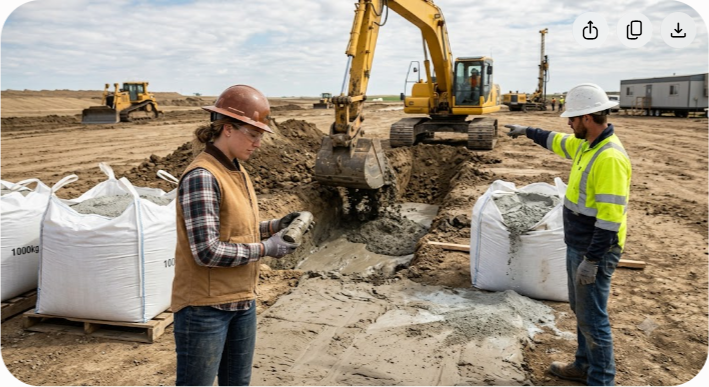
Whether it's a decorative lake on a golf course in Florida, a massive agricultural irrigation reservoir in California, or a dairy waste lagoon in the Midwest, leaking water is an expensive and potentially illegal problem. Traditional synthetic membranes like HDPE liners are prone to punctures from rocks, heavy machinery, or animal hooves. Sodium bentonite offers a natural alternative or supplement. By blending dry bentonite directly into the native soil and compacting it, or applying a pure blanket layer covered with protective earth, operators create an unbreakable seal that lasts indefinitely. Since it's a natural mineral, it won't degrade under ultraviolet sunlight or leach harmful chemicals into the ecosystem.
The Resource Conservation and Recovery Act (RCRA) sets strict mandates for how municipal and hazardous waste landfills must be designed and closed. To prevent rainwater from percolating through trash and turning into a toxic cocktail called leachate, landfill operators install composite capping systems. Sodium bentonite is a primary component here, often utilized in Geosynthetic Clay Liners (GCLs). A GCL consists of a thin layer of high-grade sodium bentonite stitched between two layers of geotextile fabric. When moisture hits the GCL, the clay swells into a highly impermeable sheet, effectively locking out rainwater and forcing it to run off safely into storm drainage networks.
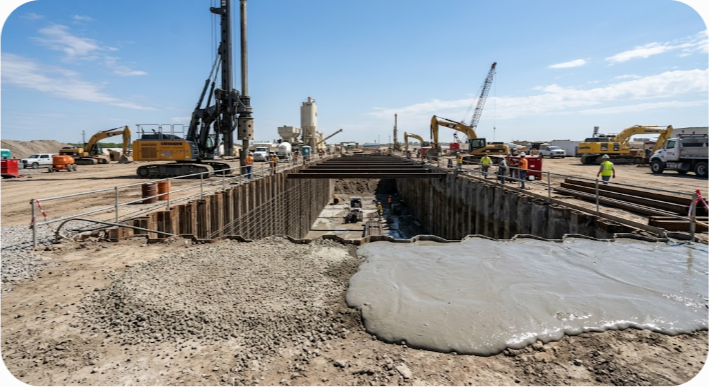
In urban areas where deep foundations are dug right next to existing buildings or high water tables, controlling groundwater movement is a major challenge. Civil engineering teams build slurry walls by digging deep, narrow trenches and filling them simultaneously with a bentonite-water slurry. The heavy weight of the slurry keeps the trench walls from collapsing while the excavation proceeds. Once the trench reaches bedrock, concrete is pumped in from the bottom up, displacing the lighter bentonite slurry. The remaining bentonite forms a slick, impermeable filter cake along the trench walls, preventing groundwater from seeping into the new basement or subway tunnel.
The American oil, gas, and infrastructure sectors run on efficient drilling. From the historic fields of Texas and North Dakota to horizontal directional drilling (HDD) projects under busy intersections in New York, drilling fluids are the lifeblood of the operation. Sodium bentonite is the core additive used to create these complex fluids, often referred to as drilling mud.
When a drill bit cuts through thousands of feet of rock, several critical issues arise simultaneously. First, the rock cuttings must be removed from the bottom of the hole and transported to the surface. Second, the heavy drill string and spinning bit generate immense friction and heat, requiring constant lubrication and cooling. Third, the hydrostatic pressure of the fluid column must balance the natural pressures inside the surrounding rock formations to prevent dangerous blowouts or borehole cave-ins.
Sodium bentonite addresses every single one of these challenges due to its unique thixotropic properties. Thixotropy is a characteristic where a fluid thins out when agitated or sheared but thickens into a gel when left at rest. When the mud pumps are actively running, the bentonite fluid thins out, allowing it to flow easily down the inside of the drill pipe and exit through the bit nozzles at high velocity. As it flows back up the outside of the pipe (the annulus), it carries the rock cuttings along with it.
If the crew needs to pause drilling to add a new section of pipe or repair equipment, the mud pumps are turned off. In a standard fluid, the heavy rock cuttings would immediately settle back to the bottom of the hole, pinning the drill bit and risking a stuck pipe situation. But with a sodium bentonite mud, the fluid instantly gels into a semi-solid state the moment agitation stops, suspending the heavy cuttings perfectly in place. When the pumps restart, the gel breaks down smoothly, and circulation resumes without an issue.
Furthermore, as the bentonite fluid travels up the borehole, the positive pressure forces a small amount of liquid into the porous rock walls. The flat, plate-like clay particles are left behind, plastering themselves against the formation to create a thin, tough, and impermeable 'filter cake'. This filter cake seals off porous zones, preventing expensive drilling fluids from escaping into the earth (lost circulation) and stopping external groundwater from entering and destabilizing the wellbore.
In high-stakes industrial environments, you can't just throw any field clay down a hole or into a pond liner and hope for the best. Engineers require strict verification. In the USA, two primary organizations dictate the quality standards for sodium bentonite: the American Petroleum Institute (API) and the American Society for Testing and Materials (ASTM).
For drilling applications, the gold standard is API Specification 13A (specifically Section 9 or 10 for bentonite). This standard outlines strict metrics for physical and chemical performance, including:
For civil engineering and sealing projects, ASTM standards like ASTM D5890 (Swell Index) and ASTM D5891 (Fluid Loss) are commonly specified. A premium industrial-grade sodium bentonite will typically demonstrate a swell index of 24 milliliters per 2 grams of dry clay or higher. Meeting these benchmarks ensures that the mineral will perform reliably under real-world field conditions, where variable water chemistry and mechanical stress test the limits of the material.
While the United States has its own domestic deposits of bentonite, the massive scale of modern infrastructure and energy projects requires a resilient, global supply chain. This is where strategic global producers play a vital role. Axewelledge, ranking among the top five global producers and operating as a major mine owner and exporter from India, bridges this demand gap by supplying premium-grade sodium bentonite tailored specifically for international industrial standards.
With over 60 million tons of high-quality mineral reserves, our processing operations utilize advanced refinement and milling techniques to ensure that every batch exported to the USA matches the exact particle size distribution, moisture profile, and swelling capacity required by North American engineers. Managing an international supply chain for bulk minerals requires more than just digging clay out of the ground; it requires meticulous quality control at the processing plants, advanced logistics integration, and regional support networks to guarantee that shipments arrive at American ports and project sites on schedule, without contamination.
To achieve the theoretical performance metrics of sodium bentonite in actual field projects, proper application techniques are non-negotiable. Many field failures blamed on 'poor material quality' are actually the result of installation errors.
When sealing a pond using the pure blanket method, the ground must first be cleared of all large rocks, tree roots, and debris that could disrupt the continuous layer. The dry bentonite powder or granules should be spread evenly at the specified rate—typically between 3 to 5 pounds per square foot, depending on the porous nature of the native soil. Once spread, it is vital to cover the bentonite with a protective layer of soil or gravel at least 4 to 6 inches deep. This cover layer provides the confining pressure necessary to force the bentonite to swell into a dense, tight matrix rather than expanding freely into loose, watery mush. For large-scale projects, utilizing pre-fabricated Geosynthetic Clay Liners (GCLs) can dramatically speed up installation while ensuring a perfectly uniform clay distribution.
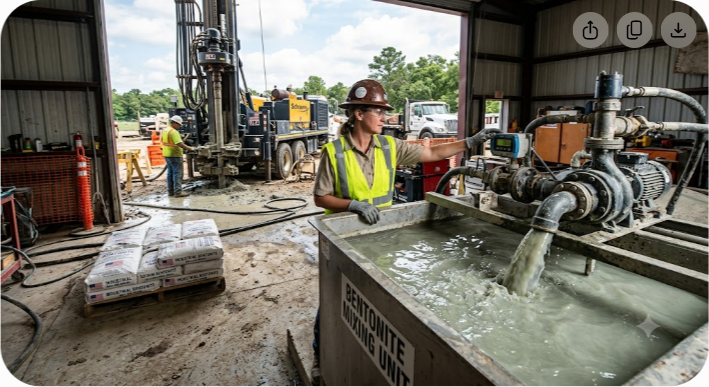
When mixing drilling mud, the order of operations matters. Always add the sodium bentonite powder slowly to water that is being vigorously agitated by a mechanical mixer or a venture hopper. Dumping large clumps of dry clay into stagnant water causes 'fish-eyes'—large balls of dry powder coated in a hydrated outer skin that cannot dissolve or break apart easily. Additionally, pay close attention to the make-up water chemistry. High levels of hardness (calcium or magnesium ions) or excessive salinity can suppress the swelling mechanism of sodium bentonite by crowding out the sodium ions. If your source water is hard, treat it beforehand with soda ash (sodium carbonate) to precipitate out the calcium ions and optimize the pH to a slightly alkaline range of 8.5 to 9.5.
As industrial sectors face increasing scrutiny regarding their environmental footprint, the materials chosen for large projects must be evaluated for their long-term ecological impact. Sodium bentonite holds a significant advantage here because it is a completely natural, chemically inert mineral. It does not introduce synthetic polymers, volatile organic compounds (VOCs), or toxic heavy metals into the soil or surrounding water tables.
In groundwater remediation and protection projects, bentonite plays a proactive role. When used in barrier walls around old industrial sites or chemical storage facilities, it stops plume migration, containing contaminants safely in place until they can be treated or neutralized. Furthermore, because it does not degrade over time, a properly installed bentonite seal can remain effective for centuries, offering a permanent solution that minimizes the need for ongoing maintenance, replacement, or energy-intensive interventions.
From the deep subterranean pathways of oil and gas exploration to the critical environmental barriers protecting our freshwater resources, sodium bentonite stands out as an irreplaceable asset in modern heavy industry. Its remarkable ability to swell, seal, and transform fluid dynamics under extreme pressure makes it a cornerstone material for engineers who refuse to compromise on structural integrity and environmental safety. By selecting high-quality minerals that comply with rigorous API and ASTM metrics, and adhering to meticulous field installation practices, industrial operators can ensure that their projects remain secure, efficient, and compliant for years to come.













Have questions about our products? We're here to help!