Axewelledge, a leading exporter from India, specializes in high-quality Bentonite. With a commitment to excellence, we supply premium Bentonite to the Middle East and Southeast Asia markets.


North Angle Complex, 304,
150 Feet Ring Rd, Opposite Ambedkar Nagar BRTS Stop,
Madhav Park, Punit Nagar,
Mavdi, Rajkot, Gujarat 360004
© Axewelledge 2026, All Rights Reserved.
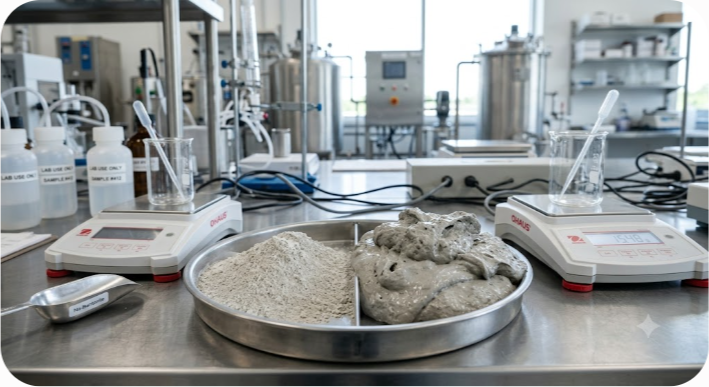
Think about the materials that keep our modern world turning. Often, the most critical components aren't sleek high-tech alloys or complex synthetic polymers. Instead, they're the humble, raw materials pulled directly from the earth. Sodium bentonite is a perfect example of this. You might look at it and see just a pile of greyish, dusty clay. But beneath that simple appearance lies one of the most versatile and high-performing minerals in modern industry.
At Axewelledge, we spend our days knee-deep in the geology of this material. We see how its unique structure changes the way oil wells are drilled, how it protects groundwater from contamination, and how it makes foundations for massive infrastructure projects possible. When you get the right quality of bentonite, it's not just a filler or a cheap additive. It's an engine for efficiency.
What makes sodium bentonite special? It comes down to chemistry at a microscopic level. Bentonite is a type of volcanic ash-derived clay, rich in the mineral montmorillonite. When sodium is the dominant exchangeable ion in that clay, it gains a superpower: it swells.
When water hits high-quality sodium bentonite, the molecules wedge themselves between the thin, plate-like clay layers. The material can expand to several times its original dry volume. Because this process happens inside a confined space, that expansion creates a remarkably tight, impermeable seal. This isn't just about getting wet. It's about creating a barrier that is incredibly difficult for fluids or contaminants to pass through. Understanding this fundamental property is the first step toward leveraging it in your own operations.
If you work in oil and gas, you know the drill—literally. Maintaining an efficient drilling fluid is the difference between a successful well and a costly delay. Your drilling mud isn't just a cooling agent; it's the lifeblood of the borehole.
High-quality sodium bentonite is the gold standard here. It gives the fluid the necessary viscosity to carry drill cuttings to the surface without settling. But more importantly, it helps build a 'filter cake' on the walls of the hole. This thin, tough layer prevents the fluid from seeping into porous formations, which stabilizes the hole and prevents fluid loss. When you use lower-grade material, you might save pennies on the front end, but you'll pay for it with unstable boreholes and inefficient operations. Quality matters.
Infrastructure needs to stay put, and nothing likes to move quite like water. Whether you're working on tunnels, landfills, or earth dams, containing water is often the biggest challenge. Sodium bentonite is a workhorse in civil engineering because it is self-healing.
If you use a synthetic liner, a single puncture can lead to a catastrophic leak. With a bentonite-based barrier, if a crack forms, the clay simply hydrates and swells into that space, effectively sealing itself. This property is why it's used in bentonite mats, slurries, and soil amendments. You're effectively building a living, reacting barrier that stands the test of time.
Environmental compliance is getting tougher, and that's a good thing. Sodium bentonite plays a quiet but vital role in wastewater treatment and environmental remediation. Because of its high surface area and ionic charge, it acts like a magnet for heavy metals, oils, and other suspended impurities in liquid waste streams.
It helps clarify industrial water, allowing facilities to recycle more and discharge less. This is where the term 'efficiency' really hits home. You aren't just meeting regulatory standards; you're often reducing costs associated with water usage and hazardous waste disposal.
Not all bentonite is created equal. You’ve likely encountered inconsistent batches, poor swelling performance, or excessive impurities that wreak havoc on your processing equipment.
We believe the mineral is only as good as the process behind it. We manage our own mines, which allows us to control the quality from the moment it leaves the ground. It’s not just about digging; it’s about refining, milling to the right particle size, and ensuring the chemical composition is consistent for your specific application. When you're using our product in a high-pressure drilling scenario, or as a binding agent in a demanding foundry environment, you need to know exactly how it’s going to behave. Reliability is the bedrock of industrial partnership.
When we look at the industrial landscape, we see a move toward more sustainable, efficient, and cost-effective processes. Natural minerals like sodium bentonite fit this trend perfectly. They are abundant, earth-friendly, and deliver performance that is hard to replicate with complex synthetics.
However, unlocking that efficiency requires a partner who understands the nuance of the material. It requires looking beyond the price per ton and considering the cost of performance. What does a 10% increase in swelling capacity mean for your filter cake integrity? What does higher purity mean for your final product finish in a ceramic application? These are the questions that define true industrial efficiency.
Every industry has its own unique set of constraints. A foundry needs specific thermal stability, while a cosmetics manufacturer needs high purity and rheological control. Even within the oil and gas sector, the requirements for a deep-water offshore well are vastly different from a shallow geothermal project.
We spend a significant amount of time in R&D to ensure our bentonite can be adjusted—whether that's through specific particle size distribution or mineral conditioning—to meet those distinct needs. It’s about taking a versatile raw material and fine-tuning it to become a specialized tool.
High-quality bentonite doesn't do you much good if it’s stuck in a warehouse halfway around the world when you need it on-site. We’ve built our logistics network around the reality that industrial operations rarely have the luxury of waiting.
With our processing plants and regional hubs, we've focused on closing the distance between our reserves and your project site. Seamless supply chains are just as critical as mineral quality. If you’re running a drilling project in a remote area, having that consistent supply chain prevents the kind of downtime that burns through budgets.
Let's talk about some of the headaches we hear from our clients before they switch to a premium product. High mud loss in drilling? It's almost always a quality issue with the clay. Uneven surface finishes in ceramic manufacturing? That often traces back to impurities in the binding agent.
These aren't just minor inconveniences; they are operational drags. By upgrading to a consistent, high-performance sodium bentonite, you aren't just changing a raw material. You're removing a variable from your equation, which gives you more control over your output. Control equals consistency. Consistency equals efficiency.
We hear a lot about sustainability, and for many companies, it's becoming a core business driver. Bentonite is a naturally occurring mineral. It requires far less energy-intensive processing compared to many synthetic chemical binders or sealants.
When you use it for water purification, you're helping facilitate a circular water economy. When you use it to stabilize soil or line landfills, you're using a natural material to prevent long-term environmental damage. Choosing naturally effective materials is one of the easiest ways to improve your company’s environmental footprint without sacrificing performance.
If you're currently shopping for suppliers, take a step back and ask the tough questions. Don't just look for a datasheet. Ask about their mine management, their processing capacity, and their experience in your specific industry.
Can they scale with you? Do they have a track record of consistent purity? A supplier who is also a mine owner, like we are, has a fundamentally different relationship with the product than a middleman or a simple blender. We know exactly what's in every bag because we were there when it was extracted and processed. That level of transparency is what gives you the peace of mind to focus on your actual business goals.
As we look ahead, the role of high-performance minerals is only going to grow. We're seeing new applications in advanced energy storage, sophisticated environmental filtration, and even higher-performance building materials.
We’re excited to be part of that evolution. The core properties of sodium bentonite—that incredible swelling, binding, and adsorption capacity—are timeless. But how we apply them, how we optimize them, and how we deliver them is changing. Staying at the forefront of this means staying curious, listening to the challenges of the field, and continuing to invest in both our reserves and our technology.
Efficiency is rarely about one grand, sweeping change. It’s about the cumulative impact of better raw materials, smarter logistics, and reliable partnerships. It’s about choosing the right foundation, even if that foundation is a humble, grey clay.
We’re proud to play a small but essential role in the projects that drive industry forward. Whether you’re drilling, building, or cleaning, we’re here to make sure you have the material performance you need to get the job done right.
It really comes down to this: you need a partner who understands that quality isn't an abstract goal. It's the standard for every bag that leaves our facility. We’ve built our business on that simple premise, and it’s why we’re confident that the right bentonite can genuinely transform your operations. If you're ready to look at how a more consistent, higher-performing mineral can benefit your specific project, reach out to us. Let’s look at your challenges, examine the performance you're getting now, and see where we can help you find that extra edge in your efficiency.













Have questions about our products? We're here to help!