Axewelledge, a leading exporter from India, specializes in high-quality Bentonite. With a commitment to excellence, we supply premium Bentonite to the Middle East and Southeast Asia markets.


North Angle Complex, 304,
150 Feet Ring Rd, Opposite Ambedkar Nagar BRTS Stop,
Madhav Park, Punit Nagar,
Mavdi, Rajkot, Gujarat 360004
© Axewelledge 2026, All Rights Reserved.
Choosing the wrong grade of bentonite clay for an industrial site isn't just a minor purchasing oversight—it can trigger catastrophic operational failures. Imagine a civil engineering team specifying an untreated calcium clay for a landfill lagoon liner, only to watch the barrier leak because the material lacks the necessary free-swelling capacity. Or consider a green sand foundry using high-swelling sodium bentonite without factoring in thermal durability, leading to severe casting defects and wasted melt batches.
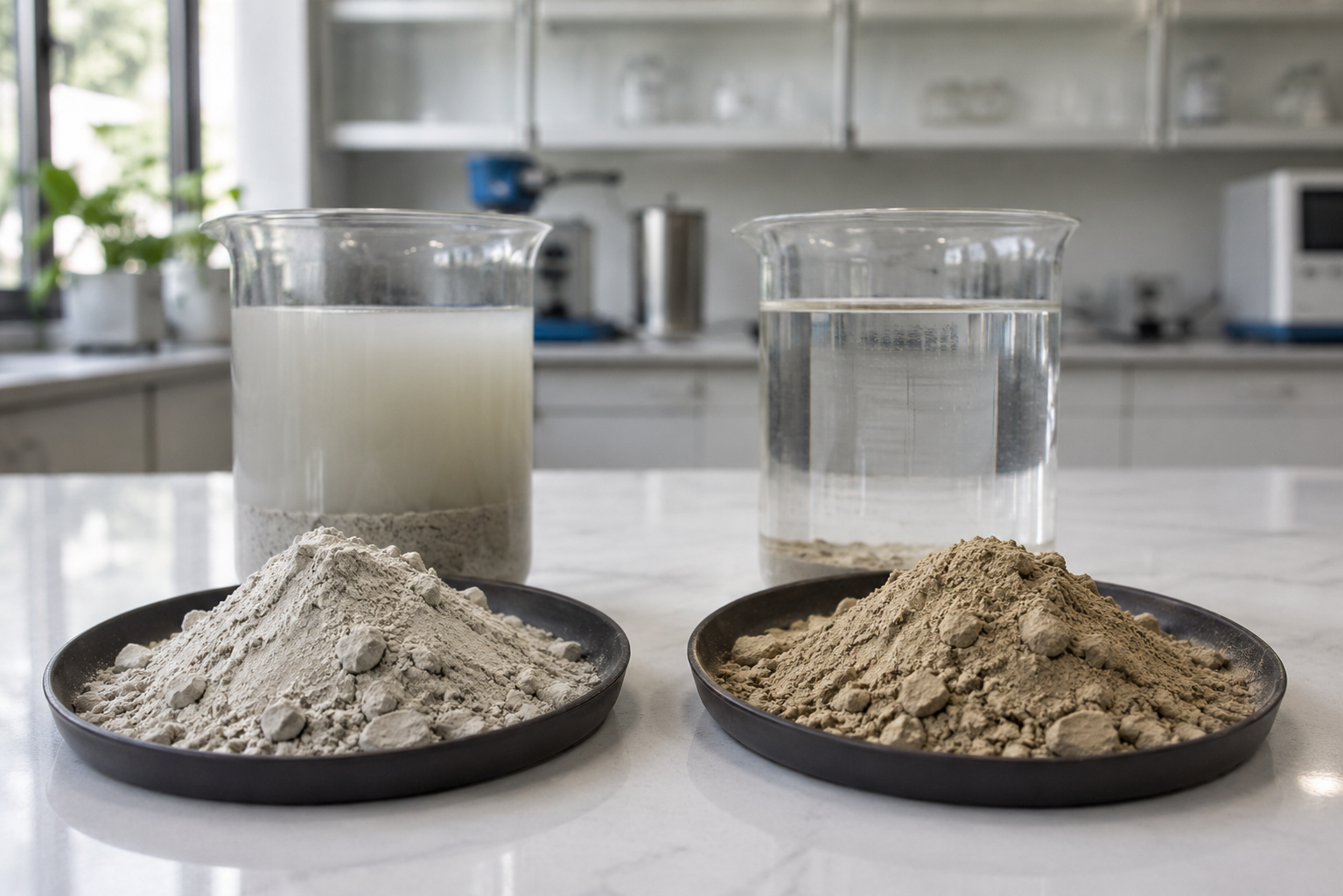
While both materials stem from the same montmorillonite mineral family, sodium bentonite and calcium bentonite act like entirely different materials on an industrial scale. The core difference comes down to their primary exchangeable cation: sodium bentonite is a high-swelling, high-viscosity clay that expands up to 15 to 18 times its dry volume in water, making it the premier choice for sealing, drilling muds, and civil construction. Conversely, calcium bentonite is a low-swelling, highly adsorbent clay that excels in cat litter, metal casting, bleaching earth refining, and environmental remediation.
Selecting the right grade requires looking beyond the raw purchase price per metric ton. You must evaluate molecular structure, swell index, cation exchange capacity (CEC), shear strength under thermal pressure, and regional water chemistry. This detailed technical guide breaks down everything you need to know to pick the ideal bentonite grade for your application.
To understand why these two clays perform so differently in industrial settings, we have to look closely at their atomic lattice structure. Bentonite is a smectite-group aluminum hydrosilicate clay formed naturally from the weathering and alteration of volcanic ash over millions of years. Its primary active mineral constituent is montmorillonite.
At the microscopic level, montmorillonite consists of a 2:1 sheet structure. Each individual clay platelet features an octahedral sheet of aluminum oxide sandwiched between two tetrahedral sheets of silicon dioxide.
During geological formation, naturally occurring isomorphic substitution takes place within this lattice: lower-valence cations (such as magnesium, Mg2+) replace higher-valence cations (such as aluminum, Al3+) in the octahedral sheet without altering the physical crystal shape. This substitution leaves the overall platelet surface with a net negative electrical charge. To maintain electrical neutrality, the clay naturally attracts positive ions (cations) into its interlayer space—the thin gap between adjacent 2:1 platelets.
The identity of these interlayer cations dictates how the clay behaves when exposed to moisture and heat.
| Mineral Characteristic | Sodium Bentonite (Na-Montmorillonite) | Calcium Bentonite (Ca-Montmorillonite) |
|---|---|---|
| Dominant Interlayer Cation | Monovalent Sodium (Na+) | Divalent Calcium (Ca2+) |
| Free Swell Capacity | 15x to 18x dry volume | 2x to 4x dry volume |
| Basal Spacing (d001 dry) | ~1.2 nm | ~1.4 to 1.5 nm |
| Hydration Mechanism | Crystalline hydration + Osmotic swelling | Crystalline hydration only |
| Fluid Permeability | Ultra-low (less than 10^-9 cm/sec when hydrated) | Moderate to High |
| Slurry Rheology | High yield point, strong thixotropy | Low yield point, low viscosity |
| Thermal Stability Limit | 400°C to 500°C (begins losing swelling) | 600°C to 700°C (retains structure longer) |
Industrial procurement specifications rarely list simple terms like 'sodium' or 'calcium.' Instead, engineering datasheets focus on specific chemical tests and physical benchmarks. Understanding these key metrics will help you source the exact material grade your project requires.
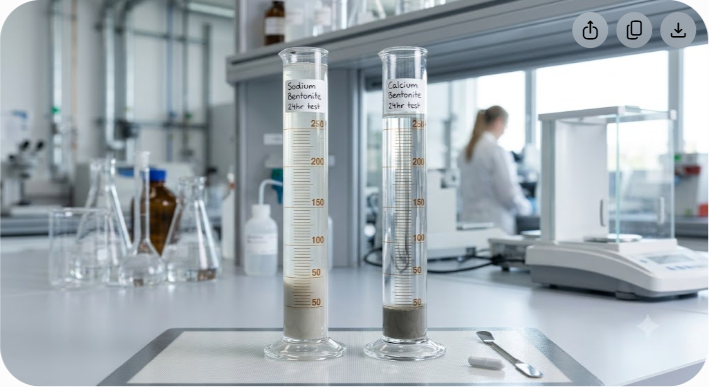
The Swell Index test measures how much two grams of dried, finely ground bentonite expand when dusted into a 100 mL graduated cylinder filled with distilled water over 24 hours.
If your application relies on creating an impermeable hydraulic seal—such as pond liners, borehole grouting, or landfill caps—a high Swell Index is vital.
Cation Exchange Capacity measures the total amount of exchangeable ions a clay mineral can hold, expressed in milliequivalents per 100 grams (meq/100g). High-quality montmorillonite exhibits CEC values ranging from 70 to 110 meq/100g.
Clay with a high CEC offers greater potential for surface chemical reactions. This makes it ideal for specialized applications like acid-activation, organophilic modification, or heavy metal absorption in industrial effluent treatment.
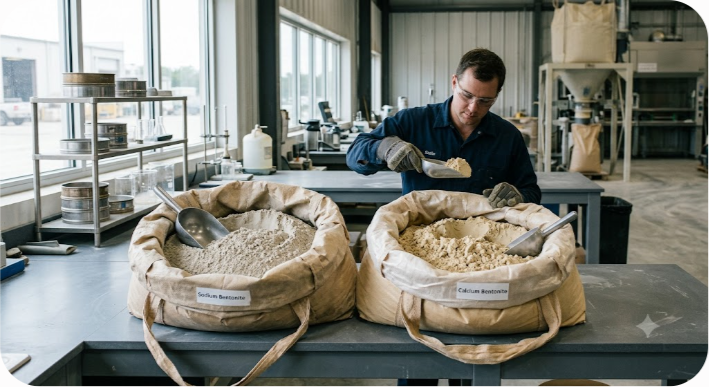
In drilling fluids and civil tunneling slurries, bentonite must suspend heavy rock cuttings, coat borehole walls, and prevent liquid loss into surrounding rock formations.
When metal casters pour molten iron or steel (1,400°C+) into a green sand mold, the clay binder is exposed to extreme thermal stress.
While sodium bentonite provides exceptional green compression strength and dry strength, its hydrated structure begins to degrade around 400°C as crystalline water is driven off. Calcium bentonite, with its tightly bound divalent structure, holds its crystalline moisture longer at elevated temperatures, often demonstrating superior wet tensile strength in specific high-heat foundry zone applications.
Because natural sodium bentonite deposits are geographically concentrated—found primarily in the Wyoming Black Hills region of the United States and select high-purity reserves in Gujarat, India—industrial processors frequently convert low-cost natural calcium bentonite into 'activated sodium bentonite.'
Processed via a solid-state chemical exchange reaction, natural calcium bentonite is mixed with soda ash (sodium carbonate, Na2CO3) under controlled moisture and mechanical shearing conditions:
The sodium ions replace the calcium ions within the clay lattice, while the displaced calcium precipitates out as insoluble calcium carbonate.
Activated bentonite is widely used across Europe, South America, and parts of Asia because it provides an economical alternative to imported natural sodium clay. However, engineers must understand the practical performance limits of activated material:
Matching the correct bentonite grade to your specific industrial process is critical for cost performance and technical success.
| Industry / Application | Recommended Grade | Critical Performance Specification |
|---|---|---|
| Oil & Gas Drilling | API 13A Natural Sodium | Viscosity, Low Filtrate Loss (less than 15 mL) |
| Civil Waterproofing / GCLs | High-Swell Natural Sodium | Swell Index > 24 mL/2g, Permeability < 10^-9 cm/s |
| Iron Ore Pelletizing | High-Purity Sodium | High Green/Dry Drop Number, Low Silica Content |
| Heavy Iron/Steel Foundry | Natural Sodium | High Dry/Hot Strength, Durability (> 400°C) |
| Light / Non-Ferrous Foundry | Natural Calcium or Sodium Blend | High Green Strength, Easy Shake-out |
| Edible Oil Refining | Acid-Activated Calcium | High Surface Area (> 250 m2/g), Bleaching Efficiency |
| Cat Litter (Clumping) | Granular Sodium | Fast Swelling, High Clumping Mass Density |
| Wastewater Treatment | Organophilic or Calcium | High CEC, Surface Adsorption Area |
Even experienced procurement directors and field engineers can run into costly issues when sourcing bentonite. Here are three common real-world failure scenarios and how to prevent them:
The Problem: You purchased premium sodium bentonite for a civil sealing project, but field testing shows poor swelling and high permeability.
The Cause: High salinity or hard water on the construction site. If site water contains elevated concentrations of dissolved calcium ions (Ca2+), magnesium (Mg2+), or sodium chloride (NaCl), osmotic swelling drops dramatically. Calcium ions in the local groundwater undergo cation exchange with the sodium bentonite, turning high-swell clay into low-swell calcium clay right in the ground.
The Solution: Always run a pre-construction water analysis. If site water exhibits high total dissolved solids (TDS) or hard water conditions, specify salt-tolerant polymer-modified sodium bentonite grades designed to resist ionic exchange.
The Problem: An environmental contractor purchases low-cost 'sodium bentonite' for a lagoon barrier. Two years later, the liner develops leaks.
The Cause: The supplier shipped soda-ash activated calcium bentonite instead of natural sodium bentonite. Over time, natural groundwater leached away the superficial sodium ions, causing the clay to revert to its low-swell calcium state.
The Solution: Request clear laboratory certification confirming whether the clay is natural sodium or chemically activated. Always specify natural sodium bentonite for permanent containment and environmental applications.
The Problem: A foundry experiences high defect rates (scabbing, expansion buckles, sand inclusions) after upgrading to a faster automated molding line.
The Cause: The foundry relied solely on low-cost calcium bentonite or poor-quality activated clay. The extreme thermal load burned out the clay binder rapidly, collapsing the mold walls during pouring.
The Solution: Upgrade to a high-durability natural sodium bentonite with higher thermal stability. Look for clay that maintains a high active clay percentage over multiple heating cycles.
When buying industrial bentonite in bulk—whether in 25 kg multi-wall paper bags, 1-ton super sacks, or bulk pneumatic tankers—establishing rigorous incoming quality control protects your operations from costly downtime.
Sourcing industrial minerals requires an established supply chain partner who controls mining reserves and processing facilities. Quality variance between different quarry seams can cause major issues if the processor lacks strict laboratory controls.
When selecting a bentonite supplier, verify:
As a global bentonite exporter with extensive reserves and refined processing systems, Axewelledge delivers high-grade sodium and calcium bentonite tailored to international industrial standards. Axewelledge supplies drilling, foundry, construction, and water purification clients across the globe.
Use this final practical decision checklist before issuing your next procurement tender:
By matching the fundamental mineralogy of sodium and calcium bentonite to your operational demands, you protect your infrastructure, improve product quality, and drive maximum efficiency into your raw material supply chain.













Have questions about our products? We're here to help!