Axewelledge, a leading exporter from India, specializes in high-quality Bentonite. With a commitment to excellence, we supply premium Bentonite to the Middle East and Southeast Asia markets.


North Angle Complex, 304,
150 Feet Ring Rd, Opposite Ambedkar Nagar BRTS Stop,
Madhav Park, Punit Nagar,
Mavdi, Rajkot, Gujarat 360004
© Axewelledge 2026, All Rights Reserved.
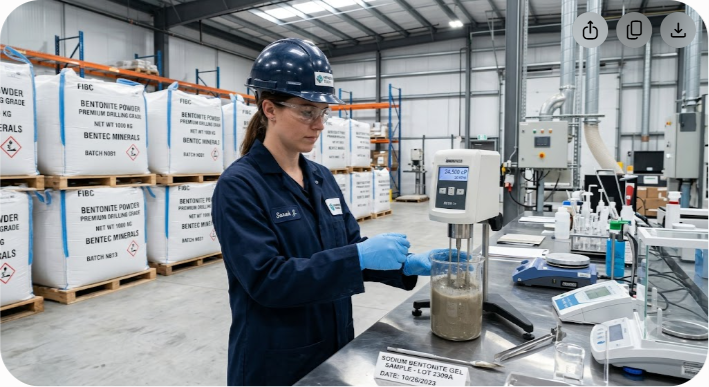
A batch of bentonite arrives at your facility, but instead of forming a gel, it settles at the bottom of the mixing tank. The cost of that single failure goes far beyond the price of the shipment. Downtime in civil engineering, off-spec metal castings in foundries, or fluid loss during deep well drilling can turn a cost-saving mineral purchase into a financial nightmare.
Sourcing industrial-grade bentonite requires balancing technical mineralogy with global supply chain management. Whether you manage procurement for an oilfield service company, a foundry, or a civil engineering project, getting the right material demands an understanding of montmorillonite content, cation exchange capacities, and regional logistics.
This guide breaks down everything you need to procure industrial bentonite with confidence: from understanding sodium and calcium varieties to evaluating international quality standards, auditing global supply chains, and writing bulletproof technical specifications.
Not all bentonite performs the same way. At its core, bentonite is an absorbent aluminum phyllosilicate clay consisting mostly of montmorillonite. However, the specific exchangeable cation present in its crystalline lattice changes its physical behavior entirely.
+-----------------------------------------------------------------------+
| MONTMORILLONITE CLAY STRUCTURE |
| |
| [ Silica Sheet ] --> Si-O Tetrahedral Layer |
| [ Alumina Sheet] --> Al-OH Octahedral Layer (Isomorphous Sub.) |
| [ Silica Sheet ] --> Si-O Tetrahedral Layer |
| |
| ~~~~~~~~~~~~~~~~ INTERLAYER SPACE ~~~~~~~~~~~~~~~~ |
| Exchangeable Cations: Na+ (High Swell) OR Ca2+ (Low Swell) |
| Water molecules enter here, pushing sheets apart. | +-----------------------------------------------------------------------+
Natural sodium bentonite features sodium ions (Na+) as the dominant exchangeable cation in the interlayer space between clay platelets. When exposed to water, sodium ions hydrate, drawing water deep into the crystal structure. This causes the clay platelets to separate, expanding the mineral up to 15 to 20 times its original dry volume.
This high swelling capacity forms a colloidal gel with exceptional thixotropic properties—meaning it liquefies when agitated and thickens when static. High-swelling sodium bentonite is the industry standard for:
Calcium bentonite contains calcium ions (Ca2+) as its primary interlayer ion. Because calcium is a divalent ion carrying a +2 charge, it holds the montmorillonite layers together tightly. Water cannot easily penetrate between the sheets, resulting in low swelling capacity (typically 2 to 4 times dry volume).
Despite low swell, calcium bentonite has strong adsorption capabilities. It excels in:
When natural sodium bentonite reserves are unavailable, processors convert calcium bentonite into sodium-activated bentonite. This is done by adding sodium carbonate (soda ash) during wet processing, exchanging calcium ions for sodium ions.
Activated bentonite achieves high initial swelling and viscosity, but its long-term stability differs from natural sodium bentonite. Over time, or when exposed to saline groundwater and elevated temperatures, activated clay can undergo cation reversion—reverting to a calcium-dominant state and losing its sealing performance. Knowing whether your application permits activated clay or requires natural sodium bentonite is critical during procurement.
Matching the right bentonite grade to your industrial process requires tracking specific chemical and physical metrics.
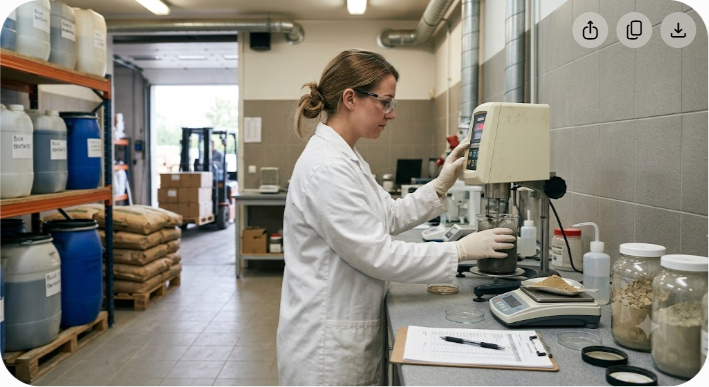
| Industrial Sector | Primary Performance Metric | Key Testing Standard | Critical Value Threshold |
|---|---|---|---|
| Oilfield & Drilling | Viscosity & Fluid Loss | API Specification 13A | Yield point / plastic viscosity ratio; filtrate volume less than 15 cm³ |
| Foundry Casting | Green Compression Strength | AFS (American Foundry Society) | Green strength greater than 100 kPa; Wet tensile strength greater than 0.25 N/cm² |
| Civil & Geotechnical | Swell Index & Permeability | ASTM D5890 / ASTM D5084 | Free swell greater than or equal to 24 mL/2g; Hydraulic conductivity less than or equal to 10?? cm/s |
| Water Treatment | Cation Exchange Capacity | Methylene Blue Index | CEC greater than 70 meq/100g; High adsorption efficiency |
| Pelletizing (Iron Ore) | Dry Bond Strength | ISO 13500 | Wet drop number greater than 5; Dry compression greater than 1.5 kg/pellet |
In directional drilling and civil piling, bentonite maintains borehole stability. The key indicator here is yield volume—the number of barrels of 15 centipoise (cP) mud produced from one ton of dry bentonite. High-tier drilling bentonite yields 90 to 100+ barrels per ton, minimizing bulk consumption on site.
Foundries require bentonite that withstands high heat without losing structural integrity. Procurement teams evaluate thermal durability by measuring green strength after subjecting the sand-bentonite mix to temperatures exceeding 500°C (932°F). High-durability natural sodium clays preserve their binding ability across multiple casting cycles.
For containment applications, low hydraulic conductivity is mandatory. The material must form a dense barrier that blocks fluid flow under high hydrostatic head pressures. Testing focuses on free swell index (ASTM D5890) and fluid loss (ASTM D5891).
Never buy bentonite based on a general specification sheet. To guarantee consistency across ocean containers or vessel shipments, require lab testing aligned with recognized international standards.
+-----------------------------------------------------------------------+
| BENTONITE TESTING FLOWCHART |
| |
| [Raw Shipment] --> [Sampling (ASTM C50)] |
| | |
| v |
| +-------------------+-------------------+ |
| | | |
| v v |
| [Rheology & Yield] [Mineral Integrity] |
| - Viscometer Dial @ 600 RPM - Methylene Blue (CEC) |
| - Fluid Loss Filter Press - X-Ray Diffraction (XRD) |
| - Particle Size (Mesh Pass) - Moisture Balance | +-----------------------------------------------------------------------+
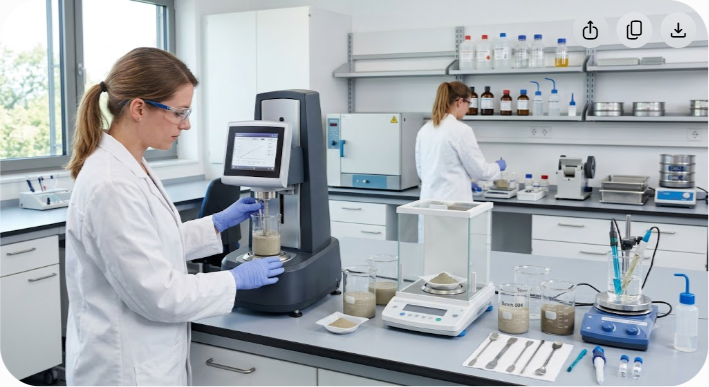
Testing bentonite slurry with a rotational viscometer measures plastic viscosity (PV) and yield point (YP). High YP allows the fluid to carry heavy cuttings out of a hole, while low PV ensures the fluid pumps easily without overloading equipment.
This test measures the Cation Exchange Capacity (CEC) of the clay, directly correlating to the active montmorillonite percentage. Pure sodium montmorillonite exhibits an MBI of 70 to 100+ meq/100g. If an incoming sample drops below 60 meq/100g, the material contains non-swelling gangue minerals like quartz, feldspar, or gypsum.
Finely ground bentonite (200-mesh or 325-mesh, where 90%+ passes through) hydrates rapidly, ideal for instant slurries. Coarser granular bentonite (8 to 20 mesh) is better suited for dry-blending or direct placement in water where slow, controlled hydration prevents clumping.
Standard commercial bentonite carries a moisture content between 8% and 12%. If moisture drops below 6%, the clay can over-dry, damaging its crystal lattice and lowering swell capacity. If moisture exceeds 13%, you pay for excess water weight and risk material caking inside silos or bulk bags.
Understanding where industrial bentonite originates helps procurement teams build resilient supply chains and anticipate freight costs.
[ Wyoming, USA ] ---------> High Quality Natural Sodium (Wyoming Swell Clay) Primary Market: Americas, Oilfield
[ Kutch, India ] ---------> World-Class High-Swell Reserves (Western India Hub) Primary Market: Global, Asia, ME, USA
[ Mediterranean ] ---------> Mixed Calcium / Soda-Ash Activated (Greece / Turkey) Primary Market: Europe, Industrial
Selecting the right packaging impacts both freight efficiency and material handling on site:
Mineral shipping faces common global logistics challenges. Fine bentonite powder easily absorbs ambient moisture during long ocean transit, leading to clumping or "bag hardening."
To prevent transit degradation, mandate heavy-duty polyethylene liners inside bulk bags and specify container desiccant packs for ocean transit through tropical climate zones. Establish clear lead times that account for port customs clearance, bulk density verification, and pre-shipment sample approvals.
Avoid generic purchase orders like "100 MT Sodium Bentonite." Vague requests lead to receiving inferior material that meets basic chemical names but fails on site.
Follow this structured approach to write watertight RFQs:
State exact working conditions: water salinity, operating temperatures, mixing equipment shear rates, and expected shelf life.
Specify clear min/max ranges rather than single target numbers:
Demand that every shipped lot carry a CoA from an ISO 17025 certified laboratory. A pre-shipment sample should be retained by both buyer and supplier for joint testing if a dispute arises.
Set clear boundaries for non-conforming shipments. For example: "If moisture content exceeds 12.5%, a price penalty applies pro-rata; if moisture exceeds 14.0% or free swell falls below 20 mL/2g, the buyer reserves the right to reject the entire shipment at seller's expense."
Use this template to build your technical Request for Quotation (RFQ).
========================================================================= TECHNICAL SPECIFICATION: INDUSTRIAL-GRADE SODIUM BENTONITE Document Ref: RFQ-BEN-0042 =========================================================================
Product Name: High-Yield Natural Sodium Bentonite Origin: Natural, non-activated sodium montmorillonite clay Application: Civil Engineering Slurry / Directional Drilling
Parameter Test Method Specification Range
Montmorillonite Content MBI Titration >= 80 meq/100g Free Swell Index ASTM D5890 >= 24 mL / 2g Fluid Loss (30 min) API 13A Sec 4 <= 13.5 cm3 Moisture Content ISO 787/2 8.0% - 12.0% max Particle Size ASTM C136 >= 90% passing 200 mesh pH (5% slurry) pH Meter 8.5 - 10.5 Yield (15 cP) API 13A >= 90 barrels/ton
Evaluating mineral suppliers goes beyond comparing prices per metric ton. Watch for these red flags during vendor audits:
RED FLAG CHECKLIST:
[ ! ] 1. Unusually low price with missing mineralogy breakdown [ ! ] 2. Reluctance to specify natural sodium vs. soda-ash activated [ ! ] 3. Inconsistent mesh sizes causing mixing equipment clumping [ ! ] 4. Inability to provide lot-traced Certificates of Analysis [ ! ] 5. Single-mine operations lacking contingency reserves
Securing consistent, high-grade bentonite requires a reliable supply partner. Established global miners streamline procurement by providing direct control over mining reserves, advanced refinement processing, and dedicated export logistics.
When evaluating supply partners, prioritize companies with deep reserve capacity, rigorous ISO quality controls, and proven international delivery networks.
Axewelledge operates among the top global producers, controlling over 60 million tons of high-grade bentonite reserves in India's premier mining regions. With integrated processing facilities, advanced R&D labs, and regional distribution offices in strategic hubs like the UAE, Axewelledge delivers standardized, high-yield sodium bentonite directly to industrial clients across North America, the Middle East, and Asia.
By building direct relationships with integrated mine owners, procurement teams secure consistent product specifications, reduce intermediary costs, and safeguard their operational supply chain against market shortages.
Before issuing your next tender for industrial bentonite, verify these key operational steps:













Have questions about our products? We're here to help!