Axewelledge, a leading exporter from India, specializes in high-quality Bentonite. With a commitment to excellence, we supply premium Bentonite to the Middle East and Southeast Asia markets.


North Angle Complex, 304,
150 Feet Ring Rd, Opposite Ambedkar Nagar BRTS Stop,
Madhav Park, Punit Nagar,
Mavdi, Rajkot, Gujarat 360004
© Axewelledge 2026, All Rights Reserved.
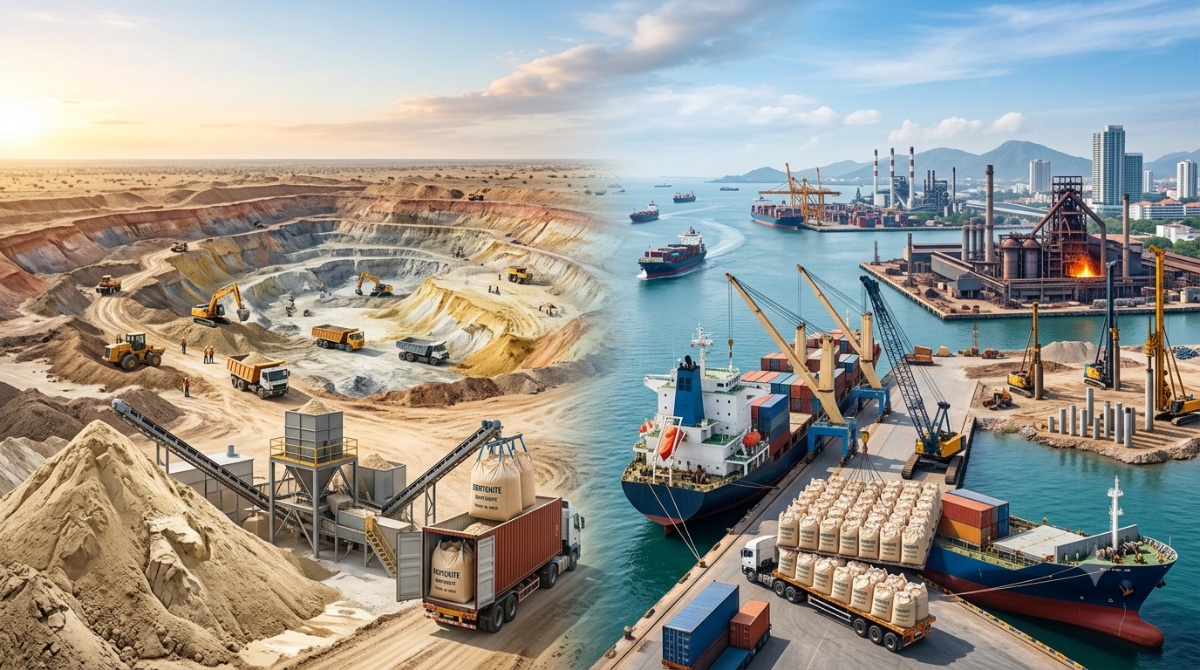
The global industrial landscape relies heavily on versatile minerals that can adapt to specialized engineering needs. Among these, bentonite clay stands out as an indispensable resource. In Southeast Asia, Thailand has emerged as a major industrial hub with expanding sectors in civil engineering, automotive foundries, agricultural development, and environmental management.
Because Thailand’s domestic production of high-grade swelling clay is limited, the nation heavily relies on international imports to sustain its industrial momentum. Over the years, India—particularly the mineral-rich regions of Gujarat and Rajasthan—has positioned itself as the premier sourcing destination for Thai procurement managers.
This comprehensive guide explores the dynamics of the Thailand bentonite market, analyzing why Indian exporters dominate the supply chain, the distinct industrial applications driving demand, detailed pricing benchmarks, and how to choose a reliable partner.
Thailand's economic growth is heavily supported by infrastructural development, heavy manufacturing, and an export-driven agricultural sector. Each of these industries utilizes specific grades of bentonite, creating a highly diversified import market.
Thailand, especially urban centers like Bangkok, features complex, soft-soil geology. Large-scale construction projects require advanced geotechnical engineering techniques to ensure structural stability. During the excavation of deep foundations, bored piling, micro-tunneling, and diaphragm wall construction, engineering teams utilize high-yield sodium bentonite.
The clay is mixed with water to form a dense, viscous slurry. This slurry performs several vital functions:
Hydrostatic Pressure Control: It applies outward pressure against the borehole walls, preventing catastrophic structural collapses.
Cuttings Suspension: It holds drilled soil and rocks in suspension, carrying them efficiently to the surface.
Filter Cake Formation: It creates an impermeable lining along the borehole walls, preventing groundwater intrusion and filtration loss.
Thailand is often referred to as the "Detroit of Asia" due to its massive automotive manufacturing and assembly industry. This sector relies on a network of metal casting foundries that produce engine blocks, brake discs, and structural components.
Foundry-grade bentonite serves as the primary binding agent in green sand molding. High-quality Indian sodium bentonite provides high thermal stability, optimal green compressive strength, and excellent dry strength. This ensures that the sand molds can withstand the extreme temperatures of molten iron or steel without deforming, resulting in smooth castings with minimal defects.
Agriculture remains a cornerstone of the Thai economy, alongside a booming aquaculture sector specializing in shrimp and fish farming. In regions facing soil degradation or poor water retention capabilities, calcium and sodium bentonite are deployed as soil conditioners.
Bentonite enhances the soil’s cation exchange capacity (CEC), allowing it to retain crucial nutrients and moisture far longer. In aquaculture, specialized bentonite is utilized to seal the beds of shrimp ponds, preventing the seepage of nutrient-rich water into the surrounding water table and stabilizing pond conditions.
Thailand is a prominent producer of agricultural oils. The refining process requires activated bleaching earth—a derivative of calcium bentonite—to remove impurities, pigments, and trace metals from crude oils. Furthermore, expanding industrial zones demand efficient wastewater treatment solutions, where bentonite acts as a natural flocculent to bind and precipitate heavy metals and organic pollutants out of industrial effluents.
While bentonite deposits exist in various parts of the world, Thai importers overwhelmingly prefer sourcing their industrial clay from India. This structural preference is rooted in geographical, economic, and mineralogical advantages.
India houses some of the world's finest natural reserves of sodium and calcium bentonite. The Kutch district in Gujarat and the Barmer region in Rajasthan are globally renowned for their vast, high-grade deposits.
The sodium bentonite found in Kutch possesses an inherently high montmorillonite content, providing exceptional swelling capacities and superior rheological properties right out of the ground. Because these reserves are massive, top Indian mining companies can ensure long-term, consistent material composition across multi-year supply contracts.
Leading Indian producers do not merely export raw earth; they operate state-of-the-art processing and pulverization plants. Indian bentonite is processed to comply with rigorous international standards, including:
API (American Petroleum Institute) specifications for drilling muds.
OCMA (Oil Companies Materials Association) criteria.
ISO 9001:2015 quality management frameworks.
Advanced laboratories monitor parameters such as swelling index, gel time, moisture percentage, mesh size, and liquid limit for every batch before it leaves the port.
Proximity to major maritime trade routes gives India a significant edge when shipping to Southeast Asian ports like Laem Chabang and Bangkok. Shipments originating from Mundra or Kandla ports in Gujarat benefit from regular feeder vessel availability, short transit times, and highly competitive ocean freight rates compared to Western alternatives.
Furthermore, the favorable trade dynamics and cost-effective processing operations in India allow exporters to deliver premium minerals at a highly competitive Total Cost of Ownership (TCO) for Thai buyers.
When sourcing from India, it is critical for procurement teams to understand the structural differences between the two primary classifications of the mineral. Selecting the wrong type can lead to operational failures on the field or inside the foundry.
| Property / Specification | Sodium Bentonite (High Swelling) | Calcium Bentonite (Low Swelling) |
| Primary Exchangeable Ion | Sodium ($Na^+$) | Calcium ($Ca^{2+}$) |
| Swelling Capacity | 15 to 30 times its dry volume | 2 to 5 times its dry volume |
| Viscosity & Gel Strength | Exceptionally high | Low to moderate |
| Primary Thai Industry | Construction Piling, Foundries, HDD | Agriculture, Oil Refining, Pet Litter |
| Moisture Content | 10% – 13% | 10% – 12% |
| pH Range | 8.5 – 10.5 (Alkaline) | 7.0 – 8.5 (Neutral to slightly alkaline) |
This grade is the workhorse of heavy industry. When hydrated, the sodium ions allow water molecules to penetrate deep within the clay's crystalline layers, causing it to swell dramatically. This creates a highly stable, thixotropic gel.
If your company operates in civil engineering, tunneling, horizontal directional drilling (HDD), or iron ore pelletization, this is the exact grade required. To understand how leading suppliers structure their production capacities and global distribution channels for this mineral, organizations can explore how a top bentonite exporter from India coordinates operations across various international markets.
Unlike its sodium counterpart, calcium bentonite has a non-swelling nature because the divalent calcium ions hold the clay sheets tightly together, restricting water absorption. However, it possesses excellent adsorptive properties, making it an exceptional candidate for chemical activation, clarifying agents, animal feed binders, and environmental liners.
To assist procurement professionals in creating accurate purchase orders, here are the standard technical benchmarks that Indian exporters fulfill for the Thai market:
Swelling Volume: $ge 24 ext{ ml} / 2 ext{g}$
Moisture Content: $10\% - 12\% ext{ maximum}$
Marsh Funnel Viscosity: $35 - 45 ext{ seconds}$
Fann Viscosity (at 600 rpm): $ge 30$
Sieve Analysis (Mesh Size): $95\% ext{ passing through 200 mesh}$
Fluid Loss (Filtration Volume): $le 15 ext{ ml}$
Montmorillonite Content: $ge 80\%$
Swelling Index: $20 - 28 ext{ ml} / 2 ext{g}$
Liquid Limit: $450\% - 550\%$
Green Compressive Strength (GCS): $ge 10 ext{ N/cm}^2$
Dry Compressive Strength (DCS): $ge 30 ext{ N/cm}^2$
Methylene Blue Value: $ge 320 ext{ mg/g}$
Form: Powder, Granules, or Pellets
Base: Calcium or Low-Swelling Sodium
pH Value: $7.5 - 9.0$
Cation Exchange Capacity (CEC): $70 - 90 ext{ meq}/100 ext{g}$
Packaging: 25kg, 50kg, or customized Jumbo bags
Understanding the pricing structure of imported bentonite is essential for forecasting operational budgets. Bentonite is an industrial commodity, meaning its Free On Board (FOB) and Cost, Insurance, and Freight (CIF) prices are influenced by several variables.
While exact contracts depend on volume and customized chemical tweaks, standard market indications for Indian bentonite exported to Thailand follow these ranges:
Raw/Crude Bentonite (Unprocessed Bulks): $35 – $50 per Metric Ton (FOB India)
Standard Piling/Civil Engineering Grade: $65 – $90 per Metric Ton (FOB India)
Premium Foundry Grade (High Thermal/GCS): $85 – $125 per Metric Ton (FOB India)
API/OCMA Certified Drilling Grade: $95 – $140 per Metric Ton (FOB India)
Activated Bleaching Earth / Ultra-Fine Powder: $130 – $190 per Metric Ton (FOB India)
Note on CIF Thailand Pricing: To calculate the final price at Laem Chabang port, buyers must add ocean freight costs (typically ranging from $15 to $35 per ton depending on global shipping container availability), customs clearance charges, and local import duties under the ASEAN-India Free Trade Area (AIFTA) frameworks.
[Processing Costs (Milling & Mesh Size)]
                 +
[Mineralogical Purity (Montmorillonite %)]  ===>  [FINAL BENTONITE PRICE]
                 +
[Packaging & Logistics (Bags vs. Bulk)]
Processing Complexity & Particle Size: Coarse lumps are cheap to produce. Ultrafine powders (micronized down to 325 mesh) or chemically activated clays require more energy, specialized machinery, and processing time, which increases the base price.
Packaging Configurations: Sourcing material in loose bulk vessels or 1.25 Metric Ton Jumbo Bags with inner plastic liners is highly cost-effective for large infrastructure projects. Conversely, packing material into individual 25kg or 50kg multi-walled paper or PP bags increases manual labor and packaging material costs, adding a premium of $10 to $20 per ton.
Energy and Fuel Costs: Mining and drying bentonite require significant energy inputs. Variations in global fuel and electricity prices directly impact processing overheads in Indian manufacturing plants.
Volume and Minimum Order Quantities (MOQ): Most Tier-1 Indian exporters operate on a minimum order quantity of one Full Container Load (FCL), which typically equates to 20 to 27 Metric Tons depending on container restrictions. Higher volume annual off-take commitments yield significant volume discounts.
For Thai purchasing managers looking to set up a resilient mineral supply chain, navigating the sourcing process requires strict quality verification steps. Here is a reliable roadmap to follow:
Before reaching out to suppliers, clearly outline your industry-specific requirements. Are you evaluating the clay based on its viscosity, binding strength, or moisture retention? Determine your required mesh size, packaging preferences, and volume schedules.
Importers looking to evaluate the broader industrial footprint of these minerals across different sectors can gain deeper context by checking out the top 10 industries that import bentonite from India, which highlights the multi-sector utility of high-grade Indian clay.
Working with intermediaries or small-scale traders poses risks regarding quality variance across different shipments. Prioritize established Indian companies that possess direct ownership or long-term lease control over their mining reserves in Gujarat or Rajasthan. Direct mine ownership guarantees that the raw mineral feed remains uniform over the entire life cycle of your project, protecting your business from sudden market shortages.
Never execute a commercial contract without testing physical pre-shipment samples in your local laboratory. Request a 1kg to 5kg sample from the exporter and test it under simulated field conditions. Check for:
Physical Parameters: Color, particle distribution, and moisture levels.
Chemical Composition: Silica, alumina, and exchangeable sodium/calcium ratios.
Performance Indicators: Swelling index, marsh funnel viscosity, and fluid loss.
For procurement professionals looking for a structured, step-by-step blueprint on how to efficiently manage the documentation, sampling protocols, and verification stages during an import cycle, reading a comprehensive guide to importing bentonite from India serves as an incredibly useful operational model.
Ensure that every shipped batch comes accompanied by an official Certificate of Analysis (CoA) issued by an independent, third-party laboratory (such as SGS or Intertek) or the exporter’s internal ISO-certified testing facility. Key shipping documents required for smooth customs clearance at Thai ports include:
Commercial Invoice and Packing List.
Clean Shipped on Board Bill of Lading (B/L).
Certificate of Origin (Form AI to leverage preferential tariff benefits under AIFTA).
Material Safety Data Sheet (MSDS) and Technical Data Sheets (TDS).
As we move through 2026 and look toward the future, the trade relationship between Thai industrial consumers and Indian bentonite producers is projected to strengthen. Thailand’s commitment to expanding its mass-transit railway networks, deep-sea ports, and smart-city infrastructure ensures a steady baseline demand for civil engineering grades.
Concurrently, global emphasis on sustainability is pushing Thai foundries and factories to optimize their production efficiency. High-purity Indian sodium bentonite enables these manufacturers to minimize sand consumption, lower casting scrap rates, and maintain eco-friendly operations.
By aligning with established, asset-heavy Indian exporters who combine deep mining expertise with modern laboratory control, Thai businesses can secure a highly reliable, cost-efficient, and premium-grade mineral supply chain to power their industrial growth.
If your organization is seeking a reliable, high-capacity partner for international procurement, exploring the capabilities of an industry leader is an excellent next step. Organizations worldwide rely on specialized mineral portfolios tailored to demanding industrial requirements. To see a full breakdown of export grades, packaging capabilities, and technical parameters available for global distribution, check out the specialized bentonite products and global export solutions designed to meet stringent global engineering criteria.













Have questions about our products? We're here to help!