Axewelledge, a leading exporter from India, specializes in high-quality Bentonite. With a commitment to excellence, we supply premium Bentonite to the Middle East and Southeast Asia markets.


North Angle Complex, 304,
150 Feet Ring Rd, Opposite Ambedkar Nagar BRTS Stop,
Madhav Park, Punit Nagar,
Mavdi, Rajkot, Gujarat 360004
© Axewelledge 2026, All Rights Reserved.
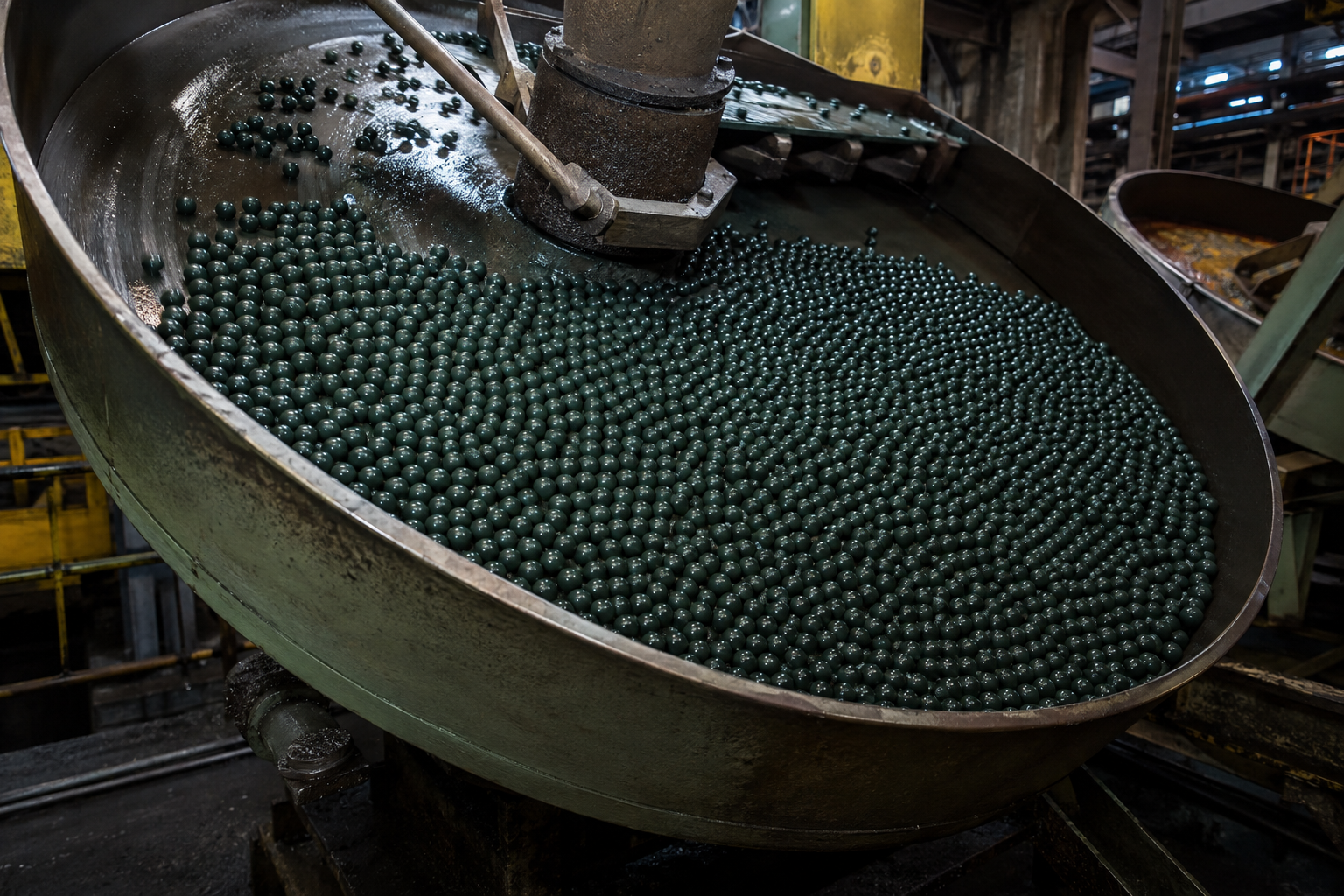
Adding just 0.5% to 1.0% bentonite clay to millions of tons of iron ore concentrate seems like a minor detail in a steel mill's budget, but that small additive determines whether an entire induration furnace runs smoothly or collapses into a costly mess of fine dust and slag. If your green pellets crack on the conveyor belt, disintegrate during drying, or choke your blast furnace airflow, the culprit is rarely the iron ore itself. Almost always, the problem traces back to binder physics—specifically, the gel index of your bentonite.
A high gel index bentonite is not just a convenience for pellet plant operators; it is a technical necessity for high-yield, energy-efficient iron ore agglomeration. When sodium bentonite exhibits a high gel index, it forms a resilient, three-dimensional colloidal structure at lower addition rates. This structure locks moist iron ore fines together, absorbs capillary water during rapid thermal drying, and maintains mechanical integrity up to 1,000°C.
Understanding the relationship between bentonite rheology, hydration dynamics, and green pellet performance is key to reducing binder consumption, maintaining high iron grades, and protecting furnace productivity.
Gel index measures a bentonite suspension's ability to transition from a fluid state when agitated to a semi-solid, self-supporting gel when at rest—a property known as thixotropy. In industrial mineral processing, gel index reflects how efficiently montmorillonite clay platelets hydrate, delaminate, and build an interconnected network in water.
The bentonite hydration process follows three distinct physical stages during slurry preparation:
When high-grade sodium bentonite contacts water, water molecules enter the interlamellar spaces between individual montmorillonite layers. The exchangeable sodium cations ($Na^+$) dissociate, pushing the mineral sheets apart. Under mechanical shear during mixing, these sheets break into microscopic, negatively charged platelets with positively charged edges.
When shear stops, these charged platelets align in an edge-to-face "card-house" structure. Gel index quantifies the strength and speed of this card-house formation.
While these terms are often grouped together on chemical specification sheets, they measure distinct physical properties:
A bentonite can display high free swell yet perform poorly as a binder if its gel index is low. Swelling shows how much water the clay holds; gel index shows how strongly the clay holds that water under stress. High gel index bentonite provides structural rigidity at lower water-to-clay ratios, which is crucial for binding dense iron ore particles (4.8–5.2 g/cm³) without over-wetting the green ball mix.
To understand why gel index is critical, we must examine how iron ore concentrate transforms into green pellets inside a disc or drum pelletizer.
Iron ore concentrate consists of finely ground magnetite or hematite particles, typically ground so that 80% to 90% passes through a 325-mesh (45-micron) sieve. To convert these loose fines into spherical balls measuring 9 to 16 mm, water is added to generate capillary forces.
Three main mechanical forces operate within a green pellet during rolling:
Water alone can hold fine particles together via surface tension, forming capillary bridges between ore grains. However, capillary forces break down under stress. When a moist green pellet drops onto a conveyor belt or rolls inside a balling drum, impact forces deform the sphere. Water alone has zero yield stress; under impact, capillary water migrates outward, causing the green ball to flatten, stick, or burst.
Bentonite alters this balance. When a high gel index sodium bentonite hydrates within the moist ore concentrate:
Without a high gel index binder, green pellets remain brittle, sensitive to small moisture shifts, and prone to breaking during transit to the induration machine.
Bentonite plays a continuous structural role across all four key operational phases in a pellet plant:
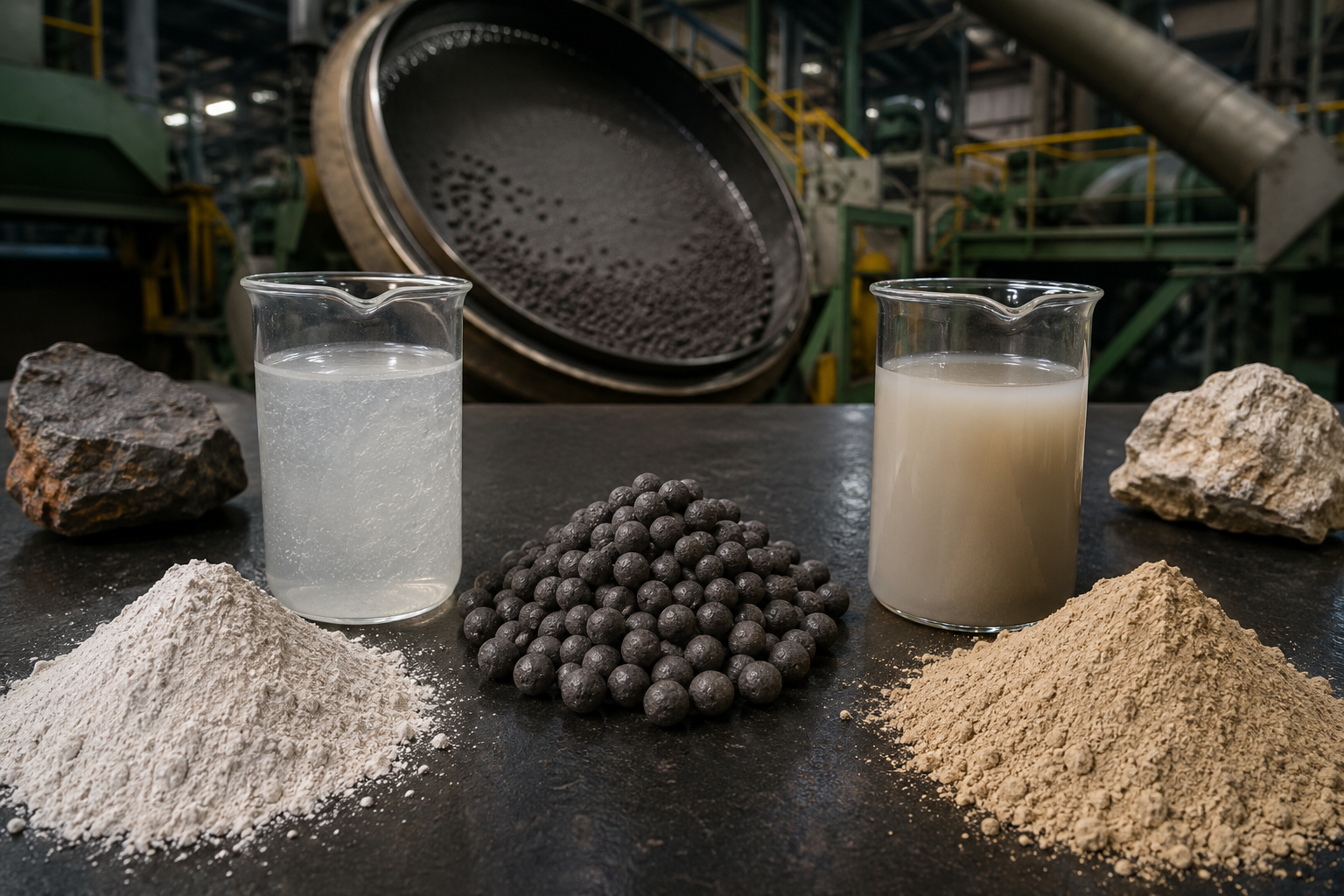
Green pellets undergo constant mechanical stress before reaching the firing furnace. They drop from disc pelletizers onto collecting belts, transfer across shuttle conveyors, and cascade onto roller screens or travelling grates.
High gel index bentonite forms an extensive, interconnected card-house network between ore particles. This network increases plastic deformation capacity, allowing the green pellet to absorb kinetic energy during impacts. A bentonite with a low gel index yields weak, brittle green pellets that crumble on conveyor transfers, creating fine dust that clogs airflow in the induration furnace.
The most critical transition in pellet production occurs in the drying zone of the induration furnace, where gas temperatures jump from ambient levels to 300°C–400°C.
As water inside the green pellet rapidly turns to steam, internal vapor pressure surges. If the moisture escapes faster than the pellet's pores allow, the pellet explodes—a failure known as thermal spalling. Spalled pellet fragments blind the bed, obstruct hot air movement, and force plant shutdowns.
High gel index sodium bentonite acts as a moisture buffer in two ways:
Uniform spherical shape is essential for bed permeability in straight-grate and grate-kiln systems. Irregular, non-spherical pellets pack tightly, choking gas flow and leading to uneven firing.
High gel index bentonite stabilizes the plastic state of the green ball mass. During disc pelletization, seed balls grow by picking up dry ore fines and water droplets. The thixotropic nature of high gel index clay ensures that when the growing ball rolls across the disc, the shear force thins the surface gel layer, letting new ore particles adhere smoothly. As the pellet rolls away from the shear zone, the gel thickens instantly, locking the new layer into a smooth, spherical shape.
Every ton of bentonite added to iron ore concentrate dilutes the overall iron content of the final pellet. Bentonite contains mostly silica ($ ext{SiO}_2$) and alumina ($ ext{Al}_2 ext{O}_3$), which add unwanted gangue.
As a general rule in pellet plant metallurgy, every 0.1% increase in bentonite addition reduces the iron grade of the finished pellet by approximately 0.05% to 0.08% Fe.
In blast furnace operations, every additional 1.0% of silica in the feed increases coke consumption by roughly 1.5% and inflates slag volume, driving up operating costs.
Because high gel index bentonite forms a dense colloidal network at low concentrations, pellet plants can cut binder addition rates from 0.8%–1.0% down to 0.4%–0.6% by weight without sacrificing green strength or drop resistance. Lowering binder consumption preserves iron grade, slashes silica contamination, and cuts transport costs per ton of product.
Not all bentonites are created equal. The natural exchangeable cation on the montmorillonite structure determines whether a clay can achieve a high gel index.
| Property / Characteristic | Natural Sodium Bentonite | Calcium Bentonite (Unactivated) | Sodium-Activated Calcium Bentonite |
|---|---|---|---|
| Primary Cation | Sodium ($ ext{Na}^+$) | Calcium ($ ext{Ca}^{2+}$) | Sodium ($ ext{Na}^+$) via $ ext{Na}_2 ext{CO}_3$ exchange |
| Interlamellar Structure | Single layer of water molecules; wide spacing | Double layer of water molecules; tight ionic bridging | Artificially expanded structure |
| Delamination Ability | High (breaks down into individual sheets) | Low (remains in thick crystalline stacks) | Moderate to High (depends on activation quality) |
| Gel Index Range | High to Very High (8.0–15.0+) | Low (1.5–3.5) | Moderate (4.5–7.5) |
| Free Swell (mL/2g) | 24 – 40+ mL | 4 – 8 mL | 15 – 22 mL |
| Thermal Stability | Retains binding power up to 500°C–600°C | Dehydrates rapidly below 200°C | Moderate thermal breakdown as soda ash decomposes |
| Ideal Addition Rate | 0.4% – 0.6% | Unsuitable for iron ore | 0.7% – 1.0% |
Calcium ions ($ ext{Ca}^{2+}$) carry a 2+ charge, holding adjacent montmorillonite layers together with strong electrostatic bonds. This prevents water from pushing the layers apart. As a result, calcium bentonite does not delaminate into thin platelets; it remains stuck in coarse stacks. Its gel index stays low, its swelling is minimal, and its binding capability is weak.
Adding calcium bentonite to iron ore concentrate yields low drop numbers, low green strength, and severe thermal spalling unless used in high quantities (1.5%–2.0%), which destroys the pellet's iron grade.
Natural sodium montmorillonite sheets exhibit strong cation repulsion and high interlamellar hydration, enabling full delamination into a high-surface-area card-house gel network. Conversely, calcium montmorillonite sheets are locked together by strong divalent ionic bridges, resulting in low surface area, limited swelling, and minimal gelation.
When high-grade natural sodium bentonite is unavailable, producers often activate calcium bentonite by mixing it with sodium carbonate ($ ext{Na}_2 ext{CO}_3$, or soda ash). This triggers an ion exchange where calcium montmorillonite reacts with sodium carbonate to yield sodium montmorillonite and precipitated calcium carbonate.
While activation boosts short-term swelling and gel index measurements at room temperature, it has clear drawbacks in pellet plants:
Natural, high gel index sodium bentonite remains the industry benchmark for consistent pelletizing performance.
To control binder quality, metallurgical labs use standardized rheological tests to evaluate bentonite shipments before they enter the processing line.
Evaluating bentonite rheology follows a four-step laboratory testing sequence:
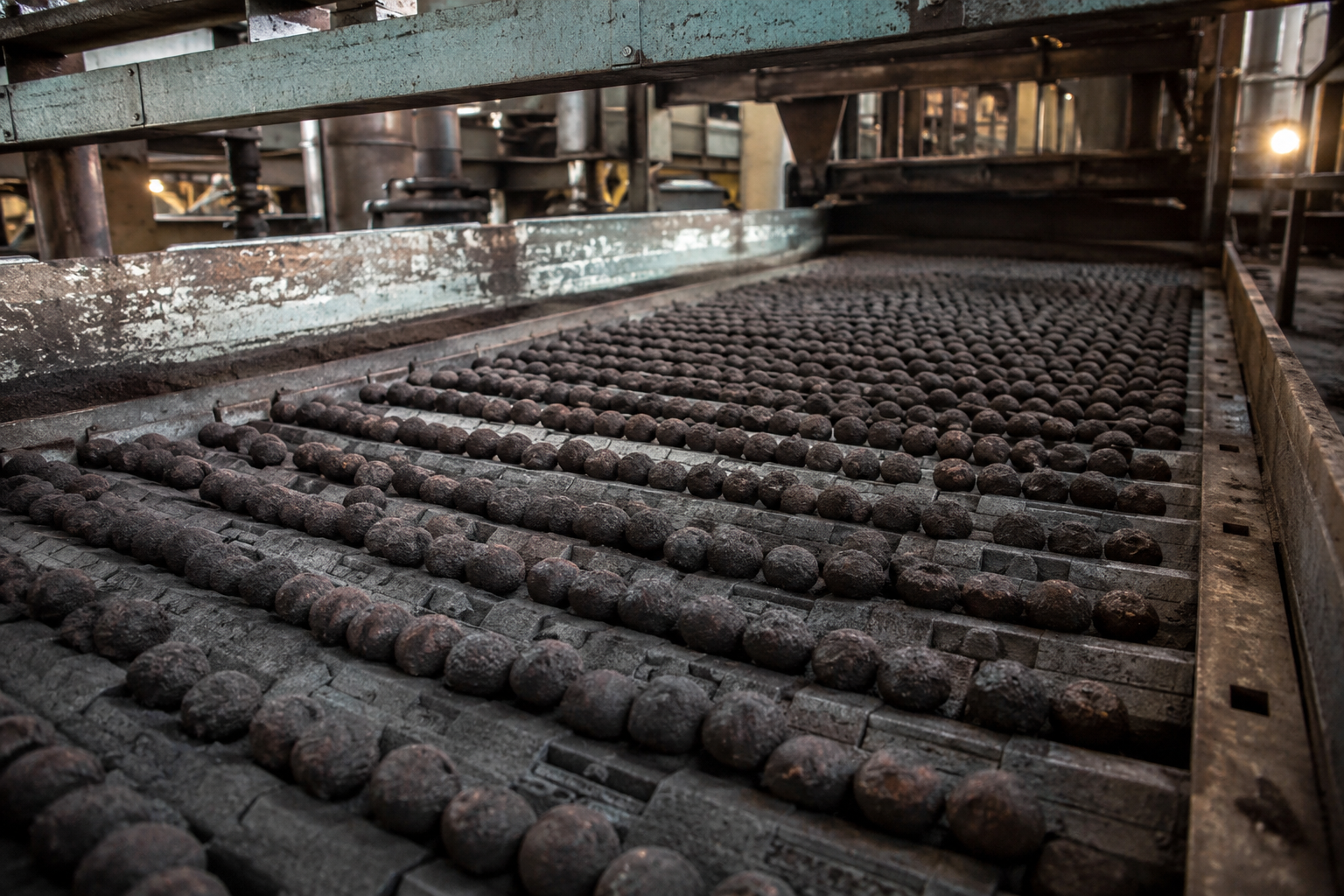
The standard test uses a rotational viscometer (such as a Fann Model 35) following modified API RP 13B-1 procedures:
The gel index ratio is calculated by dividing the 10-minute gel strength reading by the 10-second gel strength reading. A high gel index bentonite exhibits a rapid increase between these readings, demonstrating strong thixotropic recovery.
A simpler field test involves measuring sedimentation volume:
When green pellet quality drops, plant operators often default to adding more moisture or increasing overall binder dosage. However, if the underlying issue is poor binder gelation, these tweaks usually worsen the problem.
The troubleshooting steps below address common operational failures linked to binder rheology:
High-performance bentonite costs more per ton delivered, but evaluating binders solely on purchase price is a costly mistake for procurement teams. The true economic value of a binder shows up in net pellet production costs and furnace efficiency.
Optimizing bentonite gel index creates value across three production stages:
Switching from a standard bentonite requiring a 1.0% addition rate to a high gel index sodium bentonite requiring just 0.5% cuts total binder consumption in half.
For a pellet plant producing 5 million metric tons of pellets per year, standard binder usage at 1.0% equals 50,000 metric tons annually. Reducing binder addition to 0.5% lowers usage to 25,000 metric tons, saving 25,000 metric tons of clay each year.
This 50% reduction lowers total freight, handling, storage, and processing expenses, offsetting any upfront premium in raw material price.
Cutting bentonite consumption by 0.5% removes roughly 0.30% to 0.35% silica ($ ext{SiO}_2$) from the final iron ore pellets.
In blast furnace operations, every 1% reduction in slag volume drops overall fuel consumption (coke and pulverized coal injection) by approximately 15 to 20 kg per ton of hot metal produced.
For a 5-million-ton pellet plant integrated with steelmaking facilities, preserving iron grade yields millions of dollars in energy savings every year.
Thermal spalling limits how fast an induration line can run. When pellets burst easily, operators must lower drying gas temperatures and extend drying times, restricting plant throughput.
High gel index bentonite elevates thermal shock thresholds, allowing plants to raise drying zone temperatures safely. Increasing bed speed by even 5% to 8% adds hundreds of thousands of tons of sellable pellet capacity annually without capital expenditure.
Achieving consistent iron ore pelletizing performance requires a binder sourced from uniform, high-grade mineral reserves and processed under strict technical standards.
Axewelledge is a global leader in mining, refining, and exporting industrial bentonite solutions. As India's largest mine owner and exporter of high-purity sodium bentonite—ranking among the top five producers globally—Axewelledge manages over 60 million tons of proven reserves.
In modern iron ore pelletizing, binder performance involves fine-tuned colloidal chemistry. A high gel index sodium bentonite protects green ball integrity under mechanical shear, shields pellets against thermal shock during drying, and minimizes gangue dilution to safeguard iron grades.
Investing in high-performance binder rheology reduces operational downtime, lowers energy consumption, and improves overall furnace productivity.
To optimize your agglomeration process, contact the metallurgical mineral specialists at Axewelledge to request technical specifications, arrange lab testing, or schedule a plant trial.













Have questions about our products? We're here to help!