Axewelledge, a leading exporter from India, specializes in high-quality Bentonite. With a commitment to excellence, we supply premium Bentonite to the Middle East and Southeast Asia markets.


North Angle Complex, 304,
150 Feet Ring Rd, Opposite Ambedkar Nagar BRTS Stop,
Madhav Park, Punit Nagar,
Mavdi, Rajkot, Gujarat 360004
© Axewelledge 2026, All Rights Reserved.
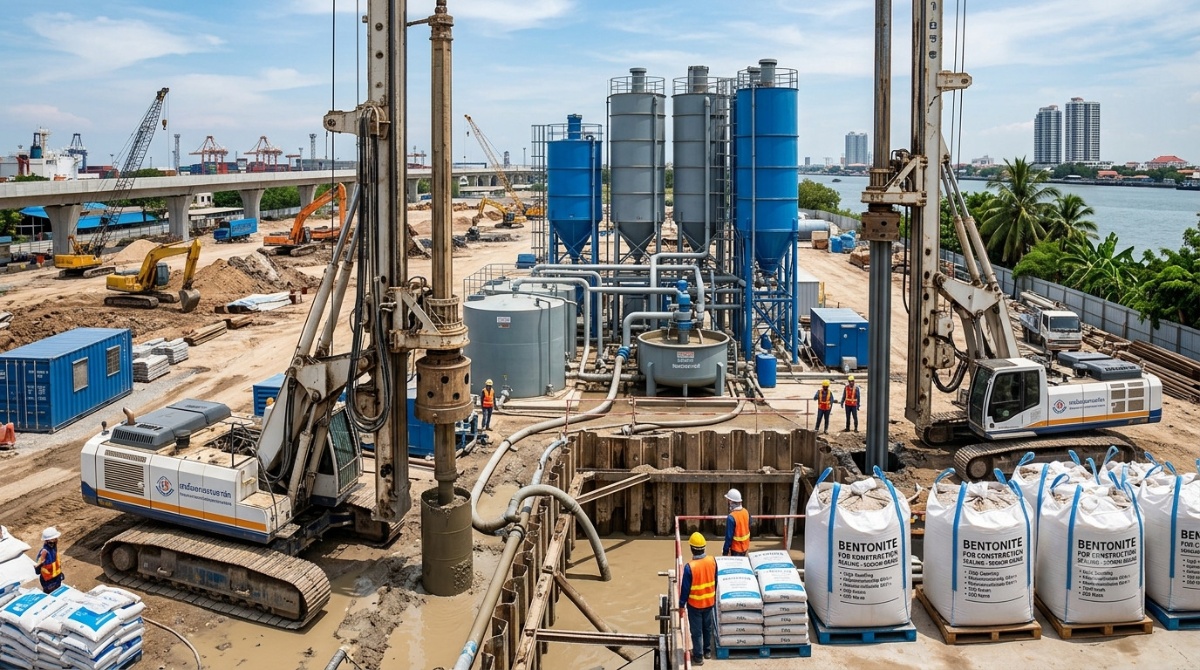
Thailand’s infrastructure landscape is expanding rapidly. From the expansion of Bangkok’s Mass Rapid Transit (MRT) lines and massive flood-mitigation tunnels to deep foundational piling for coastal high-rises in Pattaya and heavy industrial zoning in the Eastern Economic Corridor (EEC), modern engineering projects face demanding subterranean challenges.
Among these challenges, managing groundwater, stabilizing weak soils, and ensuring absolute waterproofing are the most critical. This is where high-quality bentonite clay becomes indispensable.
However, buying bentonite for a construction project in Thailand is not as simple as asking for "drilling mud" or "sealing clay." The geological diversity of Thailand—ranging from the soft, water-logged alluvial clay of the Chao Phraya River basin to the coastal sands of the south—demands hyper-specific mineral profiles. Ordering the incorrect grade can lead to borehole collapses, massive fluid loss, compromised structural integrity, and skyrocketing project overheads.
This comprehensive guide breaks down exactly what type of bentonite you need for construction sealing and infrastructure projects in Thailand, how to evaluate technical specifications, and why sourcing your material from a premier global producer is the most reliable path to project success.
Before exploring product specifications, it is vital to understand why Thailand’s ground conditions demand superior sealing materials.
The "Bangkok Soft Clay" Layer: Much of Central Thailand, particularly Bangkok and its surrounding provinces, sits on a thick layer of highly compressible marine and alluvial clay. This soil features high water content and low shear strength. Deep excavations, diaphragm wall construction, and bored piling here require specialized slurry to prevent soil squeezing and wall collapse.
High Groundwater Tables: Across Thailand's coastal regions and river plains, the groundwater table rests just a few meters below the surface. This creates intense hydrostatic pressure during underground excavations.
Varying Water Chemistry: Water sourced for construction sites in Thailand often contains high salinity (especially in coastal zones) or mineral hardness. This can severely disrupt the hydration and performance of inferior bentonite products.
To mitigate these risks, civil engineering contractors rely heavily on Sodium Bentonite due to its unique mineralogical properties.
Bentonite is an absorbent aluminum phyllosilicate clay formed primarily from weathered volcanic ash. Its commercial and industrial efficacy stems from the presence of the mineral montmorillonite. However, not all bentonite clays behave the same way. The performance depends heavily on the dominant exchangeable cation within the clay’s crystal interlayer structures.
Premium sodium bentonite contains an abundance of sodium ($Na^+$) ions. This atomic composition allows the clay to absorb immense amounts of water, swelling up to 15 to 20 times its dry volume. When hydrated, it transforms into a highly thixotropic gel that acts as an impenetrable barrier to water. For civil engineering, piling, and environmental containment, sodium bentonite is the mandatory industry standard.
Calcium bentonite possesses a dominant population of calcium ($Ca^{2+}$) ions. It features a significantly lower swelling index, usually expanding to only 2 to 3 times its dry volume. While highly effective for industrial purification, bleaching, or animal feed additives, it lacks the hydraulic sealing and thixotropic properties required to support deep excavations or form waterproofing liners.
The Verdict for Thailand Construction: Always specify and order high-yield Sodium Bentonite. If local suppliers offer cheaper calcium bentonite, it will fail to form a stable filter cake or stop water ingress in high-pressure subterranean environments.
To determine exactly what to order, you must match the product grade to your specific engineering application. High-grade Indian bentonite, known globally for its purity, is custom-milled to serve these critical construction sectors:
In urban high-rise construction and transit network expansions across Bangkok, deep foundations rely on bored piling and diaphragm walls. During excavation, a bentonite slurry is pumped into the borehole or trench.
The slurry performs three critical actions:
Hydrostatic Support: It exerts outward pressure against the soil walls, preventing collapse.
Filter Cake Formation: The swelling sodium clay particles plate out onto the porous soil walls, creating a micro-porous, low-permeability "filter cake" that prevents fluid loss into the surrounding formation.
Cuttings Suspension: It suspends heavy soil and rock cuttings, carrying them to the surface for desanding.
Thailand’s rapidly updating urban utilities—such as underground electrical cabling, communication networks, and deep-tunnel sewerage lines—frequently utilize trenchless technology to avoid disrupting heavy surface traffic.
In microtunneling and pipe jacking, a specialized bentonite grade serves as a vital lubricant between the advancing concrete or steel pipe string and the surrounding soil. This drastically reduces skin friction, lowers the required jacking force, protects expensive machinery, and accelerates excavation cycles.
For cross-country oil pipelines, gas networks, and river-crossing utility lines throughout Thailand, HDD techniques are heavily deployed. HDD operations require a high-yield drilling bentonite that complies with American Petroleum Institute (API) or OCMA technical specifications to ensure stable boreholes, clean bits, and predictable rheology over long distances.
When constructing deep basements, dry docks, or retaining structures near bodies of water (such as the Chao Phraya River), managing lateral water migration is vital. Engineers mix sodium bentonite with local soil or cement to build low-permeability slurry cut-off walls. This creates a permanent underground barrier that seals off groundwater inflows into the active construction site.
Environmental protection regulations in Thailand are becoming increasingly strict. For municipal solid waste landfills, industrial hazardous waste containment zones, and wastewater treatment lagoons, engineers install GCLs—thin layers of high-purity sodium bentonite needle-punched between geotextile fabrics. Upon contact with moisture, the trapped bentonite swells into a self-healing, highly impermeable hydraulic seal that locks in dangerous leachates and prevents groundwater contamination.
When submitting a Request for Quotation (RFQ) to a supplier or exporter, relying on generic product names is risky. To ensure your material handles Thailand’s challenging soils, check the following physical and rheological parameters on the manufacturer's technical data sheet:
| Technical Parameter | Recommended Range / Value | Why It Matters for Construction Sealing |
| Montmorillonite Content | $ge 80\%$ | Dictates the core purity, swelling power, and long-term chemical stability of the clay. |
| Swelling Index | $15 ext{ to } 20 ext{ mL} / 2 ext{g}$ | Measures the volumetric expansion upon hydration; essential for creating an absolute seal against water. |
| Marsh Funnel Viscosity | $35 ext{ to } 50 ext{ seconds}$ | Determines the slurry's flow characteristics and its capacity to exert hydrostatic pressure inside a borehole. |
| Fluid Loss (Filtrate Loss) | $< 15 ext{ cm}^3$ (API Standard) | Low fluid loss indicates that the slurry forms a thin, tough filter cake rather than leaking uncontrollably into porous sandy layers. |
| Particle Size (Mesh Size) | $ge 90\%$ passing 75 microns (200 mesh) | Finer milling ensures rapid dispersion, smooth hydration, and zero unhydrated lumps ("fish-eyes") in mixing tanks. |
| Moisture Content | $10\% ext{ to } 12\%$ | Optimal balance ensures the powder stays free-flowing during storage without premature agglomeration. |
While Thailand does have local mineral deposits, the volume, consistency, and high-montmorillonite purity required for heavy civil engineering are rarely met by local extraction alone. As a result, Tier-1 construction firms across Southeast Asia consistently import high-performance bentonite from global hubs.
India, particularly the geologically blessed region of Bhuj and Kutch in Gujarat, is home to some of the world's finest deposits of natural sodium bentonite. This mineral is globally renowned for its high thermal stability, high green compression strength, and exceptional thixotropic gel properties.
By partnering with an established industry leader like Axewelledge, international buyers gain direct access to vast mineral reserves and advanced refinement operations. As one of India's preeminent mine owners and exporters, shipping over 100 containers daily to more than 50 countries, the company possesses the scale and technical precision necessary to fulfill complex industrial requirements. Read more about how these large-scale operations serve infrastructure demands globally in this look at the Top Bentonite Exporter from India.
Navigating international supply chains requires careful planning around site logistics, storage footprints, and tropical climates. When ordering your shipment to ports like Laem Chabang or Bangkok Port, keep these practical variables in mind:
To match the material-handling equipment on your specific Thailand construction site, choose the correct packaging configuration:
Jumbo Bags (Ton Bags): Available in 1.0 MT or 1.25 MT heavy-duty PP configurations with reinforced lifting loops. These are perfect for large-scale batching plants, continuous slurry mixers, and high-volume piling sites with crane access.
Small Bags: 25 kg or 50 kg multi-wall paper or heavy plastic bags stacked and shrink-wrapped on wooden pallets. This format is ideal for tight urban job sites with restricted spatial footprints, manual mixing setups, or microtunneling shafts with limited crane capacity.
Thailand’s tropical climate features consistently high ambient humidity, especially during the monsoon season. Bentonite is highly sensitive to atmospheric moisture and can prematurely hydrate or clump if exposed to damp air. Ensure your supplier uses multi-layered, moisture-resistant packaging with high-density internal polyethylene liners to guarantee the powder arrives perfectly dry, free-flowing, and ready for rapid dispersion.
Urban projects in downtown Bangkok rarely have extensive storage yards or sprawling material silos. To prevent spatial logjams on site, work with an exporter capable of managing structured, staggered container deliveries that seamlessly line up with your active drilling, piling, or excavation schedules. For an in-depth blueprint on how distributors balance localized storage limits with large-scale import operations, review our comprehensive case study detailing a Singapore Bentonite Distributor.
Ordering the correct grade is only half the battle; proper mixing and hydration on-site are required to fully activate the clay’s engineering properties. Follow this standard sequence to optimize your sealing fluid:
[Water Quality Check] âž” [pH Adjustment to 8.5–9.5] âž” [High-Shear Bentonite Addition] âž” [Hydration Period (min. 4–6 hours)]
Before adding any powder, test your make-up water. High salinity, total dissolved solids (TDS), or high calcium hardness will inhibit the swelling of sodium bentonite.
Hardness: Should ideally be below $100 ext{ ppm}$.
pH Level: The optimal range for bentonite hydration is between 8.5 and 9.5. If your local water source is acidic or neutral, treat it by adding small amounts of sodium carbonate (soda ash) at a concentration of 0.5 to 1.0 kg per cubic meter of water before adding the clay.
Never dump bentonite powder directly into a static water tank, as this creates massive unhydrated lumps that clog pumps and ruin filter cake formation. Always introduce the clay slowly through a high-shear venturi mixer or a high-speed colloidal mixer. This ensures each individual clay platelet is instantly wetted and dispersed uniformly throughout the fluid.
Bentonite requires time to fully swell and build its thixotropic gel network. Allow the mixed slurry to hydrate in a clean storage tank for a minimum of 4 to 6 hours (preferably 24 hours) before pumping it into the borehole, trench, or cut-off wall excavation.
To guarantee absolute waterproofing, stable excavations, and seamless execution on your next Thai infrastructure asset, keep this quick procurement summary close at hand:
Specify Cation Type: Insist on premium Sodium Bentonite. Reject calcium-dominant variants for sealing applications.
Confirm Key Metrics: Ensure the technical data sheet displays a Montmorillonite content $ge 80\%$ and a Swelling Index of $15 ext{ to } 20 ext{ mL}/2 ext{g}$.
Match Application to Grade: Request civil engineering piling grade for deep foundations/D-walls, high-yield API/OCMA grade for trenchless HDD, and pure, fine-mesh variants for microtunneling lubricants.
Insist on Tropical Packaging: Order heavy-duty, UV-stable jumbo bags with moisture-proof internal liners to insulate the material from Thailand's high humidity.
Partner with Proven Mine Owners: Sourcing directly from an established asset owner ensures reliable volume scalability, lower logistics overheads, and absolute batch-to-batch consistency.
By focusing heavily on chemical purity, verifying technical benchmarks, and aligning with global export leaders, engineering procurement managers across Thailand can easily secure high-performance subterranean seals that withstand punishing ground conditions for decades to come.
For further analysis of how different industrial sectors capitalize on specialized mineral profiles, browse our extensive guide covering the Top 10 Industries That Import Bentonite from India, or explore our dedicated technical resource on the Vietnam Foundry Industry to see how Indian clay performs under extreme thermal stress.













Have questions about our products? We're here to help!